Rick Dalton's house
Once Upon a Time in HollywoodRick Dalton's house is a marker of the career that built it and a private stage on which he keeps working. On the night of February 7, 1969, its garden, driveway, and kitchen frame a sequence of rehearsals and chance encounters: while a party unfolds nearby at the Polanski residence, Rick runs his lines, meets Steve McQueen at his gate, and later performs a telephone scene with Trudi Frazer. The house is not simply a possession or a backdrop; it gathers the public history of Rick's success around the solitary labor by which he tries to remain an actor.
A house built by a television career
When Steve McQueen looks toward the house and asks whether it is Rick's, Rick identifies it as the house that Bounty Law built. The phrase makes the property a material measure of his years as a television star: his acting career has provided a home he owns, one that can be seen and recognized by another movie star. Rick clarifies that the expression does not mean he built the house himself. Its significance lies instead in the work that paid for it, a connection made explicit later when he looks around at the fabulous home and understands it as something earned by doing, professionally, what he had once done for free as a boy pretending to be a cowboy.
That retrospective understanding does not erase the unease around his career. Rick has just been discussing his prospects with Marvin Schwarz, and he has plenty of complaints about his work and life, though he does not voice them to McQueen. The house therefore holds two truths at once: it testifies to a successful career, but it cannot by itself quiet Rick's anxiety about where that career is going. Its value becomes newly visible to him not through its furnishings or scale, but through the memory of the work and pleasures that made it possible.
The garden and the neighboring party
At night, Rick stands in his driveway in a red silk kimono he bought on a trip to Japan, watering the roses with a hose while running the next day's dialogue into a tape recorder. He follows advice from a Japanese gardener: water the roses at night, when they can take in nourishment without much of it evaporating in the sun. The scene joins a small domestic routine to professional preparation. Rick tends the garden while keeping his lines in circulation, and the private space of home becomes another place where the work of acting continues.
The surrounding Hollywood world presses audibly against that routine. Cars arrive in a steady stream at the nearby Polanski residence, where a party is underway. Rick hears music, laughter, and splashes from the pool as he rehearses alone. He has not yet met Roman Polanski or Sharon Tate; until recently, he had only glimpsed them. Their house is a source of distant social activity, while Rick remains in his driveway with roses, a hose, and his recorded dialogue. When a fast convertible Porsche comes up Cielo Drive, Rick recognizes its driver as Steve McQueen. The encounter brings a celebrated movie star directly to the boundary of Rick's domestic space, interrupting an otherwise solitary evening of preparation.
A working room for performance
After McQueen enters the Polanski residence, Rick is left holding his beer stein, tape recorder, and garden hose as the gate closes. The arrangement captures the evening's combination of labor and diversion: he has been rehearsing, drinking whiskey sours, and attending to the garden, with the party's sounds carrying down to him. He has spent about twenty minutes on the phone with Marvin Schwarz and roughly an hour working through his lines. Near midnight, aware that another drink might tempt him to keep going, he decides to go to bed.
Instead, the wall-mounted kitchen phone rings. Trudi calls, and the house becomes a rehearsal space once more. Rick paces through the kitchen in his kimono, drinks from the beer stein, and takes on the cowboy dialect of Caleb DeCoteau. Trudi performs Mirabella Lancer, the kidnapped young woman in the scene; Rick answers her lines as Caleb threatens her father with a choice between paying him and receiving his daughter's body. At the end of the rehearsal, Trudi's Johnny Lancer shoots Caleb. Rick goes for an imaginary pistol and falls to the kitchen linoleum, clutching his face as though he has been shot there. The shift from garden to kitchen does not interrupt his work: the house accommodates both the quiet repetition of dialogue and a fully physical performance.
The house and Rick's change in perspective
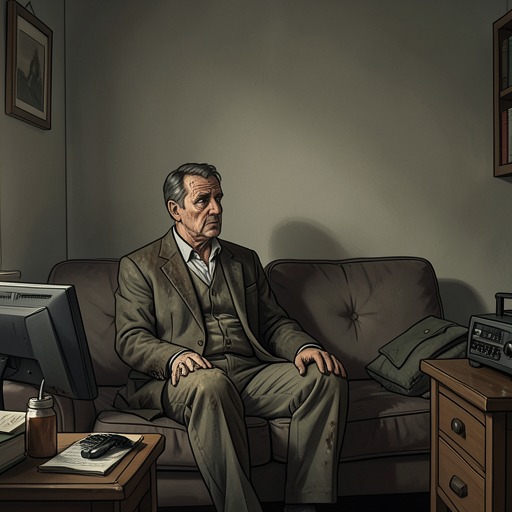
After the scene, Trudi reminds Rick that their job is a fortunate one. For the first time in ten years, he recognizes how much his career has given him: the actors and actresses he has worked with, the people he has met, the places he has visited, the stories he has lived, and the attention that came with being a working Hollywood actor. Looking around the house, he connects that life to its most tangible result. The home was paid for by a profession that began in childhood play, but its meaning now extends beyond status or security: it helps him see his past work as a source of good fortune rather than only a cause for complaint.
That recognition gives the house a role in the scene's emotional resolution without turning it into a cure for Rick's professional doubts. It remains the setting for his solitary practice and his late-night drinking, and a place where the spectacle of Hollywood is close enough to hear but not necessarily to join. Yet within it, a telephone rehearsal with a much younger scene partner leads Rick back to appreciation of the work itself. The house that Bounty Law built is thus both evidence of a career and the intimate setting in which Rick begins, however briefly, to value that career anew.