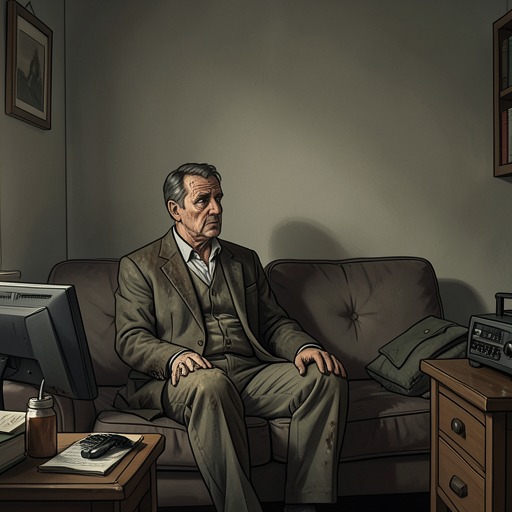
Rick Dalton—Marvin Schwarz representation
Once Upon a Time in HollywoodRick Dalton—Marvin Schwarz representation is a proposed professional alliance built around a hard distinction: Rick is not being offered the leading-man status he wants, but a marketable version of his existing fame. Marvin Schwarz sees Rick’s television recognition and familiar cowboy image as assets in foreign-film casting, while Rick has to confront that his usefulness may depend on being a substitute for a star the producers cannot get. Their meeting turns career advice into a painful lesson about how reputation is made—and how it might be changed.
The Meeting and Its Purpose
Rick’s regular agent, Sid, asks Marvin to meet him. Rick initially understands the appointment as a straightforward offer to work together, but Marvin clarifies that he has a more specific role at the William Morris Agency: he places famous American talent in foreign films. Rick already has an agent, so the point is not simply to add another representative. Marvin is presenting access to a market and a kind of casting opportunity that Rick does not know well.
Marvin describes his work through the standing of his clients. He says that his contacts in the Italian, German, Japanese, and Filipino film industries depend both on the people he represents and on what their names signify. He contrasts his business with dealing in has-beens, placing himself instead in the Hollywood-royalty business. As he lists established actors including Van Johnson, Joseph Cotten, Farley Granger, Russ Tamblyn, and Mel Ferrer, he treats a client list as a form of industry currency: fame, accumulated filmographies, and international connections are linked.
Research, Recognition, and the Substitute-Star Market
Marvin has had people check Rick’s statistics in Europe. His small leather notebook turns the discussion from general salesmanship to specific evidence: Bounty Law aired in Italy, England, and Germany, and Rick is also known in Belgium, though not France. Marvin has also looked into Rick’s films and asks how they performed. The research establishes that Rick is not an unknown abroad, but it does not establish him as a leading movie star. His recognition is unevenly distributed and tied to the television work that made him familiar.
Marvin explains the casting logic with examples of one star standing in for another: producers who want Marlon Brando may take Burt Reynolds, and those who want Warren Beatty may take George Hamilton. Rick’s prospects, in Marvin’s account, follow the same pattern. Italian filmmakers may want him, but initially because they want Steve McQueen and cannot secure him. Rick could then become the available alternative: a McQueen they can get. The opportunity is real, but so is its limitation. Rick is being valued partly through resemblance to an absent star, not solely on his own terms.
The explanation wounds Rick. As Marvin describes the market, Rick feels tears beginning to gather behind his eyes. Marvin does not at first understand the effect his blunt assessment is having; from his own perspective, the situation is encouraging. A popular American leading man with established feature-film success would not need this particular route into foreign pictures. Rick, however, wants to extend his leading-man career in features rather than keep playing the bad guy of the week on television. Marvin’s expertise makes him useful precisely because he can explain an industry Rick does not know, but that expertise also exposes the distance between Rick’s ambitions and his current market position.
Candor, Humility, and Reinvention
Marvin’s candor does not amount to dismissing Rick. He distinguishes between the fact that Italian filmmakers may want him and the reason they will want him, then treats the latter as a viable opening rather than an insult. Rick’s tears make visible what the commercial analysis leaves out: a casting category can be an opportunity to an agent and a blow to an actor who hears it as a verdict on his standing.
The exchange ends with a qualified encouragement. Marvin smiles, Rick smiles back, and Marvin says that the situation is forgivable but requires reinvention. When Rick asks what he must reinvent himself as, Marvin’s answer is someone humble. The advice addresses more than one possible foreign-film role: it asks Rick to accept the gap between his self-image and the way the market currently classifies him. The professional relationship is therefore founded on friction as well as access—Marvin offers the opportunity, but he refuses to flatter Rick about its terms.
The Advice in Rick’s Later Work
The meeting’s significance resurfaces when Rick plays Caleb DeCoteau in the Lancer pilot. The role is a murderous gang leader, unlike the heroic television cowboy Rick has been known for, and its distinctive clothes include a brown fringe jacket and a hat. At first Rick wonders whether the altered look will make him unrecognizable. Later, seeing Caleb reflected in a western-style window, he becomes more receptive to the change. The missing pompadour and shaggy-haired appearance make him look less like an aging cowboy actor and more like a contemporary performer. He recognizes in that reflection something of Marvin’s description of an Eisenhower actor in a Dennis Hopper Hollywood.
The casting also places Rick in a changing Western landscape. The pilot’s director, Sam Wanamaker, chooses a familiar television star for the heavy rather than Joe Don Baker, valuing the subversion of Rick’s established image. Wanamaker wants a grittier style than the older television Western conventions, while CBS limits how far the production can go. Rick’s role as the heavy in a pilot led by Jim Stacy gives that image shift a concrete form: a performer known as a cowboy hero appears as the dangerous opponent whom the new hero must defeat. The casting is not proof that Rick has secured the career he wanted, but it turns the problem Marvin identified—being known through an established persona—into material that a production can use differently.
That change remains partial rather than triumphant. Rick worries that viewers may not recognize him, yet comes to see that not looking like himself may be an advantage. The representation’s clearest consequence is thus a shift in how he considers his own screen identity: the old look is not an unchangeable essence, and a different role can make room for a different actorly impression. Much later, after Trudi Frazer reminds him that actors are lucky, Rick remembers the people, places, work, and life his career has given him. That gratitude does not erase the career uncertainty that brought him to Marvin, but it places the pursuit of reinvention within a broader appreciation of having been able to act at all.