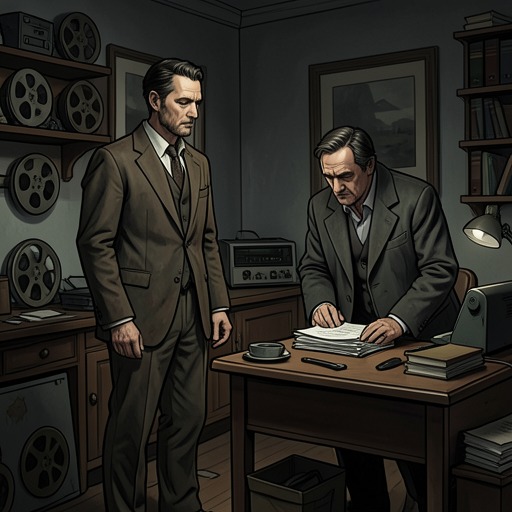
Rick Dalton—Paul Wendkos mentorship
Once Upon a Time in HollywoodRick Dalton—Paul Wendkos mentorship links Dalton’s early career to a later return to leading film work. Wendkos first directed him in Battle of the Coral Sea, then brought him onto Bounty Law for seven or eight episodes. Years later, after a three-year silence, Wendkos called with a leading role in Hell Boats. Their renewed collaboration offered Dalton not only a new production but a chance to work again with a director who had helped shape his career.
Early Work and Bounty Law
Dalton began working with Wendkos in his early days as an actor, appearing in Battle of the Coral Sea, a picture in which Dalton recalled spending much of the film in the background of a submarine alongside Tommy Laughlin. The recollection places their professional connection near the start of Dalton’s screen career: Wendkos was among the directors with whom he first worked, before Dalton became known as a television star.
Their collaboration continued when Dalton landed the lead role in Bounty Law. Wendkos joined the series and directed approximately seven or eight episodes, giving the two men sustained experience working together rather than a single encounter on a film set. Dalton regarded Wendkos’s contribution warmly. When Marvin Schwarz called Wendkos an underrated action specialist, Dalton agreed, connecting the director’s skill to his own early career and the success of Bounty Law.
The Years Apart and the Call
After their work together, the two men did not speak for three years. Dalton was glad to hear from his former mentor when Wendkos called, seven months after Dalton returned from a film trip to Italy with a new Italian wife. The timing marked a change in Dalton’s professional circumstances: his standing had risen after the incident in which he used the flamethrower from The Fourteen Fists of McCluskey, and the film itself had also gained attention.
Wendkos was not calling merely to catch up. He needed to know whether Dalton was available for Hell Boats, a Second World War action film set to shoot in Malta. The production belonged to Oakmont Productions, which made modestly budgeted war-adventure films with British casts and usually placed a television-known American actor in the lead. Dalton’s television fame made him suited to that pattern, while his renewed profile helped make him an appealing choice for the production.
A Reunion Through Hell Boats
The role came to Dalton after the film’s planned star, James Franciscus, was delayed by his work on Beneath the Planet of the Apes. Wendkos had faced a similar casting problem on The Fourteen Fists of McCluskey, when Fabian had to leave after breaking his shoulder; on that occasion, he had thought of Dalton. Now, with Franciscus unavailable, Wendkos again turned to him. Dalton and Cliff Booth flew first to London and then to Malta for a five-week shoot.
Hell Boats therefore restored a working relationship while giving Dalton another studio lead. The director’s choice also drew on familiarity: Wendkos had directed Dalton in both an early film and multiple Bounty Law episodes, and knew him from earlier professional work. For Dalton, the assignment was not simply a new job but a return to a director whose projects had been important across more than one stage of his career.
Further Opportunities and Mentorship
Wendkos’s interest in Dalton did not end with Hell Boats. He had previously wanted him for the role corresponding to Steve McQueen’s part in a third Magnificent Seven film, but Dalton was committed to Universal Pictures and had to turn it down. After Wendkos’s success on that film, the Mirisch Company offered him another installment, then titled Cannons for the Magnificent Seven. The script centered on Chris and his companions undertaking a dangerous mission into Mexico against Córdoba, a bandit with an army and six stolen cannons.
The earlier missed casting opportunity and the later call show the persistence of the professional connection: Wendkos considered Dalton for substantial roles more than once, while contractual commitments could prevent their collaboration. Hell Boats reopened that possibility and allowed Wendkos to bring Dalton into his next picture. Their mentorship is consequently expressed less through formal instruction than through a recurring pattern of recognition, trust, and employment—Wendkos remembered Dalton when a lead role opened, and Dalton welcomed the chance to work with the director again.