Rick Dalton’s Alcohol Dependence
Once Upon a Time in HollywoodRick Dalton’s Alcohol Dependence turns the private rituals of a successful actor’s life into a cycle of self-medication, blackout, and shame. His drinking is not presented as an isolated vice: it gathers force around career insecurity, loneliness, boredom, and violent mood swings that Rick does not understand as symptoms of an illness. The consequences become visible in ordinary details—a swimming-pool routine, four beer steins, a bedsoiled morning, and a mirror in which he speaks to himself as if he were both accuser and patient.
Background and pressures
Rick’s drinking intensifies against the strain of a career he fears is slipping away. During Marvin Schwarz’s blunt assessment of his prospects, Rick feels tears gathering as he hears that Italian filmmakers may want him not for himself but as a substitute for Steve McQueen. On the drive home, he declares himself a has-been and describes his career as a decline from ascent to stagnation and then a race downward. The shock is not simply professional: the meeting makes his feared loss of status feel like an accomplished fact.
Cliff Booth offers a contrasting view of the Italian work. He points out that he is no longer a full-time stuntman and that his own role has become driver, gofer, and house-sitter; from his position, a chance to star in films in Rome does not look like a fate worse than death. Rick, however, experiences the prospect through the lens of humiliation and decline. The surrounding narrative identifies self-loathing, self-pity, and boredom as the three forces behind his drinking, linking the career blow to the private misery that follows him home.
The account also makes clear that the pattern has a longer history than this immediate crisis. Since high school, Rick has experienced violent mood swings: his lows are unusually deep, while his highs can approach mania. After completing a four-picture deal with Universal Pictures, particularly after the failure associated with Salty, the Talking Sea Otter, his downswings seem to sink further. At the time, Rick does not know that an unrecognized condition lies behind these extremes, and he will not understand it for years. He treats whiskey sours as the only relief available to him when loneliness, boredom, and self-pity converge at night.
The nightly routine and its consequences
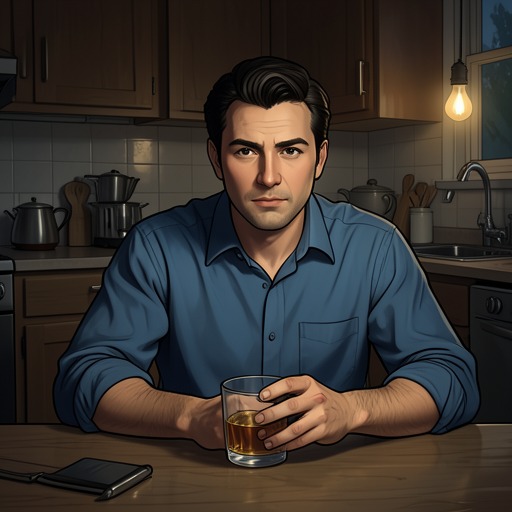
Rick’s drinking is woven into preparation for work. While learning dialogue for Lancer, he often runs lines in his swimming pool, floating in a chair, smoking and drinking whiskey sours. He mixes the drinks himself and pours them into German beer steins from his collection. One stein holds two bar-sized cocktails; on the night in question, he goes through four. The count becomes a small, stark escalation: the ritual that looks like a way to unwind has become eight drinks, enough for him to black out.
The next morning exposes what the blackout has concealed. Rick wakes in bed without remembering leaving the pool, removing his clothes, or climbing into bed, and finds that he has vomited over himself. The clock radio reads 6:52, with Cliff expected in about twenty minutes. Emptying his stomach makes him feel physically better, but the relief is sharply qualified by disgust and self-contempt. He feels pathetic and dirty, then has to get ready for the first day of a new job while still carrying the effects of the previous night.
At 7:15, Cliff’s Karmann Ghia arrives. Rick’s face is sweaty, his complexion green, and his stomach still unsettled; he expects to rely on coffee and cigarettes until early afternoon. In the bathroom mirror, he turns his professional insecurity against himself, accusing himself of wasting the potential that led CBS to give James Stacy a new series. He then tries to rally with a performer’s practiced optimism, telling himself to take the morning one cup of coffee at a time and putting on his show-must-go-on expression. Even that performance does not erase the bodily evidence: before leaving, he notices a trace of blood in his saliva and wonders what it means. The scene shows work continuing not after recovery, but while the damage is still present.
Dependence, masculinity, and concealment
The book distinguishes Rick’s pattern from the more ordinary drinking it describes among actors of the period. Many have a couple of cocktails or glasses of wine after work; Rick turns a couple into eight, then loses consciousness and memory. The distinction is not only quantity. His drinking is private relief from feelings he cannot manage, yet he interprets the resulting impairment as weakness rather than as a sign that something deeper is wrong.
That self-judgment is sharpened by the masculine image he performs: the working cowboy actor who smokes, drinks, and gets himself to the set. In the car, career panic comes out as bravado and anger; at home, the same distress becomes self-pity and self-attack. His mirror-side speech makes the contradiction literal. Rick can summon a public face for the day’s work, but in private he directs the contempt inward. The account’s later explanation of his mood swings complicates that apparent failure of character without making the drinking harmless or denying its consequences.
Later course and limits of change
Rick’s drinking does not end with the morning after the Lancer rehearsal. After Pete Duel’s death in 1971, Rick undertakes the hard work of not leaning so heavily on alcohol. The account places that effort in the context of a loss that makes Rick feel he understands something about Duel’s death, while also noting that Rick himself had not recognized the condition behind his own moods. This marks a change in how heavily he relies on booze, not evidence of abstinence or a completed recovery.
By 1973, Rick and Richard Harris have reached a pattern while filming The Deadly Trackers in Durango, Mexico: they stay off alcohol from Monday through Thursday, then drink heavily from Friday night into Sunday afternoon. The routine sets a boundary around drinking but remains a substantial weekend binge. It is a measure of adjustment, not a simple resolution.
Later, a younger scene partner’s reminder that actors are lucky helps Rick recognize the abundance in his life: the performers and places he has known, the work and stories, the home he owns, and the career that began with pretending to be a cowboy. His renewed gratitude offers a counterweight to the self-loathing that feeds his drinking, but the narrative does not say that gratitude cures his dependence. The arc remains deliberately uneven: Rick gains perspective and works to reduce his reliance on alcohol, while the evidence stops short of claiming that the underlying illness or the drinking has disappeared.