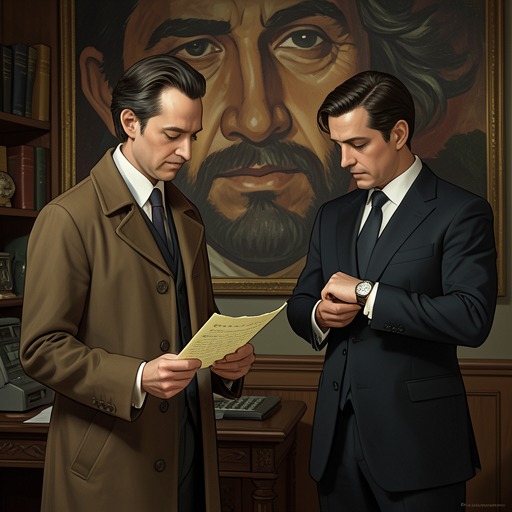
Sexy evil Hamlet
Once Upon a Time in HollywoodSexy evil Hamlet is the acting concept Sam Wanamaker gives Rick Dalton for playing Caleb DeCoteau, a murderous gang leader who holds Mirabella Lancer for ransom in the Lancer pilot. The phrase turns a wooden chair, a hostage threat, and an actor’s uncertainty into one theatrical proposition: Caleb is not merely a Western heavy but a ruler exercising power, and Rick must make that power visible.
Identity and Dramatic Circumstances
The direction comes during a scene on the Royo del Oro Western-town set, where Caleb’s gang operates from the Gilded Lily saloon. Sam draws Rick’s attention to a handsome high-backed mahogany chair and explains that Caleb will use it while making ransom demands for Mirabella. Rick first treats it as an attractive piece of furniture. Sam insists that he understand it instead as the throne of Denmark, establishing the Shakespearean analogy that gives the expression its meaning.
The analogy is deliberately practical. Mirabella is precious to the Lancer men, and Caleb has taken her as leverage. Sam wants Rick to convey that Caleb can threaten her life and compel the family to obey. Calling him Hamlet makes the chair a seat of authority; calling him sexy and evil adds a forceful, performable contrast between personal allure and cruelty. Caleb’s menace is not abstract: it must register through the actor’s command of the room and the danger he poses to the captive girl.
Building the Hamlet Analogy
Sam extends the comparison in stages. Caleb is Hamlet, while Mirabella is his pint-sized Ophelia; both Caleb and Hamlet possess power and are mad. Sam identifies the source of Hamlet’s madness as the murder of his father by his uncle, who is also having an affair with Hamlet’s mother. For Caleb, Sam offers a different cause: syphilis. The analogy does not make the characters’ histories identical. Instead, it gives Rick a recognizable dramatic structure for a Western villain whose illness is meant to inform his conduct.
Rick has not read Hamlet and does not initially understand the Denmark reference or know who Ophelia is. He is also surprised to learn that Caleb has syphilis and that the condition is connected to his madness. Sam does not require literary knowledge from him. He redirects the task toward action: Rick must seize the throne, rule Denmark violently and cruelly, and make the Lancer men believe Caleb will kill Mirabella unless they comply. Hamlet becomes a rehearsal tool rather than a test of Rick’s education.
The direction culminates in blocking. Sam points Rick to the chair and tells him to assume the throne. Rick steps past the director, sits, grips the chair’s arms, and straightens his spine into a posture of kingship. Sam presents the image to the set as Prince Hamlet. The transformation happens through concrete physical choices: a chair becomes a throne, and a working actor is asked to occupy the authority of the character he plays.
Rick’s Performance and Changing Image
The scene fits Rick’s broader adjustment to the part. At first, Caleb’s costume and makeup make him uneasy; he worries the audience may not recognize him. Walking through the Western set, however, Rick studies his reflection in a shop window and begins to see the fringe jacket’s movement as something he can use. The hat, boots, shaggy hair, and jacket make him look less like the established cowboy persona associated with Jake Cahill and more like a contemporary actor. Sam’s instruction to play a sexy, evil Hamlet belongs to this larger effort to make Caleb a distinct character rather than a repetition of Rick’s familiar screen image.
That distinction matters because Rick’s career is unsettled. After Marvin Schwarz’s blunt assessment that Italian filmmakers want Rick partly as an accessible substitute for Steve McQueen, Rick experiences the conversation as an affront and later calls himself a has-been. He describes his career as five years of ascent, ten years of treading water, and then a race to the bottom. Cliff Booth counters that his own current work is largely driving and errands, and that starring in films in Rome does not sound like the catastrophe Rick imagines. Against this crisis, Caleb offers a demanding part in which Rick can test a new appearance and a new kind of authority.
The casting also makes Rick’s old Western identity part of the role’s dramatic charge. Jim Stacy is pleased that the celebrated television actor known for Bounty Law and The Fourteen Fists of McCluskey will play the pilot’s heavy. Caleb’s defeat by Johnny Lancer can therefore stage a contest between the familiar Western icon Rick represents and Stacy’s new hero. The Hamlet direction helps Rick play the villain as a figure of power, while the casting itself lets the series turn his established reputation into an obstacle for its protagonist to overcome.
Function and Significance
Sexy evil Hamlet joins performance to interpretation without requiring Rick to master Shakespeare. Sam translates a literary comparison into stage business, a physical posture, and a clear objective: rule through cruelty and make the threat to Mirabella unmistakable. Rick’s initial incomprehension is part of the scene’s construction; Sam keeps supplying playable instructions until the actor can act the idea with his body, even when its literary references remain unfamiliar.
The expression also crystallizes the difference between wearing a role and discovering how to perform it. Rick’s reflection has already suggested that he might look and move like someone other than the aging cowboy actor he fears becoming. In the chair, that possibility becomes action: he sits as Caleb, grips the arms, and accepts the posture Sam has proposed. The moment does not erase Rick’s career anxiety, but it gives him a concrete way to meet it—not by pretending Caleb is Jake Cahill, and not by relying only on recognition, but by taking on the authority of a character who is deliberately unlike him.