Sharon Tate
Once Upon a Time in HollywoodSharon Tate’s path from Texas beauty-pageant winner to working actress gives her story its outward shape, but the novel’s portrait is made vivid by the ordinary details that resist the glamour of stardom. She is a dreamer who takes a chance on Hollywood, a generous stranger on the road, and a woman whose preferences do not always match the tastes of her fashionable circle. At home with Roman Polanski, her cheerful public persona coexists with irritation, independence, and a wish to be considered rather than simply accommodated after the fact.
From Texas to Hollywood
Four years before the main Los Angeles scenes, Sharon is hitchhiking out of Dallas with a canvas duffel bag, wearing a pink T-shirt and miniskirt, a large white sun hat, and no shoes. A rodeo cowboy named Ace Woody offers her a lift. Their ride lasts about six hours. Once she feels comfortable, she tells him the real reason she is heading west: she wants to act in movies, or at least on television. She has kept the ambition to herself because it sounds like a cliché and, coming from a Texas pageant winner, a pie-in-the-sky fantasy. Her father thinks it is foolish. Ace instead tells her that someone with her looks should try for a career in pictures and that he likes her chances.
The encouragement becomes a private thread connecting the roadside beginning to Sharon’s later work. As she walks away, Ace calls after her to remember his prediction if she acts opposite Tony Curtis. When she eventually makes her motion-picture debut opposite Curtis in the comedy Don’t Make Waves, she passes on Ace’s greeting. Her ambition has become a professional fact, and the small exchange with the cowboy survives as a marker of the moment she chose to pursue it.
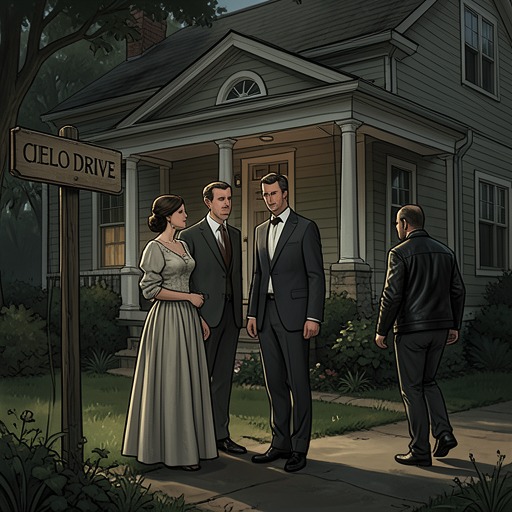
By 1969, Sharon is living on Cielo Drive in the Hollywood Hills with Roman. The couple arrive as Rick Dalton’s new neighbors in a vintage English Roadster, with Roman at the wheel and Sharon holding the gate clicker. The scene introduces them as conspicuous figures in the neighborhood, but the novel’s domestic portraits soon make their life less like a celebrity tableau. Their home is rented from Rudi Altobelli, who lives in the guesthouse; Terry Melcher, the previous tenant, had shared the property with Mark Lindsay before moving out.
Private tastes and the life at home
Sharon’s tastes are not simply an extension of Roman’s or of the fashionable company around them. She likes the catchy songs she hears on KHJ, including bubble-gum pop, and finds pleasure in Paul Revere and the Raiders. Their album The Spirit of ’67 is among the records left in the guest room, and she puts it on at home. She especially likes “Good Thing,” written by Mark Lindsay and Terry Melcher on the house’s white piano. The song prompts her to move her shoulders and hips before she returns to packing Roman’s suitcase for his trip to London, a task she has made into a small, affectionate routine.
That musical preference is also a quiet independence. Roman dislikes what he calls the band’s bubble-gum sound; Sharon neither picks a fight nor adopts his judgment. She privately prefers the Monkees to the Beatles, and would rather hear “Last Train to Clarksville” than “A Day in the Life.” Her enjoyment does not require the approval of her hip friends. The contrast makes her less a symbol of the period’s fashionable culture than a person selecting what she likes from it.
Her household life includes Jay Sebring, her former fiancé, who is in the kitchen making a sandwich before driving her to his salon on Fairfax to have her hair done for a television appearance. Jay exclusively does men’s hair, but Sharon is the one woman for whom he makes an exception. The previous night, Sharon and Roman attended a party at Hugh Hefner’s Playboy Mansion. Hefner invited Roman onto Playboy After Dark, and Roman committed the couple to another appearance without consulting her. Sharon would rather stay home and read Gore Vidal’s Myra Breckinridge beside her husband. Instead, she prepares to perform the starlet persona she jokingly calls her “sexy little me” act.
Her relationship to film is also changing. Entering a darkened auditorium, she listens to the projector’s reels turn and the small tick of the 35mm print passing through the gate; she loves the sound. In Texas, movies had been entertainment, whether at the Azteca, on an Army base, or at a drive-in. Life with Roman has taught her to see that film can be art. She distinguishes his Rosemary’s Baby from the literary art of Thomas Hardy, but regards it as art in a different form, and believes Roman’s film is more artful than the book. Her changed understanding is not presented as a rejection of her earlier pleasures, but as a new way of seeing what movies can do.
Encounters on the road
Sharon’s warmth toward strangers recurs in her encounter with Cheyenne. Driving her black Porsche along Wilshire Boulevard toward Westwood Village, Sharon is singing along to Françoise Hardy’s version of “There but for Fortune.” Tears run down her face, but the passage describes the crying as anxiety-free; she is on errands, carrying dry-cleaning and a book she has bought for Roman. When she sees Cheyenne hitchhiking, she is in a pleasant mood and decides to offer a lift.
The two women talk during the thirteen minutes it takes to reach Westwood Village and share sunflower seeds from Cheyenne’s small leather pouch. Cheyenne is heading to Big Sur to meet friends at an outdoor music festival. Sharon finds the plan appealing and thinks that, if Roman were leaving for London two days later, she might consider driving Cheyenne there and joining the gathering herself. She may not actually do it, but the possibility suits her impulsive streak, which the novel contrasts with Roman’s less spontaneous nature. In the parking lot behind the Westwood Village Theatre, Sharon hugs Cheyenne goodbye. They part in opposite directions: Sharon heads west to finish her errands, while Cheyenne continues north.
Earlier, when an unfamiliar hippie appears at the Cielo Drive property asking after Terry Melcher, Sharon hears Jay tell him that Melcher no longer lives there and that the house is now the Polanski residence. She puts down the shirt she is holding and leaves the guest bedroom to find out who Jay is speaking with. The scene places her ordinary domestic routine beside an intrusion into the property, but the supplied episode stops with her going to investigate; it does not describe what she learns or what follows.
Marriage, performance, and reciprocity
The strain between Sharon’s private wishes and her public obligations sharpens after another appearance on Playboy After Dark. At ten o’clock, she and Roman speed away from the Sunset 9000 building in their convertible English Roadster, passing Ben Frank’s Coffee Shop and the Tiffany Theater. Sharon dislikes the old car, and she is also resentful that Roman agreed to another event the day after the Playboy Mansion party. She had planned to spend the evening reading in bed. Getting dressed and made up for television requires more effort from her than it does from him, but she has gone along and done the appearance for his sake.
Roman recognizes her hostile silence and knows that she has been good-natured about the commitments, though he does not know she complained about them to Jay earlier. Sharon confirms that his understanding is right. When he tells her that he loves her for being accommodating, she privately questions whether that is the reason he loves her. His attempt to propose a more balanced exchange prompts her succinct answer: “Pool. Party.” The request turns the scene from unspoken resentment into a concrete negotiation. Sharon does not merely continue to absorb the costs of Roman’s plans; she names an event she wants in return.
Narrative role
Sharon’s scenes repeatedly place performance beside private preference. The actress who once feared her ambition would sound ridiculous has made it to Hollywood, yet her life is not reduced to career milestones. A suitcase, a pop record, a projector’s ticking mechanism, a shared pouch of sunflower seeds, and an overdue wish for a pool party give her story its scale. These details connect the glamour of the movie business to domestic habits and passing encounters, while showing that Sharon’s friendliness does not erase her capacity for irritation or choice. In the material presented here, her defining movement is not from uncertainty to fame alone: it is also from accommodating other people’s plans toward stating, plainly, what she would like.