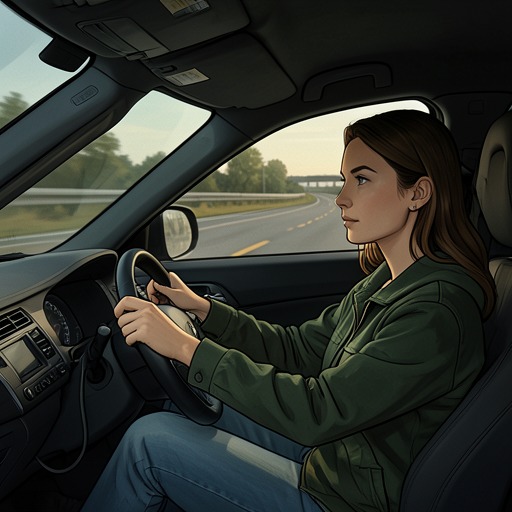
Sharon Tate gives Cheyenne a ride
Once Upon a Time in HollywoodSharon Tate gives Cheyenne a ride that lasts only thirteen minutes, but the encounter briefly opens onto a different possible journey: the hitchhiker is headed north to a music festival, and Sharon can imagine joining her. The lift ends in Westwood Village, with Sharon continuing to her errands and Cheyenne setting out for Big Sur. Its significance lies in that small crossing between a practical limit and an expansive possibility: Sharon offers a ride only partway, yet the conversation makes the road beyond that limit imaginable.
The Encounter on the Road
About a mile after turning onto Wilshire from Santa Monica Boulevard, Sharon spots a young hippie girl standing beside the road with her thumb raised. The girl looks pleasant, and Sharon is in a pleasant mood; her decision to stop comes as an unforced response to the moment. The scene establishes a contrast between the passerby’s immediate openness to an unfamiliar person and the bounded errand that organizes her day. Sharon does not set out to find a traveling companion. She sees someone waiting, considers the possibility, and pulls over.
She stops at the curb in front of the freckle-faced hitchhiker and lowers the passenger-side window to explain that she is going only as far as Westwood Village. The limit is clear before the ride begins. It makes the offer modest and specific, rather than a promise to take the stranger all the way to her destination, while still creating the opportunity for the two women to travel together. The scene’s movement depends on that distinction: a short lift can remain a short lift even as the conversation gives it the shape of a larger adventure.
The Conversation and the Road Ahead
During the thirteen minutes to Westwood Village, the women chat easily. The hitchhiker calls herself Cheyenne and says she is heading to Big Sur to meet friends at an outdoor music festival. The planned performers include Crosby, Stills and Nash, without Young, as well as the James Gang, Buffy Sainte-Marie, and the 1910 Fruitgum Company. The destination and the gathering give Cheyenne’s journey a concrete purpose, while their conversation makes it sound inviting to Sharon. The ride is brief, but it carries both women’s attention beyond the immediate route.
Music becomes part of their shared time in the car. They talk about Big Sur and Crosby, Stills and Nash, listen to Françoise Hardy, and eat sunflower seeds from Cheyenne’s small leather pouch. These are the scene’s particular details of companionship: conversation, a record of shared listening, and food passed from the hitchhiker’s pouch. They do not turn the women into established friends or erase the difference between a driver and a passenger meeting by chance. Instead, the ordinary acts give the brief encounter its ease and make its temporary nature more noticeable.
An Unchosen Extension
Sharon imagines that, if the ride took place two days later, after Roman Polanski had left for London, she might consider driving Cheyenne to Big Sur and joining her and her friends for the concert. The possibility remains expressly uncertain: she might not actually do it, but she would consider it. That qualification matters. The scene presents no decision to abandon her plans, no completed trip to the festival, and no claim that an impulse must become action. It reveals a possible extension of the day, held open in thought but not taken.
The narration connects that possibility to Sharon’s impulsive streak and contrasts it with Roman Polanski’s lack of one, describing impulsiveness as one of the few things that makes her cooler than her husband. The contrast gives the imagined detour a personal context without changing what happens in the car. Sharon’s willingness to entertain the idea of continuing north belongs to the same disposition that led her to stop for a stranger; it remains a possibility rather than an enacted departure. Her defined destination and her openness to an unforeseen one coexist for a few minutes.
Parting in Westwood Village
At the pay parking lot behind the Westwood Village Theatre, Sharon hugs Cheyenne goodbye and wishes her fun at Big Sur. A large six-sheet poster for Joanna, a film by Roman Polanski’s friend Michael Sarne, is fly-posted on the wall. The poster places another film-world connection in the setting of the farewell, while the women’s attention remains on their immediate parting. Afterward Sharon strides west into Westwood Village to complete her errands; Cheyenne continues north on her California adventure.
The ending returns the encounter to its original boundary without diminishing the possibility it briefly raised. The women share a ride, a conversation, music, and sunflower seeds, then separate in opposite directions. Sharon does not join Cheyenne’s trip, and Cheyenne does not remain with Sharon. The scene closes on two distinct routes continuing from the same parking lot: one toward errands already in progress, the other toward friends and a festival. Its understated turn is not a change of destination but the momentary sense that another destination might have been chosen.