Spahn Movie Ranch
Once Upon a Time in HollywoodSpahn Movie Ranch is a deteriorating western movie set and working ranch in Chatsworth, California, whose change from Hollywood location to home for Charles Manson’s Family joins the book’s fading studio-era West to the commune’s attempt to establish a home. The ranch’s remaining western-town streets preserve the traces of its screen past, even as neglect and the Family’s presence alter what the place means. It is also where George Spahn lives under the care of Squeaky, and where Cliff Booth’s discovery that a group of hippies has settled prompts him to go and check on an old friend.
Setting and Hollywood Past
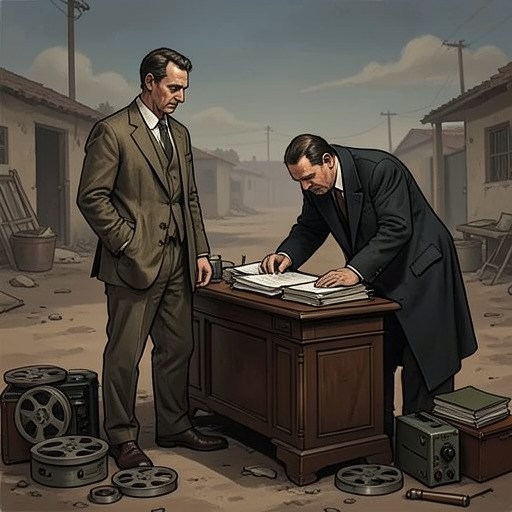
For decades, George Spahn rented the ranch to Hollywood for film and television productions. Its main drag was built as a western town, where the Lone Ranger, Zorro, and Jake Cahill once rode. The set’s streets and storefronts gave productions a ready-made version of the frontier; in the book’s present, the same scenery is worn and neglected, a remnant of an entertainment industry that has moved elsewhere. The ranch has not become entirely inactive. Magazine photo shoots and album-cover sessions still take place there, including one for the James Gang. Horses remain on the property, and families can still take guided, follow-the-leader rides through the Santa Susana Canyons. These modest uses sit beside a sharp decline in the ranch’s former cinematic standing: its movie productions are now described as dirty western films or low-budget exploitation pictures by Al Adamson. The setting thus holds on to western imagery while the business that once sustained it has largely ebbed.
The Family’s Settlement
After moving around Los Angeles for months, The Family finds a home on George Spahn’s ranch. The location gives Charles Manson’s followers a place to put down roots and a base from which they can test his social theories and try to increase their numbers. The ranch’s former usefulness as a self-contained western world makes it available for a very different kind of communal experiment: the setting remains an enclosed landscape, but the people occupying it are no longer actors and crews making a television frontier. The settlement depends on an arrangement with the property owner. Squeaky is assigned to care for George, and her position within The Family is unusual because the group’s continued presence at the ranch rests on that work. She is expected to cook for him, nurse him, keep him company, and provide sexual service when required. Charles Manson presents these duties as necessary for the group, pressing her to put the collective’s needs ahead of her own. The bargain makes the ranch’s domestic arrangement inseparable from its larger power structure: one woman’s labor helps secure a place for the commune to stay.
George Spahn and Squeaky
George is eighty and nearly blind. He stays mostly in his house, which sits on a hill overlooking the western-town back lot. Its crowded rooms contain memorabilia from the ranch’s heyday: framed posters for westerns filmed there, sun-faded photographs of actors who worked on the property, saddles, and cowboy and Indian statues sculpted by George Montgomery. The objects preserve a history George can no longer see, while the former industry that gave them meaning has largely forgotten him. Squeaky’s work is more than a practical service arrangement. She initially considers leaving when Manson explains that her duties may include sexual attention to George, but she comes to love the lonely old man. The book distinguishes this attachment from the role The Family assigns her: she sees George not simply as the means by which the group secures the ranch, but as a person who has been abandoned and needs companionship. Her closeness to him gives her a rare place in the commune’s hierarchy, where women are generally subordinate to men and are even required to offer food to the dogs before eating. Her authority is limited, but it is tied directly to the care that keeps the household functioning. Their ordinary routines make that bond visible. George and Squeaky watch the same episode of Mannix together each night, with Squeaky describing the action because he is blind. At another point she tends eggs in the kitchen and turns on a General Electric radio tuned to KZLA, the Los Angeles country station, which plays whenever George is awake. The ranch’s history as a production site remains close at hand, but the house is now organized around the repeated work of explaining, feeding, and keeping company with its owner.
Cliff Booth’s Discovery
Cliff Booth first hears about the settlement from Debra Jo, who tells him that Spahn Movie Ranch is where she lives with her friends. He had assumed she might be George’s hippie granddaughter or caretaker; learning that a group of hippies is living there changes the meaning of her destination. He opens the passenger door for her and gives her a ride, then considers what her account might imply about George’s situation. He is unsure whether anything is wrong, but the old man’s age makes a visit seem worthwhile, and the drive to Chatsworth offers a chance to check on an old friend. The ranch therefore serves as more than a backdrop for the commune. It is the point at which the book’s entertainment history, its account of The Family’s settlement, and Cliff’s personal connection to George converge. The old western streets are both a surviving set and a place where people now live; the house above them shelters a nearly blind owner whose care has become part of the commune’s bargain. When Cliff learns who else is living there, the ranch shifts from a name in a hitchhiker’s directions to a place he feels obliged to see for himself.