Squeaky
Once Upon a Time in HollywoodSqueaky’s place in Charles Manson’s Family is both an instrument of the commune’s survival and an unusually autonomous role for one of its women. At Spahn Movie Ranch, she cares for its blind, elderly owner, George Spahn; the arrangement gives the Family a home while placing Squeaky inside George’s house, with responsibilities, comforts, and emotional attachments that set her apart from the other women.
Position at Spahn Movie Ranch
When the Family settled at the ranch after months of moving around Los Angeles, the former Western-movie set offered Charles Manson a base from which the group could put down roots, test his social theories, recruit members, and pursue the hope of creating a new order. The arrangement depended on George Spahn, an eighty-year-old former ranch operator who had rented his property to Hollywood productions for decades. By the time the Family arrived, the movie business had largely moved on, the set had fallen into disrepair, and George had become nearly blind.
Squeaky was twenty-one, redheaded and freckle-faced, and her assigned role was to cook for George, nurse him, keep him company, and provide sexual attention. Charles Manson presented those duties as necessary to the Family’s position on the ranch. The arrangement was not simply a private relationship: Squeaky’s access to George and her work in his household helped make the group’s continued presence possible.
The Family’s internal hierarchy makes her relative standing striking. Its women are treated as inferior to the men and, in Charles Manson’s ordering, beneath the ranch’s dogs: a woman must offer her food to a dog before eating it herself. Most women have no authority. Gypsy has a limited position overseeing recruitment, but Squeaky holds the closest thing to household authority because the Family’s agreement with George relies on her care.
Caregiving and Attachment
The account of Squeaky’s bond with George begins with her reluctance. When Charles Manson explained that she would have to masturbate George periodically, and perhaps do more, she considered leaving for San Francisco and trying to reconcile with her parents. Instead, she fell in love with the old man. The narration distinguishes this attachment from a romantic fairy tale: it describes a deep affection for a lonely, forgotten person, whom Squeaky came to regard as more than the grouchy figure others might see.
George’s isolation gives her care its emotional weight. The film and television industry that had used his ranch for decades had moved elsewhere, and his family had left him in a dilapidated place among the remnants of the old Western set. Money could not supply the companionship Squeaky offered: a loving touch, a sweet voice, and an attentive ear. Her feelings are presented as sincere rather than merely as the communal language of affection.
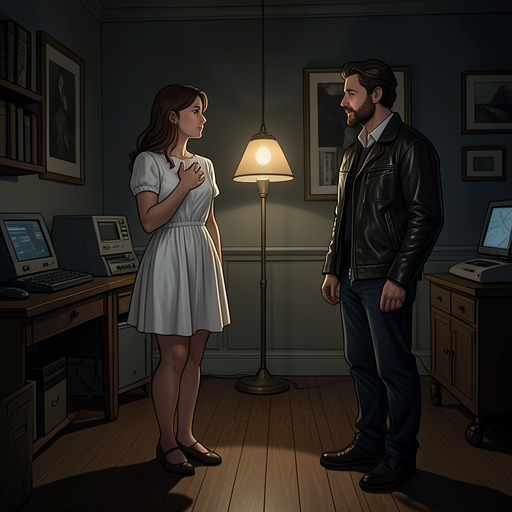
Her care is practical and repeated. She cooks, dresses George, accompanies him around the house and on walks, watches television with him, and describes what is happening on screen because he cannot see it. In one morning scene, her bare feet cross the cracked kitchen linoleum and dusty boards as she goes to wake him. She helps him into a crisp white Western-style shirt, fastens its buttons, holds out tan slacks, ties a bolo tie, and combs his wispy white hair. Taking him by the wrist and elbow, she guides him toward the kitchen table and praises the effort he makes to look handsome.
Household Authority and Unequal Privilege
Caregiving gives Squeaky a materially different life from that of the other women at the ranch. She stays in George’s house and has, in practice, become its lady of the house, a position George does not challenge. While the other women do ranch work and search through dumpsters for food, Squeaky cooks with groceries George buys and eats real meals. The contrast is severe: the others may subsist on stale bread, bruised produce, and discarded food, while Squeaky has access to a refrigerator and a kitchen.
Her arrangement also includes sexual access to George. Squeaky says that they have sex five times a week, and the narrative notes that she does not greatly mind the sexual component of the arrangement. She prefers being with George to having sex with the rough bikers who visit the ranch. These details complicate any simple picture of her position as either pure authority or pure exploitation: the duties began as an assignment serving the Family’s interests, but the narration also depicts her as attached to George and comparatively secure within his household.
The house brings further privileges. George’s country radio station connects Squeaky to a world beyond the ranch, and she can watch television freely. She and George watch the same episode of Mannix each night; because he is blind, she supplies descriptions of its action. When he misunderstands the explanation, she rolls her eyes and reminds him that she tells him the same thing every week. The teasing sits alongside her patience: she repeats the work of making television accessible to him, and their routine gives their companionship a recognizable domestic shape.
Her Love Put to the Test
Squeaky’s authority is also visible when Charles Manson and many of the Family members are away in Santa Barbara. She invites other members to the house to watch a Saturday afternoon television lineup, including American Bandstand and It’s Happening. She occupies George’s reclining chair while five others lounge on the couch and floor, passing a joint. The scene briefly reveals a household governed by her invitation and her access to George’s living space, rather than by the usual presence of the group’s leader.
A Hawaiian visitor challenges the arrangement by asking whether George is happy and aware. Squeaky answers that he knows they have sex five times a week and is happy about it, then directs the visitor to ask him if he wants to embarrass him. Asked whether she has sex with George because she loves him, she fixes the visitor with an unblinking stare and insists that she loves George completely; whether the visitor believes her, she says, matters less than nothing. The visitor follows by asking whether she is trying to influence George’s will. The exchange exposes the suspicion surrounding her unusual access to an elderly, blind property owner, while Squeaky’s answer presents her attachment as something she will defend rather than disown.
Narrative Significance
Squeaky’s story joins the Family’s coercive hierarchy to an intimate relationship that cannot be reduced to that hierarchy. Charles Manson assigns her a sexual and domestic role to secure the group’s position, and the arrangement gives her privileges unavailable to most women in the commune. Yet the account also insists that she develops a genuine attachment to George, whose loneliness and dependence are answered by her steady attention.
That tension makes her household both a refuge and an outpost of the Family’s power. Squeaky enjoys real food, television, and a degree of authority, but her exceptional status depends on service to George and on the group’s continued claim to the ranch. Her position is therefore neither equality within the commune nor simple freedom from it. It is a narrow space of influence built from care, sexual obligation, and a bond she regards as love.