The Hippie Counterculture’s Influx into Los Angeles
Once Upon a Time in HollywoodThe hippie counterculture’s influx into Los Angeles is a visible disruption in Rick Dalton’s world and a force that changes his career. On the street, the newcomers appear as a youth culture that has overtaken the town; at Rick’s house, three armed intruders make that cultural anxiety violently personal. Yet the invasion’s aftermath overturns the expected story of decline: the former television cowboy becomes a public hero, and the violence that seemed to confirm his fears helps revive his professional standing.
A changed city seen from the car
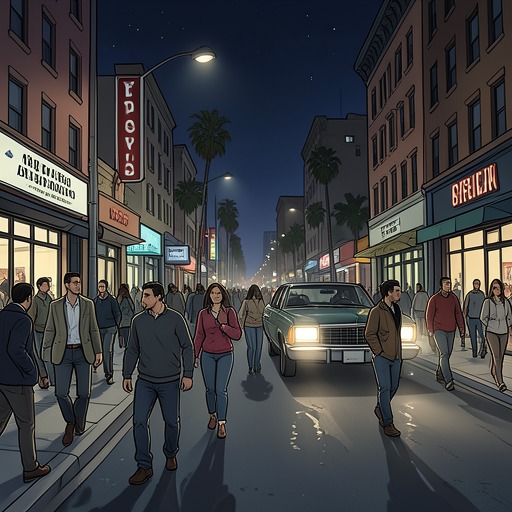
The book first makes the influx visible from Rick’s Cadillac as he and Cliff Booth drive through Los Angeles. Young people in blankets and frocks, with dirty bare feet, parade along the sidewalk. The narration compares their arrival to a locust-like swarm, language that gives the scene the scale of an invasion but also marks the description as hostile rather than neutral. Rick looks at the passersby with disgust and complains that the town used to be a nice place to live. His anger escalates into a fascistic fantasy of lining them up and shooting them. The passing crowd thus becomes a screen for his resentment about how much his surroundings—and, implicitly, his place in them—have changed.
Rick’s outburst comes before he has told Cliff what is troubling him. As the car leaves the busy streets for the calmer residential roads leading to Rick’s home on Cielo Drive, he lights a Capitol W with his Zippo and announces that he is a has-been. The sequence puts his professional insecurity beside his hostility toward the younger counterculture: both surface during the same drive, but Cliff’s question makes clear that Rick has not yet explained the career news behind his distress. The hippies are not the stated cause of his professional trouble; the scene instead shows how his private discouragement and public contempt coexist.
A separate encounter from Cliff’s perspective gives the street presence a more particular, less threatening form. Driving his Karmann Ghia up a residential Hollywood hill, Cliff stops for four young hippie women crossing in front of him. They look exceptionally dirty and carry food: cabbage, hot-dog buns, carrots, and a large jar of pickles. The last woman, a tall brunette in a crochet halter top and cutoff shorts, catches Cliff’s eye, smiles, and gives him a peace sign while balancing the pickle jar against her body. The scene’s specific groceries and friendly gesture contrast with Rick’s sweeping denunciation. The newcomers are not shown only as a faceless mass: here they are individuals moving through the neighborhood, with a moment of mutual acknowledgment between one woman and Cliff.
From intrusion to lethal violence
The confrontation at Rick’s home occurs after he and his new bride, Francesca, return from Rome. Three hippies—two women and a man—break into the house carrying butcher knives and a pistol and threaten the household. Cliff fights in the living room to protect Francesca, bashing the faces of the male intruder and one of the women. Rick is in a floaty chair in the swimming pool when the woman with the pistol nearly shoots him. The attack makes the earlier street-level hostility concrete: the danger is no longer a crowd passing the car but armed trespassers inside the home.
The male intruder’s words intensify the uncertainty around the attack. When Cliff asks what he wants, the young man invokes Satan, saying, “I’m the devil, and I’ve come here to do the devil’s business.” The intruders’ purpose is never established. The LAPD theorizes that they are high on acid and intend to perform a Satanic ritual, but the book distinguishes that explanation from what is certain: they entered armed and threatened the people in the house. The gap between an unknowable intention and a demonstrably violent assault helps turn the event into a story that can carry symbolic meaning beyond what its participants’ motives actually reveal.
Rick responds with the practice flamethrower left in his toolshed after The Fourteen Fists of McCluskey, setting the armed woman on fire. The violence echoes his screen work, but it is no longer a performance: an object associated with a fictional western becomes a weapon in the defense of his home. Rick later tells a neighbor that he burned the attacker to a crisp, while his account to authorities emphasizes how close he came to being shot. The book does not present the intruders’ deaths as a planned action against the counterculture at large; it presents a specific home invasion and a brutal fight in which Rick and Cliff defend the household.
The attack becomes a career turning point
By the next day, the encounter has moved from private violence into public spectacle. Rick’s story travels from local news to network evening news and then around the world. The image that captures the public imagination is Jake Cahill, Rick’s television-cowboy character, killing three long-haired hippie villains with the flamethrower from The Fourteen Fists of McCluskey. In the transformation of the event into news and legend, the boundaries between Rick, his screen persona, and the weapon used at home blur. The former television cowboy becomes a folkloric hero associated with Nixon’s “silent majority.”
The new attention produces concrete professional opportunities. Rick is offered a guest role on Bruce Geller’s Mission: Impossible, receives an inside profile in TV Guide—his third in that magazine—and appears for the first time on The Tonight Show Starring Johnny Carson, where he proves popular. Carson brings him back throughout the seventies when he has a film role, television movie, prominent guest appearance, or new series to promote. The same incident that could have remained an episode of private terror is recast as proof of his continuing public appeal.
Rick eventually acknowledges the reversal to Cliff, saying, “All in all, those goddamn hippies did me a favor.” The remark does not erase the threat or make the attack benign. It registers the unexpected consequence: a man who had just called himself a has-been gains renewed visibility through a violent clash with the counterculture he despises. The influx therefore functions both as a sign of a changed Los Angeles and as the unlikely catalyst for Rick’s return to professional relevance.