The rumor that Rick almost starred in The Great Escape
Once Upon a Time in HollywoodThe rumor that Rick Dalton almost starred in The Great Escape is a piece of Hollywood casting gossip that keeps returning because it offers a tantalizing alternative history of his career. Rick acknowledges that his name may have appeared on a list of four possible replacements for Steve McQueen, but insists that being listed was not the same as being close to the role. For him, the story exaggerates a remote contingency into a personal near-miss, eclipsing the work he actually did.
How the Story Follows Rick
The rumor reaches Rick through colleagues who treat it as a provocative piece of trivia. While filming the Lancer pilot, Jim Stacy asks whether Rick almost got the McQueen part. Rick recognizes the question as a familiar one: he remembers being asked about it before by Van Williams on the set of The Green Hornet and by Ron Ely while Ely was playing Tarzan. Rick recalls that neither man could conceal the pity in his eyes. The repeated question therefore arrives with an implication that Rick has been defined by a part he did not play, rather than by the performances he made.
Rick gives Jim a qualified account. He says he never auditioned, never had a meeting, and never met John Sturges. The story, as he understands it, is that Steve McQueen briefly considered passing on the film, and Rick was apparently among four names on a list during that moment. The other three were George Peppard, George Maharis, and George Chakiris. Rick's careful distinction between the reported list and an actual opportunity is the core of his objection: the rumor has a factual kernel, but its familiar retelling makes that kernel sound far more consequential than he believes it was.
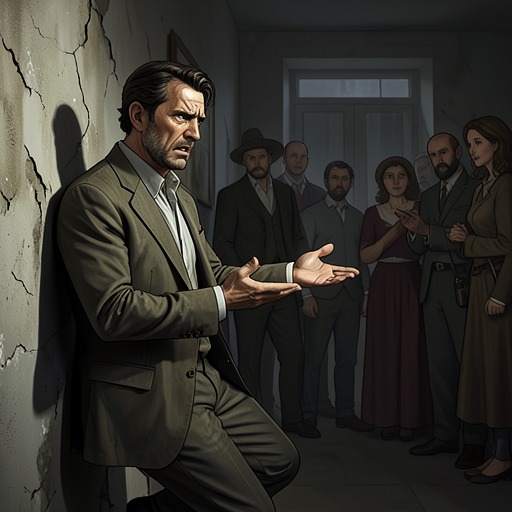
The subject resurfaces among Rick, Jim, Cliff Booth, Curt Zastoupil, and Warren Vanders. Jim dramatizes the rumor for the group, holding two fingers an inch apart to illustrate how close Rick supposedly came. Rick counters with the same gesture, then spreads his arms wide to insist that the distance was much greater. When Jim encourages him to tell the story, Rick resists, calling it Sportsmen’s Lodge gossip and objecting to having to repeat it yet again. His impatience shows how the anecdote has become less a flattering legend than an unwanted public shorthand.
Rick’s Counterfactual
When Rick later explains his reasoning to Jim, he does not merely deny the possibility; he reconstructs the chain of substitutions that the rumor leaves out. First, Steve McQueen would have had to make what Rick considers an absurd decision: reject The Great Escape, a prominent film written for him by his mentor John Sturges, in favor of The Victors. Rick notes that McQueen did not make that choice. Even granting the hypothetical, Rick argues, the role would not automatically have passed to him. George Peppard would have been the obvious next choice, and Rick reasons that Peppard would have accepted The Great Escape rather than turn it down.
Rick then pushes the hypothetical further to expose its fragility. For him even to remain in contention, Peppard would have to become unavailable. Rick invents an increasingly elaborate series of possibilities, including Peppard being eaten by a shark while surfing in Malibu. George Maharis would then be considered, Rick says, in part because of his television popularity and because Sturges had cast him in The Satan Bug. If Maharis were also unavailable, Rick still would not necessarily inherit the part: George Chakiris, with his Oscar and other advantages, would have been offered it first.
The point of the comic escalation is not that these imagined events happened, but that the rumor silently skips over the many decisions and alternative candidates between McQueen and Rick. Even after joking that McQueen, Peppard, Maharis, and Chakiris might all be removed from contention, Rick rejects the idea that the role would then have been his. The filmmakers could have drawn up a new list, considered names such as Robert Redford and Robert Culp, changed the character’s nationality and pursued Michael Caine, or paid Paul Newman what he requested; they might also have received a favorable offer from Tony Curtis’s representatives. Rick’s conclusion is emphatic: he never stood a chance.
The Cost of a Near-Miss Legend
The anecdote becomes more pointed because it circulates alongside Rick’s actual professional identity. Rick has worked hard on Bounty Law, yet he tells Jim that people seem more interested in a role he never played, one he says he never had a real chance of getting. The distinction is between a body of completed work and a hypothetical credit that can be made to sound more impressive with every retelling. Calling the list questionable, and noting that he never saw it himself, Rick challenges the certainty with which others repeat the story.
That frustration has an earlier echo in his meeting with Marvin Schwarz. As Marvin gives Rick a blunt assessment of his career and the Italian film market, he describes Rick as a substitute for stars whom producers want but cannot obtain, including Steve McQueen. Rick feels tears beginning to burn behind his eyes; Marvin’s honesty lands with the force of a slap. The casting rumor and Marvin’s appraisal are not the same claim, but together they expose a painful pattern: other people repeatedly use Steve McQueen as the measure of Rick’s value, whether as a possible replacement or as the star whose absence might create an opening. Rick is distressed not simply by the comparison, but by how readily the comparison displaces recognition of his own work.
A Career Beyond the Unplayed Role
The rumor also sits beside Rick’s changing response to his work on Lancer. Reading the pilot, he recognizes Johnny Lancer as an unusually daring series lead and Caleb DeCoteau as more than a routine heavy. In costume on the western backlot, Rick studies his reflection: without his familiar pompadour, in a fringed jacket, he looks less like an aging television cowboy and more like a modern actor. The transformation helps him understand Marvin’s description of him as an Eisenhower-era actor in a Dennis Hopper Hollywood. It does not erase his unease about the industry, but it gives him a concrete encounter with the possibility of change through a role he actually has.
Jim’s interest in Rick’s mustache and his performance as the villain further frames the casting conversation as a negotiation over screen identity. Jim had initially been excited that a recognizable television star would play Caleb opposite his Johnny Lancer, making the hero’s victory over the heavy carry the added charge of defeating Jake Cahill, Rick’s familiar western persona. Rick, meanwhile, wonders whether the changed appearance and character might help separate Caleb from Jake. The contrast makes the Great Escape story especially revealing: while others keep returning to an imagined role that would have confirmed Rick’s stature, Rick is working through what it means to inhabit a different one.
The rumor never becomes evidence that Rick was on the verge of playing the Cooler King. In the later conversation, he objects to the very phrase almost got the part: being somewhere on a reported list does not establish that the role was within reach. The story’s persistence turns an uncertain possibility into a durable legend, while Rick’s insistence on the alternatives restores the distance that the legend erases. Its significance lies less in what might have happened on The Great Escape than in the gap between public fascination with the unplayed role and Rick’s effort to value the career he actually lived.