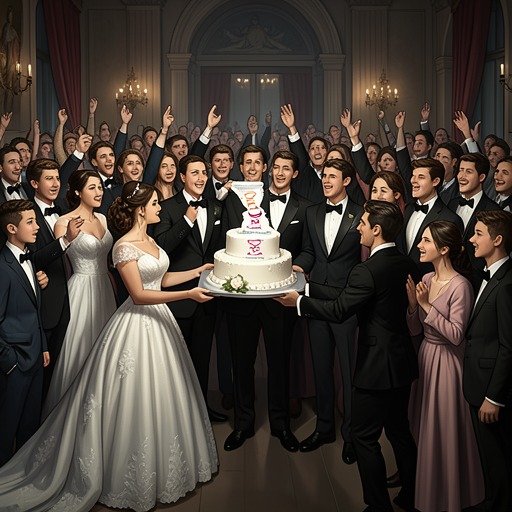
Dexter and Sylvie’s engagement and pregnancy announcement
One DayDexter and Sylvie’s engagement and pregnancy announcement is a layered disclosure to Emma Morley: Dexter first confirms that he is engaged, then reveals that Sylvie is pregnant and that their wedding is only seven weeks away. Emma’s congratulations are affectionate and apparently sincere, but the scene places them beside the marriage offer Dexter once made to her, so that his new commitment carries the weight of a future they had once joked about and never pursued.
The old offer and the new disclosure
The exchange begins with Emma recalling a promise from an earlier stage of their friendship: if she was still single when she turned forty, Dexter had said he would marry her. She raises the offer as something she could fall back on if she became desperate. Dexter stops walking and asks what offer she means, making her spell out the old arrangement. The moment gives the announcement its personal frame. This is not simply news of a friend’s engagement; it arrives immediately after Emma has invoked a hypothetical marriage between the two of them.
When Emma asks why, the text signals that part of her already knows the answer. Dexter says he is engaged. Her surprised question about what he is engaged to prompts him to clarify that he is to marry Sylvie. The progression is brief but carefully staged: the old promise is recalled, Dexter asks for clarification, and his present commitment answers the possibility Emma has just named. The scene does not establish that either character had treated the earlier offer as a current plan. Its force comes instead from the contrast between a conditional future, tied to Emma being single at forty, and Dexter’s definite announcement about the life he is entering now.
Emma’s response and the moment between them
Emma blinks slowly when she hears that Dexter is engaged. Then, almost at once, she smiles, laughs, puts her arms around his neck, and congratulates him. Her response is warm rather than openly resentful. The narration nevertheless lingers on the physical closeness: she goes to kiss his cheek as he turns his head, and their mouths brush briefly. They taste champagne on each other’s lips. The contact is incidental in its stated mechanics, but its placement gives the congratulations a charge beyond a conventional exchange between friends.
Dexter asks whether she is pleased. That question leaves a small uncertainty within the scene without resolving Emma’s private feelings into a stated confession. Her visible celebration and the fleeting contact remain together: the news is welcomed, yet the encounter does not become emotionally neutral. The earlier marriage offer sharpens that ambiguity, while the text provides no basis for claiming that Emma tries to interrupt the engagement or that Dexter is offering her a renewed choice. The moment holds friendship, remembered possibility, and present commitment in the same brief exchange.
The invitation and the pregnancy
Dexter shows Emma the wedding invitation. She notices its scent and guesses lavender; he says that lavender is what it is meant to smell like. Emma instead says it smells of money. The difference in their descriptions makes the card more than a neutral notice: she reads its expensive quality before she reads its formal announcement. The printed wording names the bride as the daughter of Mr and Mrs Lionel Cope and announces her marriage to Mr Dexter Mayhew, establishing the wedding through the invitation’s socially formal language.
The date printed on the card is Saturday, September 14. Emma works out that it is only seven weeks away, and Dexter confirms the short interval. He explains that weddings are usually planned over a longer period, but calls this one what people call a shotgun wedding. Emma does not immediately understand the implication; Dexter then tells her plainly that Sylvie is pregnant. His halting qualification that she is not merely sort of pregnant, but actually pregnant with a baby, turns the invitation’s compressed timetable into an explanation. The engagement and pregnancy are disclosed together, but not in a single sentence: the date first makes the haste visible, and the pregnancy supplies its cause.
Significance of the announcement
The wedding is planned for three hundred and fifty guests and includes a ceilidh. Those concrete details enlarge the news from a private declaration into a substantial public occasion. They also heighten the contrast with the old offer to Emma: Dexter’s future with Sylvie is already represented by an invitation, a date, a large guest list, and preparations for a celebration. Emma’s marriage with Dexter, by contrast, exists in this conversation as a remembered conditional promise, not an arrangement being made.
The scene’s decisive turn is therefore double. Dexter announces a marriage that closes off the hypothetical future Emma has just recalled, and he immediately reveals the pregnancy that explains why the wedding is so near. Emma’s congratulations acknowledge the life he is preparing to enter, while their momentary brush of mouths preserves an unresolved intimacy between them. The announcement does not settle that intimacy; it makes its limits newly visible.