Emma Morley’s post-university disillusionment
One DayEmma Morley’s post-university disillusionment is not one disappointment but a chain of abandoned ambitions, financial compromises, and uneasy attempts to find work that feels meaningful. The double-first that once seemed to promise a future becomes, in her mother’s eyes, a power Emma refuses to use; to Emma, meanwhile, artistic and political aspirations repeatedly meet the limits of money, opportunity, and her own faltering confidence. Her malaise gives the early post-graduation years their defining tension: she wants her life to matter, but cannot yet see how to make that happen.
The collapse of imagined futures
After graduation, Emma’s projects accumulate as failures rather than foundations. She plays bass in an all-girl band whose members cycle through the names Throat, Slaughterhouse Six, and Bad Biscuit without settling on a musical direction. An alternative club night attracts nobody. Two novels are abandoned; summer jobs selling cashmere and tartan to tourists offer little sense of a vocation. At her lowest, she tries a Circus Skills course, only to discover that trapeze is not a solution. Each attempt begins as a possible route out of ordinary work, then joins the growing catalogue of things that have not worked.
The Second Summer of Love, advertised as a moment of possibility, instead passes in melancholy and lost momentum. Even Edinburgh, once beloved, starts to bore and depress her. Remaining in her university town feels like staying at a party after everyone else has left. In October, she gives up her flat on Rankeillor Street and moves back in with her parents for a long, wet winter marked by recriminations, slammed doors, and afternoon television. The house feels too small, and her mother’s daily invocation of Emma’s double-first turns academic achievement into a reproach: the degree is treated as an unused instrument, while Emma experiences no clear way to put it to work.
Family life sharpens rather than eases that sense of failure. Emma’s younger sister, Marianne, is a happily married nurse with a new baby; her visits seem to Emma like a demonstration of how far the family’s golden girl has fallen. Against this domestic backdrop, the contrast between Emma’s promise and her present circumstances becomes painfully concrete. She has the qualification, but not the career or independence that the family expects it to secure.
A visit to Dexter Mayhew’s family home in Oxfordshire offers another kind of contrast. The large 1920s mansion, faded rugs, abstract canvases, garden, swimming pool, tennis court, and drinks served over ice seem to belong to a world of ease very unlike Emma’s. She imagines the visit through the glamour of The Great Gatsby, but nerves and too much alcohol undo the scene: at dinner she shouts at Dexter’s father about Nicaragua and later lies in the guest bedroom remorseful, waiting for a knock that does not come. The episode joins romantic disappointment to class unease. Emma’s hopes of closeness are present, but so is her awareness that she has behaved badly in a setting whose comfort and confidence make her feel out of place.
Idealism inside the theatre co-operative
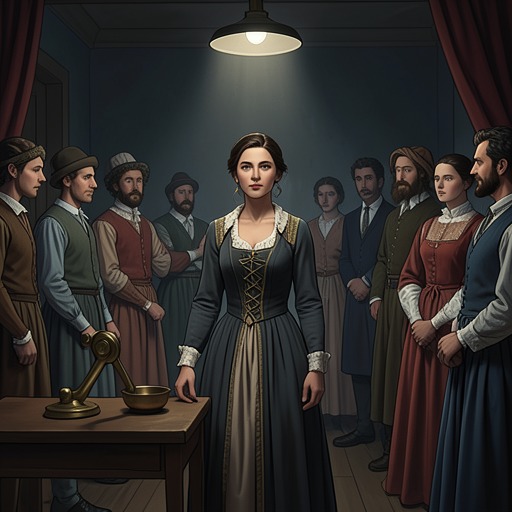
The invitation that eventually draws Emma away from her parents comes from Gary Nutkin, who had directed her in a stark production of Brecht’s Fears and Miseries of the Third Reich in 1986. Their earlier intimacy had been brief and awkwardly theatrical; after a long silence, he calls to ask whether she would join his theatre co-operative. Emma has no great ambition to act. What interests her in theatre is its capacity to convey words and ideas, and Sledgehammer Theatre Co-operative appears to promise a form of work built around those purposes.
The co-operative’s stated principles are a powerful attraction: shared intentions, a written manifesto, progressive art, and a commitment to changing young lives. Emma imagines the undertaking as a collective cause, even likening its departure in a minibus to setting out for a theatrical Spanish Civil War, with Arts Council funding. She also allows herself the hope that the group might bring romance or, at least, sex. Her expectations are therefore not purely professional. The move promises community, political purpose, and a possible personal life at once.
Three months later, that promise has curdled. Emma remembers the word co-operative stencilled on the van, but the warmth, camaraderie, social value, and fun she expected have become difficult to recognize. In the dressing room, the work is surrounded by signs of exhaustion: Sid repeats that he hates the job, Kwame sits topless and forlorn, and Candy sings while picking at her ballet-damaged toes. Emma adjusts her Empire-line dress before a cracked mirror, but the small acts of preparation cannot make the work feel like the shared ideal she signed up for. She presses her hands to her ears and confronts the questions beneath her frustration: why she is there, and whether she is making any difference.
Her discomfort also reaches into her sense of artistic identity. When asked what she does, Emma cannot comfortably claim to be a playwright. The humiliation of having performed Emily Dickinson to an empty room still burns, making the title feel as implausible as astronaut. Instead, she peels an old burrito from hardened cheese and identifies the unglamorous task in front of her. Her professed enthusiasm for the job is plainly performed: she wipes day-old ketchup onto a used napkin and heads off to show someone the toilets. The scene turns professional uncertainty into a collision between the language of vocation and the material details of service work.
London, money, and the narrowed horizon
Emma’s later London life repeats the gap between imagined possibility and daily reality. She once expected the city to offer literary salons, political engagement, parties, and romances on the Thames embankments. She meant to form a band, make short films, and write novels. Two years on, the slim volume of verse has not grown, and little seems to have gone well since she was baton-charged at the Poll Tax Riots. London feels less like a place she can conquer than an overcrowded party where no one noticed her arrive and no one would notice her leave.
She does try to find a more conventional route. On Stephanie Shaw’s advice, Emma writes to publishers, literary agents, and bookshops, but receives no opening. A recession makes people cling to their jobs; further education is beyond her means after student grants end and fees become unaffordable. Voluntary work, perhaps for Amnesty International, attracts her in principle, but rent and travel consume her money, while Loco Caliente consumes her time and energy. Even the idea of reading novels aloud to blind people remains uncertain: she cannot tell whether it is a real job or merely something she saw in a film. Financial pressure does not simply interrupt her ambitions; it leaves her too depleted to investigate some of them.
The strain is also physical and inward. Working late shifts leaves Emma pale; she describes her hair as lank and her life as shaped by restaurant food and weariness. In an empty staff room she glares at a plate of steaming nachos, takes a cigarette from Ian’s locker, and studies herself in the cracked mirror. Her thoughts turn into a set of harsh internal slogans: she is fat, stupid, and has lost a third of her life. Her mother’s suggestion that she return home, where her room is still waiting and there are jobs at Debenhams, is tempting for the first time. The possibility of retreat registers the depth of her exhaustion, even though it does not settle what she wants.
The nachos become material for a poem. Emma opens an expensive black leather notebook, clips a stubby fountain pen to it, and writes about the hard, cold cheese as an image of her life, setting the smoky attic room against laughter outside on Kentish Town Road. She stops and looks at the ceiling, then back at the page, hoping to be surprised by what she has written. The poem does not prove that her career has turned around; its importance is more immediate. Faced with a day’s lunch that seems to embody everything wrong, Emma still converts the scene into language and tests whether that language can become something better.
Work as a choice, not an answer
At a later turning point, Emma can report a modest change in circumstances: she has been offered a promotion to manager. Dexter Mayhew assumes she should refuse the restaurant job and proposes a path into his media workplace, Redlight Productions. The role would begin with unpaid runner work and might eventually lead to research. Emma thanks him but rejects the premise that television is automatically the desirable destination. She objects to the elevated respect given to the media compared with nursing, social work, or teaching, and says she does not want to work in that industry.
Her response is not a declaration that restaurant work is fulfilling. The promotion matters because it offers advancement in the job she already has, while the media proposal asks her to accept unpaid work in exchange for entry into a field she distrusts. That distinction preserves the central uncertainty of her post-university years: Emma is not simply choosing between success and failure, but trying to decide which forms of work deserve her effort. Her disillusionment persists alongside that capacity to choose. The degree, the abandoned projects, the theatre manifesto, the restaurant shifts, and the notebook do not resolve into a clean career trajectory; together they show her repeatedly testing whether a life can be made meaningful without accepting someone else’s definition of achievement.