Sledgehammer Theatre Co-operative
One DaySledgehammer Theatre Co-operative is a politically minded theatre collective built around devised performance and education, and the setting in which Emma Morley tries to turn idealism into practical work. Its Arts Council-funded touring production Cruel Cargo makes the group’s purpose visible: using theatre to confront young audiences with the history and legacy of slavery. Yet the cooperative’s egalitarian principles also bring it into contact with difficult collaborators, exposing the strain between collective ideals and everyday practice.
Identity and Founding
Sledgehammer Theatre Co-operative recruits Emma after she has spent time working behind a pub bar and feeling her intellectual life dull. Gary Nutkin, who had directed her in a production of Brecht’s Fears and Miseries of the Third Reich in 1986, contacts her with an invitation to join the group. Their earlier connection had included a brief romantic encounter followed by a long silence; the call comes as a new opportunity rather than as the continuation of an established relationship.
Emma accepts because the collective promises more than a conventional acting job. As she understands it, Sledgehammer is to be a new kind of progressive theatre co-op, founded on shared intentions, shared commitment, a written manifesto, and the ambition to change young lives through art. She has little ambition to become an actress and no great love of theatre for its own sake. What attracts her is the chance to use performance as a medium for words and ideas. She packs her rucksack, leaves her sceptical parents, and sets out with the company in its minibus, imagining the work as a political cause.
The group’s identity is therefore defined both by its form and by its declared purpose. The word cooperative promises shared responsibility rather than the pursuit of individual celebrity; its political theatre is meant to be original, collective, and socially useful. For Emma, joining it offers a life organized around action and conviction, as well as the possibility of companionship and romance.
Cruel Cargo and Educational Work
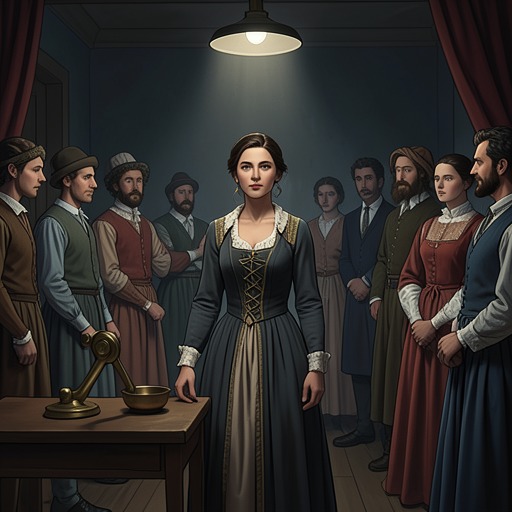
The clearest expression of Sledgehammer’s method is Cruel Cargo, an Arts Council-funded production about the slave trade. The company devises, rehearses, and tours the show, combining storytelling, folk song, and deliberately shocking mime. It is a Theatre-in-Education piece aimed at children aged eleven to thirteen, and its central argument is direct: slavery was wrong.
Emma plays Lydia, the spoilt, vain daughter of the wicked Sir Obadiah Grimm. The production’s forceful turning point comes when Lydia recognizes that her fine dresses and jewels have been bought through the suffering and blood of enslaved people. The character’s realization turns attractive possessions into evidence of exploitation, giving the performance a concrete way to connect historical injustice with privilege. The show does not rely only on staging: the cast also leads workshops in schools, extending the encounter beyond the performance itself.
Emma reports that the work can provoke strong responses from pupils, including the occasional child who throws Maltesers, but that the school workshops are exciting and the audiences often respond well. She is particularly struck by how little some children know about their cultural heritage, including West Indian children. That observation helps explain why she regards the work as worthwhile: the company is not only presenting a political message but trying to create a setting in which young people can learn about where they come from. Emma imagines change happening one child at a time, an ambitious social hope expressed at the scale of the company’s immediate work.
Collective Ideals and Everyday Friction
The cooperative’s practice is less harmonious than its principles suggest. Its cast of four includes Emma, Kwame, Sid, and Candy, whose roles and temperaments bring different kinds of tension into the touring company. Emma plays a white mistress opposite Kwame’s Noble Slave, while the production also gives their characters a sexual tension that, Emma jokes, their offstage relationship does not reproduce. Her account is affectionate but not without discomfort: she describes Kwame as serious about the work, while finding his emotional response in rehearsal excessive.
Sid, who plays Emma’s wicked father, is a former television actor. Emma sees his resentment at the unglamorous work in his refusal to mime and in his repeated references to his television past. His habits on tour—including urinating in washbasins and eating service-station pasties—make him a source of comic irritation, while Emma and Kwame suspect that he is privately racist. These details complicate the company’s political purpose without proving that its members share a common outlook: the collective has to work alongside people whose conduct and attitudes may sit uneasily with its stated commitments.
Candy creates a different kind of friction. She plays several roles, including a plantation owner and William Wilberforce, but tells Emma that she is using the job to obtain her Equity card while waiting for a chance at Hollywood. Emma resents Candy’s remarks about her appearance and her use of sexualized presentation, including yoga warm-ups in lingerie, followed by complaints about being judged for her looks. The contradiction becomes a pointed irritation within a group that had hoped to reject ego, celebrity-seeking, and showiness. Emma’s account is openly sarcastic, so it records her frustration as much as it supplies a neutral portrait of her colleague.
Significance and Limits
Sledgehammer’s central tension is between the political ethic it promotes and the imperfect, sometimes irritating people through whom it has to work. Emma had hoped for a democratic, egalitarian collective devoted to exciting original political theatre. In practice, democracy means having to listen to Sid and Candy, even when she considers their behavior or ambitions incompatible with the project. The gap does not erase the value she finds in the school work, but it makes the cooperative’s ideals harder to sustain as uncomplicated enthusiasm.
After roughly three months, Emma asks herself what has happened to the warmth, camaraderie, social value, and combination of high ideals and fun she expected. The word cooperative is stencilled on the side of the van, a visible declaration that contrasts with the exhaustion and dissatisfaction of the touring life. Her hands pressed against her ears, she confronts the basic question of why she is there. The evidence leaves that question unresolved: it shows neither the organization’s eventual fate nor a final decision by Emma to abandon it. Instead, Sledgehammer matters as a test of whether political work can remain meaningful amid compromise, personality clashes, and the unglamorous routines of touring. Emma’s answer is provisional but real: even when she is cynical, the pupils’ responses and the possibility of changing something in their lives keep the project from becoming merely an idealistic failure.