The Early-Thirties Wedding Boom
One DayThe Early-Thirties Wedding Boom is the novel’s third wave of weddings: a social season in which marriage among people in their early-to-mid-thirties becomes elaborate, costly, and difficult to treat as a joke. Introduced through the invitations arriving in Somerset on 15 July 1999, it is both a portrait of changing wedding customs and a pressure point in Emma Morley’s life. The envelopes announce other people’s commitments; the one addressed to Emma and partner leaves her acutely aware that she has no partner beside her.
Three waves of weddings
The account distinguishes three successive wedding styles. The first belongs to university, where marriage is staged as an amusing, self-conscious parody rather than a solemn adult undertaking. Receptions might be picnics in local parks, with guests in secondhand clothes, a pub afterwards, and modest gifts such as compilation tapes, framed photo collages, or candles. The informality is a kind of benign rebellion: the wedding is deliberately too slight to be mistaken for conventional ceremony.
The second wave, among people in their mid-twenties, retains some of that homemade, tongue-in-cheek character. Community centres and parents’ gardens serve as venues; couples write their own rigorously secular vows. Yet the account detects a harder professional edge beginning to intrude, signalled by the appearance of the wedding list. The ceremony is no longer simply a student joke, even if its informality still distinguishes it from the weddings to come.
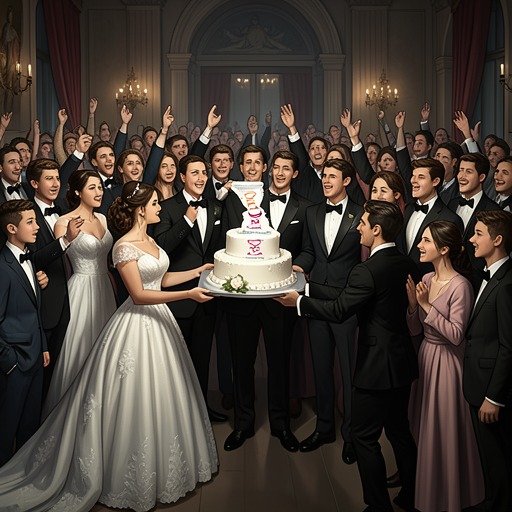
The third wave breaks decisively with both earlier styles. These are weddings of people in their early-to-mid-thirties, and, unlike the university celebrations, no one is laughing. The contrast makes the change more than a matter of taste: a practice once used to mock adult convention has become a serious, conspicuous declaration of love and commitment. The novel imagines a fourth wave of second marriages in the future, described as bittersweet and apologetic, often made brief by the presence of children. That forecast remains prospective; the narrative’s attention is fixed on the force of the third wave in 1999.
The scale and machinery of the third wave
The boom arrives at the doorstep as a cascade of luxuriously padded envelopes. Each invitation is thick and intricate, accompanied by an information dossier containing contact details, websites, directions, dress expectations, and gift information. The wedding has become an organized undertaking for guests as well as for the couple: attending requires time off work, planning, travel, and a suitable present.
The description extends from paper to spectacle. Country-house hotels are booked in blocks, marquees appear overnight, and hired morning suits and top hats are worn without irony. Florists, caterers, string quartets, ceilidh callers, ice sculptors, disposable-camera makers, and Motown cover bands all find themselves serving the season. Churches are fashionable again, while the journey from ceremony to reception might be made by open-topped bus, hot-air balloon, matching white horses, or microlight aircraft. Even confetti costs eight pounds a box; a bag of rice from a corner shop is no longer considered adequate. These details show how commitment is given a visible, logistical form, with hospitality and display demanding resources from the whole wedding party.
Emma Morley and the invitation
The 1999 scene makes the boom personal through Emma Morley’s invitation to the wedding of Tilly Killick and Malcolm Tidewell. In a motorway service station, Emma sits in her first car, a fourth-hand Fiat Panda, and reads the wording: “Emma Morley and partner.” She is certain that the wedding will include men with cigars and someone English in a kilt. Her response registers both her expectation of the occasion’s polished formality and her distance from it.
The practical details sharpen that distance. Emma has an old road atlas missing several major conurbations; turning it around does not help, and she finally slaps it onto the empty passenger seat. The seat is where her imagined partner should be. The invitation’s small phrase and the vacant space beside her make the boom’s social force legible without turning Emma’s circumstances into a general rule: the wedding is an event she must navigate alone, in both the literal and social senses. Its careful instructions contrast with the inadequate map in her car, while its promise of a couple’s celebration foregrounds her solitary journey.
July 15 and the life-course frame
The wedding invitations appear within a novel organized around successive 15 July dates. The 1999 chapter opens in Somerset with the envelopes, placing the boom at a particular point in that recurring calendar rather than presenting it as detached social commentary. The surrounding date sequence reaches back to 15 July 1988 in Edinburgh, continues through 1993 and 1996, and later arrives at the first anniversary of Emma’s death on 15 July 2005. Those dates do not all concern weddings; together, they establish how the novel revisits lives as years pass.
Within that structure, the third wave marks a life-course threshold: university’s playful resistance and the mid-twenties’ homemade ceremonies give way to marriage as a major adult commitment. The invitations’ weight, the elaborate travel instructions, and the guest’s obligation to participate make that threshold concrete. For Emma, the phrase addressed to a partner gives the social calendar a more intimate sting. The boom is therefore at once a broad change in wedding culture and a precise scene of contrast between collective celebration and one woman’s unaccompanied arrival.