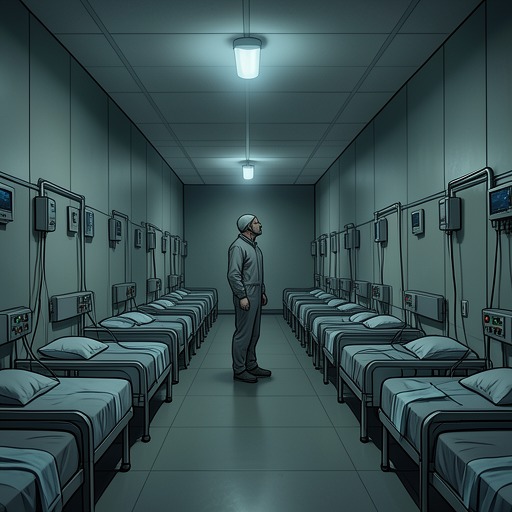
A factory for the Combine
One Flew Over the Cuckoo's NestChief Bromden’s image of the ward as “a factory for the Combine” turns treatment into production: patients enter as “mistakes,” are remade to fit a prescribed norm, and leave as functioning components of a larger social machine. The metaphor reaches beyond the hospital, connecting the ward’s mechanical routines to a system that reproduces conformity in the communities around it.
The Mill Behind the Metaphor
The image grows from Chief Bromden’s memory of a cotton mill he visited with his high-school football team. While the others left to sit on the bus, he stayed inside, absorbed by the humming, clicking, and rattling of people and machinery moving in a pattern. The mill also recalled men from his tribe who had gone to work on the gravel crusher for a dam. In both places, he saw people caught in a frenzied routine, their faces seemingly hypnotized by it.
The memory is not only of machinery. Chief Bromden recalls a mill worker in a flowered red skirt who briefly comes close to him before the factory’s rhythm draws her back to her task. The scene’s motion—her return to the machines, the fiber spilling from a table, and the white lines running through the mill—becomes part of the image that later surfaces on the ward. Its web of threads gives the factory metaphor a visual form: individual workers and machines appear bound into one operating structure.
The Ward as Production Line
Chief Bromden states the central analogy directly: “The ward is a factory for the Combine.” In his account, the hospital exists to fix people who have been marked as mistakes by their neighborhoods, schools, or churches. The desired outcome is not simply recovery on an individual’s terms. It is a person remade into an adjusted component who fits the surrounding social order, bringing satisfaction to Nurse Ratched and credit to the institution.
The imagined finished product returns to society with a welded grin, apparently happy because he has finally been “adjusted to surroundings.” The language makes adaptation sound like successful repair while also exposing its cost: what was “twisted different” is treated as defective material, and the measure of improvement is how neatly the person fits in. The factory’s apparent success is therefore inseparable from standardization.
The Combine Beyond the Hospital
The metaphor’s reach becomes clearest in the account of Maxwell Taber after his return from the hospital. A public voice praises him as a new man, despite his black-and-blue eyes and lost weight. Chief Bromden then imagines the process continuing in Taber’s basement late at night: the technicians’ “Delayed Reaction Elements” give him nimble fingers as he adjusts his wife, young daughters, and a neighbor. The patient has become an agent of the same shaping process that acted on him.
The imagined cycle extends through Taber’s later public reputation. The town remembers him as a good citizen, the newspaper prints his picture helping the Boy Scouts, and even the embalmers are moved to give his wife a more expensive treatment without charge. The sequence carries the factory’s logic from hospital treatment into family life, civic respectability, and death. In Chief Bromden’s vision, the Combine spreads not only by producing adjusted individuals but by making its products help reproduce the pattern.
Meaning and Limits of the Image
The cotton-mill recollection gives the metaphor its sensory and structural basis, while the ward and Taber’s imagined life supply its social argument. A steady hum, repetitive movements, and people caught in routine link the industrial scene to institutional treatment. The ward does not stand apart from ordinary society in this account; it is a workshop for its standards, correcting those who do not fit and returning them to the world as evidence of successful adjustment.
Because the factory image comes through Chief Bromden’s narrated perception, it presents the Combine as a powerful way of understanding how institutional control works, not as a literal description of hospital operations. Its force lies in the reversal it exposes: the language of repair and civic praise conceals a process that treats difference as error and conformity as the finished product.