Acute status
One Flew Over the Cuckoo's NestAcute status is the ward’s classification for patients the doctors believe remain sick enough to be fixed. It promises the possibility of treatment while exposing patients to surveillance, discipline, and the threat of harsher intervention. Set against the Chronics, who are treated as irreparable, the category organizes everyday life and gives the staff a powerful way to make cooperation feel like the condition of avoiding a worse fate.
Classification and Daily Life
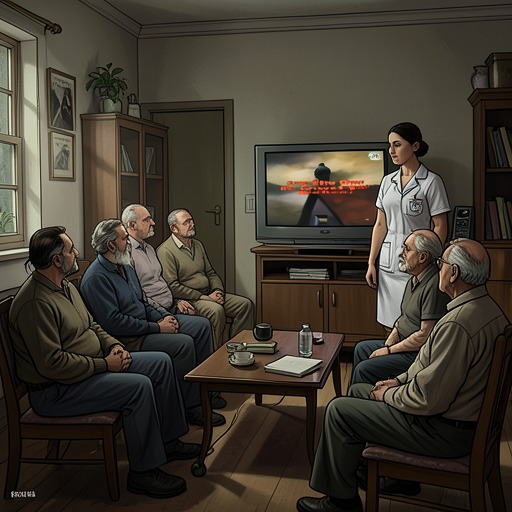
The Acutes occupy one side of the day room, apart from the Chronics. On that side, patients practice arm wrestling and card tricks; Billy Bibbit tries to roll a tailor-made cigarette, while Martini investigates what lies beneath tables and chairs. They move about, joke, write letters with chewed pencils, and sometimes let something personal slip. Such ordinary activity sits alongside constant self-monitoring: a patient who overhears a revealing remark may enter it in the ward logbook, earning a star by his name and permission to sleep late the next day.
The division is maintained as a visible routine. After breakfast, staff move the patients into their respective groups, inspect the arrangement, and signal that it should remain in place. The Chronics, apart from the narrator, generally move little; the Acutes say they would rather stay on their own side. Their aversion is not only to the Chronic side’s smell. The narrator understands that they fear seeing what they themselves might become, and Nurse Ratched turns that fear into leverage: an Acute who sulks or fails to cooperate can be warned that he may end up among the Chronics.
A Promise Bound to Discipline
The designation’s promise of cure coexists with a system of monitoring and punishment. Information patients share about themselves is described as being collected for the ward’s therapeutic purposes, but the narrator sees the logbook as a source of evidence that can send a patient to the Main Building for reconditioning. In this way, the Acute side’s sociability is not simply free interaction: disclosures can be recorded, rewarded, and made useful to staff authority.
The threat of escalation is also explicit. Fredrickson tells McMurphy that an Acute who is listed as Potential Assaultive may be sent upstairs to the Disturbed Ward, where patients do not get to leave for the Saturday movie and have no television. Harding warns that continued hostility can lead to the Shock Shop and perhaps an operation. The classification therefore offers no guarantee of gentle care; the possibility of being considered treatable exists alongside the possibility of being transferred or subjected to increasingly severe procedures.
Acute Status and Commitment
Acute status should not be confused with legal or administrative commitment. McMurphy recognizes that he is not a Chronic and goes to the Acute side when he first surveys the day room, but he later learns that his status as an involuntary patient gives the staff power over how long he remains. Harding, by contrast, says he is voluntary and can leave. The distinction changes McMurphy’s understanding of the risks of opposing Nurse Ratched: antagonizing her may affect the length of his stay, even though he belongs socially to the Acute group.
The ward’s voting procedure further exposes the limits of patient influence. When McMurphy tries to change the television policy, twenty patients vote, but Nurse Ratched points out that the ward has forty patients and that a majority is required. She closes the vote as defeated, then describes McMurphy as upset and asks Dr. Spivey to note his condition. The episode makes the promise of patient participation conditional on rules administered by the staff; Acute patients may deliberate, but their collective action does not automatically control ward policy.
The Limits of the Cure Promise
Later treatment scenes press the gap between the language of cure and the ward’s coercive power. During a visit to Building One for chest X-rays, the narrator sees patients taken through an unmarked metal door for shock treatment; McMurphy asks whether electricity is sent through a patient’s skull and why. After he is placed on the Disturbed Ward, he receives three more treatments in one week. As soon as he begins to recover, Nurse Ratched and the doctor ask whether he is ready to face his problem and return to the ward for a cure; he refuses, and another treatment is authorized.
The sharpest image of the category’s limits comes after McMurphy has been absent for three weeks. A gurney is brought into the day room with a chart identifying him as postoperative and recording a lobotomy. It is left beside the Vegetables. The novel does not state that his formal classification has changed, but the placement creates a stark contrast with the red-haired new Admission who had confidently chosen the Acute side. Acute status names the staff’s claim that a patient can be fixed; it does not ensure that the institution will preserve the person who entered under that promise.