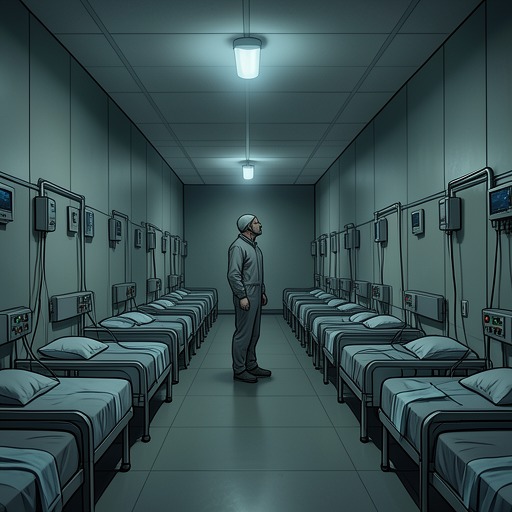
Adjusted to surroundings
One Flew Over the Cuckoo's Nest“Adjusted to surroundings” is Nurse Ratched’s euphemism for bringing people into line with the hospital’s routines and, in Chief Bromden’s vision, with the wider order of the Combine. The phrase makes coercive conformity sound like practical care: difference becomes a defect, and successful treatment becomes the production of a person who fits. Yet the ward’s votes also expose the limits of that project, as patients who have been held quiet begin to act together.
The Meaning of the Phrase
Nurse Ratched uses “adjusted to surroundings” for the nuisance she wants attended to whenever anything disrupts the ward’s smooth operation. Chief Bromden describes her outward calm—a doll-like smile and steady composure—as a cover for tension that tightens whenever something is messy, out of place, or in the way. In this context, adjustment is not simply a patient’s private accommodation to daily life. It is the ward’s demand that the patient cease to disturb its order.
Bromden extends the phrase beyond the hospital. In his account, Nurse Ratched works alongside the Combine to adjust the Outside as well as the ward Inside. Her influence appears as a web of nearly invisible wires, tended with mechanical precision; Bromden connects his ability to imagine such a system to his earlier electrical training. The image turns routine administration into a technology of control, with the nurse at its center and every wire directed toward a result she wants.
The Ward as a Factory
Bromden describes the hospital as a factory for the Combine, a place that repairs mistakes made in neighborhoods, schools, and churches. A patient who leaves successfully adjusted is, in this metaphor, a finished product: what arrived twisted or different returns as a functioning component of society. The language of repair hides the cost of this transformation by making conformity look like improvement.
Maxwell Taber supplies Bromden’s disturbing example of a product praised as successful. After Taber returns from the hospital, people describe him as a new man despite his bruises and lost weight. Bromden’s account then imagines the adjustment spreading outward: Taber applies the technicians’ installed skills to his wife, his young daughters, and a neighbor. Years later, the town honors him, and even the embalmers speak warmly of him. In this vision, approval from family, community, and institution measures not freedom but how thoroughly the factory’s work has been reproduced.
The distinction between a Dismissal and an Admission reveals the system’s priorities. A successful Dismissal brings satisfaction because it confirms the craft and the industry; an Admission, by contrast, must be worked into the routine and may threaten its smoothness. The phrase therefore names both an intended outcome and a standard by which the institution judges people: those who fit affirm the system, while those who disrupt it become problems to be managed.
Adjustment and the Ward’s Rules
The World Series vote shows this logic operating through an ordinary schedule. Randle Patrick McMurphy asks whether the patients can do their cleaning at night and watch the games in the afternoon. Nurse Ratched refuses, defending the existing timetable as delicately balanced and vulnerable to disruption. The routine is presented as necessary in itself; changing it is treated as a threat before the patients’ preference can matter.
At first, the Acutes do not answer McMurphy. Cheswick is the only patient whose hand rises when the possibility of a vote is raised, and the others look around before joining him. In the later show of hands, McMurphy’s bandaged hand rises first—the bandage marks the earlier injury he received while trying to lift the control panel—and then the other hands emerge from Bromden’s fog imagery. All twenty Acutes vote for the change. Bromden understands their vote as more than a request to watch television: it also opposes Nurse Ratched’s effort to send McMurphy to the Disturbed Ward and the way she has worn the men down over the years.
The contrast matters to the phrase’s meaning. The ward’s order depends on patients remaining quiet and predictable; the vote makes their preferences visible and gives them a way to alter a rule. What had seemed like passive compliance proves vulnerable to shared action. The schedule does not simply govern time: its defense becomes a test of whether patients may participate in decisions about their own surroundings.
Resistance and Significance
Bromden’s account also connects adjustment to the ward’s changing sense of solidarity. During the confrontation over George Sorensen, the patients’ laughter and joking stop abruptly when a black boy approaches George to make him bend his head for salve. In that pause, Bromden says, the men understand what is about to happen, why it must happen, and why they had been wrong about McMurphy. The moment does not erase the ward’s coercive power, but it reveals how the men’s understanding of McMurphy and one another has changed.
The phrase’s force comes from the gap between its mild, therapeutic sound and the machinery it conceals. Bromden’s factory and wire imagery recast adjustment as an industrial program for producing obedience; the patients’ hands, raised one after another, offer a concrete counterimage. The ward seeks to make people fit its surroundings, while their collective vote briefly makes the surroundings answer to them.