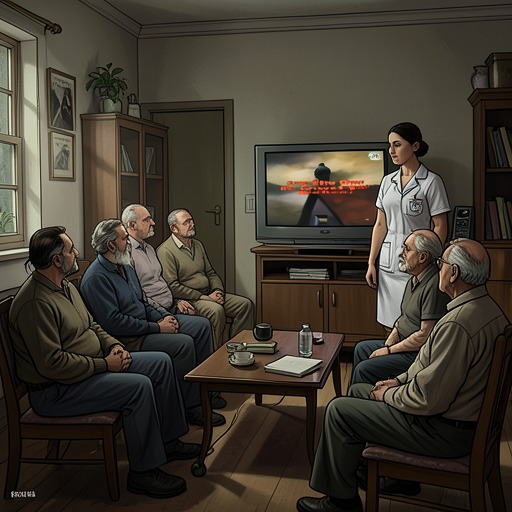
Billy Bibbit—Nurse Ratched
One Flew Over the Cuckoo's NestBilly Bibbit—Nurse Ratched is a relationship of unequal power, made most visible when Nurse Ratched responds to Billy’s discovery with a performance of sympathy that also removes him from the other patients. Billy is frightened and emotionally exposed; she controls the room, decides what his distress means, and directs what happens next. In the aftermath, his suicide gives this imbalance its gravest consequence, while her accusation against McMurphy shifts attention toward the patients she holds responsible.
The Relationship Under Pressure
The relationship comes into focus after Billy is found alone with Candy. Nurse Ratched tells him that Candy could not have forced him into the room and invokes Billy’s mother as a reason she would prefer to believe another explanation. Her words place Billy in a bind: she presents herself as his sympathetic protector, but frames his account as something that must be weighed against what she thinks his mother would want. Concern for his mother is thus not incidental to the exchange; Nurse Ratched uses it to define the terms on which Billy may be believed.
Billy tries to answer. He says that Candy did it, then names McMurphy, Harding, and the others, accusing them of teasing him and making him act as he did. His stammer intensifies as he insists that they made him do it. The account records distress rather than a composed defense: his hand remains against his cheek, and he looks directly at Nurse Ratched, waiting for her response. Whatever the truth of his allegations, his appeal places him in a position of dependence on her judgment. She has the power to accept, reject, or redirect what he says.
Sympathy as Authority
Nurse Ratched does not answer Billy’s plea with an open declaration of belief or disbelief. She keeps quiet, and the narration describes her professional, mechanical capacity returning as she assesses the situation. That silence is an action: while Billy waits, she withholds the response he is seeking and retains control over how the scene will proceed. The contrast between his urgent pleading and her composed assessment makes their unequal positions plain.
She then changes register. Nurse Ratched checks the beam, and Billy’s face drops as he sobs with relief. She places a hand on his neck, draws his cheek against her starched breast, and strokes his shoulder. Her reassurance that no one else will harm him, and that she will explain things to his mother, sounds tender in isolation. Yet she continues to glare across the group as she speaks. The soothing touch and voice therefore operate alongside a visible rebuke to the other patients; her comfort of Billy is also a display of authority over the room.
Her next decision extends that authority. She tells Billy to come with her and says he need not sit in the day room with these friends. She leads him into the doctor’s office, stroking his bowed head and calling him a poor little boy. The other patients return silently to the day room without looking at one another or speaking. Nurse Ratched has separated Billy from the group at the moment when he is most vulnerable, and her protective language makes that separation appear to be care rather than an exercise of control.
Billy’s Death and Nurse Ratched’s Response
Nurse Ratched presents Billy’s condition to the doctor as a terrible ordeal and urges him to see Billy and offer sympathy. Her account stresses the damage done to the boy and the need for tenderness. This continues the protective role she has assumed, but she is also the person who has managed the scene, sent Billy to the office, and instructed the doctor how to understand his state. The episode does not establish that her stated concern is false; instead, it places her concern within a pattern in which she determines both the language of care and its practical consequences.
The later news is delivered by Nurse Ratched herself. She tells McMurphy that Billy has cut his throat with instruments taken from the doctor’s desk and that he is in the doctor’s chair. Her description calls him misunderstood and miserable, but she turns at once to blame McMurphy, invoking the earlier death of Cheswick and accusing him of gambling with human lives. Billy is no longer present to speak for himself. Nurse Ratched supplies the account of his death and directs its meaning toward McMurphy, just as she earlier directed the interpretation of Billy’s distress.
The Relationship’s Significance
The contrast between Nurse Ratched’s intimate gestures and her power over Billy is central to the relationship. She strokes and reassures him, but she also withholds a response while he pleads, invokes his mother, removes him from the day room, and frames his crisis for the doctor. These actions need not be reduced to a single hidden motive to show their effect: Billy’s dependence makes her apparent protection inseparable from her authority to speak for him and decide where he belongs.
Billy’s suicide is not presented as proof that Nurse Ratched alone caused his death. The surrounding scene also records Billy’s accusations that the other patients teased him and made him act, and Nurse Ratched directs blame toward McMurphy. What the episode establishes is a tragic limit to her protective posture: despite her promises that no one will harm Billy and her insistence that he needs sympathy, he dies in the doctor’s office. Her response then becomes another confrontation with McMurphy, leaving the patients silent and the struggle over responsibility unresolved. Through this relationship, care is shown not simply as comfort, but as a form of power when one person controls another’s account, surroundings, and access to support.