Chief Bromden
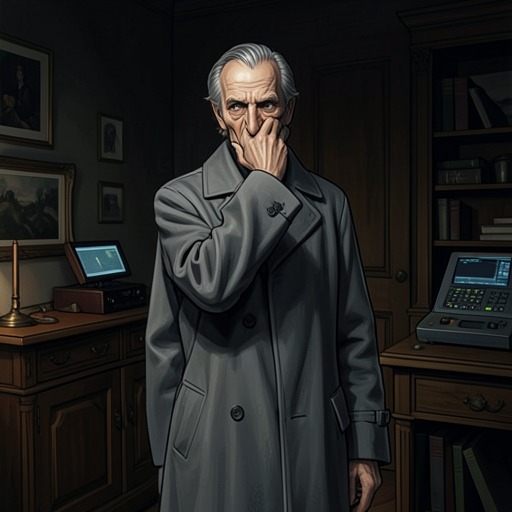
One Flew Over the Cuckoo's NestChief Bromden is the novel’s first-person narrator and a patient who has concealed his ability to hear and speak for years. His apparent silence makes him easy for the hospital to overlook, but it also lets him witness what others say when they believe he cannot understand. His movement from fearful concealment toward speech, physical action, and escape gives the novel its distinctive perspective on power: the man treated as an invisible, diminished figure proves capable of seeing, remembering, and acting for himself.
Identity and Imposed Silence
Chief Bromden is introduced as a very large man assigned to janitorial work in the ward. The black boys direct him to mop the floor and hurry him with a broom handle; their mockery depends on the belief that he cannot hear them. He moves quietly along the wall, wary of their attention, and presents himself as deaf and mute. His apparent disability is not simply a condition others observe: it is a practiced concealment that allows him to hear what people say around him while avoiding their scrutiny.
The deception has roots beyond the hospital. Chief Bromden remembers that people in the Army treated him as though he could not hear, and that at school people stopped listening to him because they assumed he was not listening to them. He recalls that the pattern began even earlier, while he was growing up in his village on the Columbia. In his account, other people’s assumptions helped produce the performance they later took as proof of his incapacity. Silence is therefore both a defense against being exposed and the mark of a long history of being dismissed.
His Indigenous identity is also filtered through other people’s assumptions. Dale Harding tells Randle Patrick McMurphy that Chief Bromden is half Indian and identifies his background with the Columbia Gorge tribe; Harding also reports that his father was a tribal leader, which accounts for the title Chief. Chief Bromden’s own account names his father as Tee Ah Millatoona and places his family in the Columbia Gorge. He remembers his father as very large when he was a child and says that his mother, Mary Louise Bromden, grew to twice his father’s size. The stories of his family and home preserve a personal history that the ward’s routine reduces to a nickname, a broom, and a supposedly deaf janitor.
The Ward as Witness
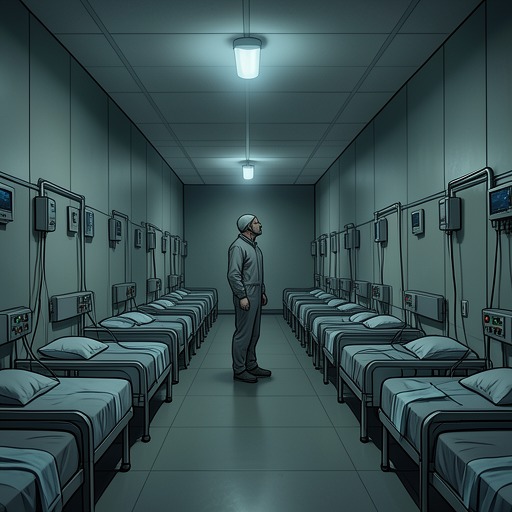
Chief Bromden’s concealment gives him access to the ward’s unguarded speech. He hears the black boys talking freely near him because they think he is deaf, and he describes their hostility through images of humming machinery and hidden secrets. His narration repeatedly blends observed events with the mechanical images through which he experiences the institution. The ward appears not only as a place where staff and patients interact, but as an environment whose pressure shapes what he can say, remember, and believe about his own strength.
That pressure is made explicit when Dale Harding explains electroshock treatment to Randle Patrick McMurphy. Harding describes patients strapped to a table shaped like a cross and wires placed against the head, with treatment serving as therapy and punishment and leaving patients disoriented afterward. He points to Chief Bromden as an example of what the treatment can do, calling him a giant janitor and reporting that he received more than two hundred treatments years earlier. Chief Bromden keeps sweeping while Harding speaks about him in the third person. The scene shows how the ward’s explanations turn him into an object of discussion even as he hears them.
His account also distinguishes between what he perceives and what he later recognizes as true. When he raises his hand during a vote, he first imagines that Randle Patrick McMurphy has attached hidden wires to him and is lifting him out of the fog. He corrects himself: he lifted his hand himself. His self-correction matters because the apparent rescue is not a trick performed on an inert man; the vote registers an action he has chosen. His hand makes the count twenty-one, a majority, and the moment brings him into view as a participant rather than an unnoticed cleaner.
Recognition, Speech, and Memory
Randle Patrick McMurphy recognizes the deaf-and-dumb act early. When he reaches Chief Bromden, he looks closely at him and asks whether he is deaf; Chief Bromden fears that the laughter is directed at the deception itself. Randle Patrick McMurphy offers his hand rather than accepting the ward’s account of Chief Bromden as someone who cannot respond. That gesture does not immediately end the concealment, but it creates a contrast between the assumptions others impose and the possibility that Chief Bromden can answer for himself.
The fear of being found out resurfaces when the patients plan a fishing trip. Chief Bromden wants to sign up, especially as Randle Patrick McMurphy talks about fishing for Chinook salmon, but he has no money and knows that joining would reveal he has heard the conversations around him. He imagines that Nurse Ratched would punish him for having listened to the ward’s confidences. He recognizes the irony of his position: he has had to keep acting deaf in order to hear. Lying awake, he asks himself whether he can ever act differently, then remembers that other people first behaved as though he were too unintelligent to hear, see, or speak.
A small exchange with Randle Patrick McMurphy breaks the silence. After Randle Patrick McMurphy gives him a package of Juicy Fruit gum, Chief Bromden thanks him. The first attempt is difficult: his throat feels rusty, his tongue seems to creak, and his laugh comes out as a squawk that sounds more like crying. The words are modest, but they are spoken aloud, and he repeats his thanks while holding the package. Randle Patrick McMurphy responds with laughter rather than alarm, making the moment an ordinary exchange instead of a clinical event.
Speaking also opens a path back to memories. When government appraisers visit the village, one of them misidentifies Chief Bromden’s father as Navaho. Chief Bromden begins to correct the woman but decides she will not listen; she and her companions leave without seeming to notice him. The encounter surprises him because it is the first time in what feels like centuries that he has recalled much of his childhood. Later, he tells Randle Patrick McMurphy that he comes from the Columbia Gorge and explains his father’s name and stature. The village and family emerge not as distant labels supplied by others, but as parts of a past he can actively remember and narrate.
Strength and Agency
Chief Bromden’s changing sense of his body becomes visible in the hydrotherapy room. Before the staff can lock the room, Randle Patrick McMurphy brings him and the other men to the control panel and has him lift it. Chief Bromden does not want to go through with the plan; he worries that the men will feel cheated when they pay out their bets. Yet he lifts the panel, then retreats to the latrine rather than face the group. Looking in the mirror, he sees that his arms, chest, and shoulders seem broad and hard again, like they were in high school and back in the village.
Randle Patrick McMurphy offers him five dollars, calling it chewing-gum money, but Chief Bromden refuses it and tries to leave. The refusal distinguishes his renewed strength from a performance staged for a reward. The earlier lifting has made him aware of what his body can do; he does not need payment to confirm it. At the same time, his discomfort at helping Randle Patrick McMurphy win the bets shows that recovered power does not erase his unease or make him simply obedient to his friend’s plans.
When Chief Bromden returns from the Disturbed Ward after Randle Patrick McMurphy has undergone treatment, the patients greet him differently. Dale Harding presents him as the wild man who broke a black boy’s arm, and the others gather to ask how Randle Patrick McMurphy is behaving and whether the reports of repeated electroshock are true. Chief Bromden answers them and tells what he knows. They accept his speech without making it the spectacle that his silence might once have been. Even two severely impaired patients on the chronic side of the ward grin and snort along with the group’s laughter. Chief Bromden recognizes in their attention the kind of response that Randle Patrick McMurphy has faced for months: their faces turned toward him, no longer treating him as invisible.
Death, Escape, and Narrative Significance
After Randle Patrick McMurphy returns from surgery profoundly changed, Chief Bromden waits until the ward is asleep before acting. He listens to the breathing for hours, then sees the body in the moonlight and smothers it with a pillow. Randle Patrick McMurphy’s body fights for a long time; Chief Bromden lies across it and restrains its kicking legs until it stops moving. The face retains the same blank expression. Chief Bromden closes the eyes and returns to bed. Scanlon tells him to take it easy and asks whether it is finished. The exchange does not undo the violence, but it places the act within the silent community of patients who know what has happened.
Chief Bromden dresses, tries on Randle Patrick McMurphy’s cap, and feels ashamed when it proves too small. He then goes to the tub room and heaves the heavy control panel upward, tearing its wires and connections from the floor. He swings it through the screened window, shattering the glass, and vaults after it when he hears the black boys running in the hall. The panel that once served as a test of his strength becomes the means of escape. His departure is physical and decisive: he runs across the grounds toward the highway, takes long strides, and continues for miles before stopping.
A truck driver heading north gives him a leather jacket and ten dollars after Chief Bromden tells a story about being a professional Indian wrestler locked in a mental hospital. He promises to repay the money. He may eventually go to Canada, but first he wants to stop along the Columbia, look around Portland, Hood River, and The Dalles, and see whether people he knew from the village are still there. He has heard that some members of the tribe built wooden scaffolding around a hydroelectric dam and spear salmon in its spillway; he wants to see the country around the gorge and bring it back into focus in his memory. His final direction is therefore both outward and backward: escape carries him away from the institution, while the journey homeward reconnects him with a history he had nearly lost.