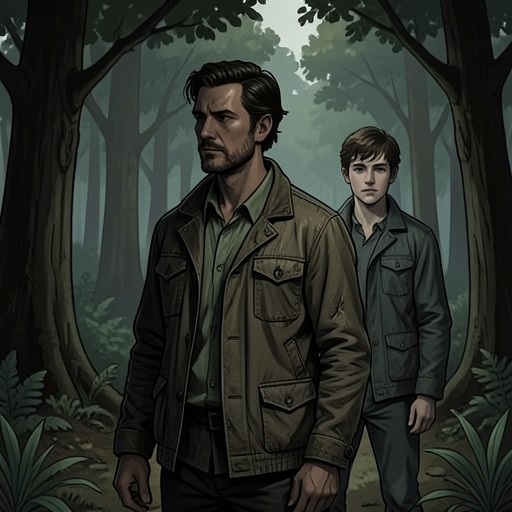
Chief Bromden and Papa's father-son relationship
One Flew Over the Cuckoo's NestChief Bromden and Papa’s father-son relationship is presented through Chief’s retrospective memories rather than a continuous account of family life. Its defining scenes join affection and shared knowledge to decline and loss: father and son hunt together, Chief notices changes in Papa, and the family’s experience of government pressure becomes a measure by which Chief interprets later choices. Papa’s decision to accept compensation for the village is especially consequential, since Chief later sees a similar calculation in McMurphy’s behavior on the ward.
Shared History and the Village
Chief’s memories place Papa within a family and community facing outside pressure. In one recollection, Chief sees the US Department of Interior advancing on their small tribe with a gravel-crushing machine. The image makes government intervention concrete and connects the father-son story to the threatened village, rather than presenting their relationship as separate from its surroundings.
Chief also remembers that a group from town favored a dam because it would bring money and work and remove the village. Papa ultimately signed the government papers, and the tribe received two hundred thousand dollars. Chief’s later account presents the decision as a practical response to a project the family could not prevent: in his view, the government would have taken the land sooner or later, while the agreement ensured payment. The choice is therefore remembered both as an accommodation to power and as an attempt to secure something for the tribe under constrained circumstances.
Hunting and Papa’s Decline
A hunting memory gives the relationship a more intimate, ordinary setting. Papa comes out of a draw and tries to shoot a six-point buck, but his shots miss; Chief, following behind, brings the animal down with his second shot. The contrast in their performance marks a change Chief has begun to notice. He asks whether Papa has ever missed like that before, and Papa attributes the difficulty to his eyesight and the shaking of his gun sights.
The exchange carries more than practical information about the hunt. Chief recognizes that Papa’s abilities have altered, while Papa answers him directly and explains what has changed. The scene lets the son witness a loss of physical steadiness without turning the moment into a general judgment of his father. Its quiet reversal—Chief succeeds where Papa does not—makes the difference between them newly visible, even as their shared activity keeps them together.
Chief connects Papa’s decline to drinking. He warns that Sid’s cactus moon is making Papa old before his time; Papa answers that a man who drinks it is already old before his time, then urges them to gut the animal before flies arrive. The exchange establishes that both understand the connection between the drink and Papa’s condition, although Papa’s response does not become a promise to stop. The conversation returns at once to the task they share, placing concern alongside the practical rhythm of the hunt.
Resemblance and Chief’s Sense of Self
The relationship also appears in the way Chief sees his own face. While hiding in the latrine from the ward’s black aides, he studies himself in a mirror and thinks of Papa’s eyes, as well as the hard-looking faces of Indigenous people he has seen represented on television. Yet he rejects that imposed image as a complete account of who he is: even when he tries to be the person his appearance seems to demand, he feels that he is only performing what others expect.
Papa thus becomes part of a difficult question about resemblance and identity. Chief recognizes a likeness in their eyes, but does not treat inherited appearance as proof that he has discovered a stable self. His uncertainty reaches outward to McMurphy, whose evident forcefulness seems to pose the same problem in another form: how can a person be what he is? The memory of Papa gives that question a family history, while the mirror scene shows how public expectations can distort Chief’s understanding of himself.
Accommodation, Resistance, and Comparison
Chief’s recollection of Papa’s signature becomes a framework for reading McMurphy. He believes McMurphy is becoming cautious and compares this to Papa recognizing that he could not defeat the townspeople seeking the dam. In Chief’s interpretation, Papa did the smart thing by signing: resistance would not have prevented the government from taking the village, whereas agreement secured compensation for the tribe.
Chief applies the same reasoning to McMurphy, deciding that he is yielding because it is the smartest available course, not for the reasons the Acutes propose. This is Chief’s interpretation of McMurphy’s conduct, not a report that Papa and McMurphy face identical circumstances. The comparison reveals how the earlier family experience shapes what Chief can imagine about resistance: sometimes a retreat may be a calculated response to an overwhelming force rather than surrender of conviction.
That reading also preserves a tension in Papa’s legacy. The signed papers represent a practical decision made under pressure, but the village’s loss remains the condition that made such a decision necessary. Chief’s memory does not erase either side. Papa is neither reduced to a failed resister nor detached from the consequences of accommodation; he remains the father whose decline Chief witnessed and whose judgment Chief later uses to understand choices made under institutional power.