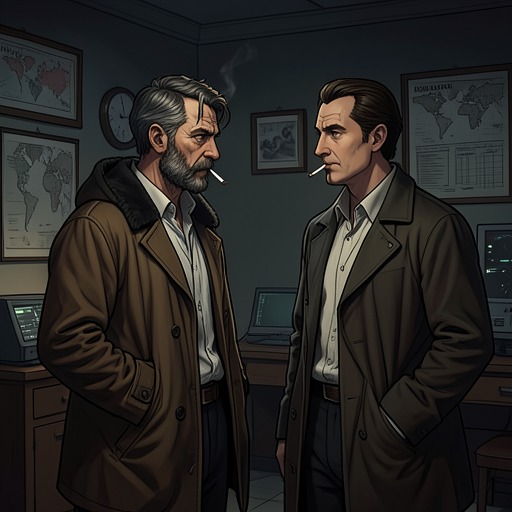
Chief Bromden begins to speak
One Flew Over the Cuckoo's NestChief Bromden begins to speak in a nighttime exchange with Randle Patrick McMurphy, turning a small act of kindness into a decisive break in his long silence. The moment moves from laughter to speech: Chief first thanks McMurphy for a packet of gum, then tells him about his father and the forces that wore him down. What begins as an awkward conversation becomes both testimony and an admission of a closeness Chief has difficulty naming.
The Exchange That Opens the Silence
The scene begins with McMurphy discovering how Chief has obtained chewing gum despite having no money for the canteen and, as far as the ward aide knows, no one giving him any. The aide has watched and waited, then finds used pieces hidden beneath Chief’s bedspread. McMurphy is amused, and the aide laughs with him before carrying away the collected gum in a sack to hide for later. The discovery makes Chief’s private resourcefulness visible, but it is McMurphy’s response—not the exposure itself—that changes the scene’s direction.
Later, McMurphy whispers to Chief and sings a question about whether spearmint loses its flavor when left on a bedpost overnight. Chief initially takes the song as mockery and grows angry; then the absurdity of the question turns his anger toward laughter at himself. He tries to contain it. The possibility of laughing aloud frightens him because it has been so long since he allowed anyone to hear more than a grunt or a bellow. McMurphy’s playfulness therefore tests the same barrier that Chief’s silence has protected: being heard by another person.
McMurphy breaks off, rummages through his nightstand, and places a small object on Chief’s bed. It is a packet of Juicy Fruit, won from Scanlon in a penny-pitching game. Chief picks it up and thanks him. His throat feels rusty and his tongue seems to creak; when he tries to laugh with McMurphy, the sound comes out more like crying than laughter. The gesture is small, but the words are not: Chief has crossed from involuntary noises into speech addressed to someone else.
From a First Word to a Story
McMurphy does not press Chief to explain himself. He says he has until six-thirty in the morning to listen and gives him time to continue. Chief cannot yet find the sort of words he wants to say, and McMurphy eventually fills the quiet with a story of his own. As a boy in the early 1930s, he picked beans outside Eugene in the Willamette Valley, the only child among adult workers. After they failed to listen to him, he kept quiet for all four weeks of the job. On the last day he exposed what the workers had been saying about one another, provoking an argument that cost him a quarter-cent-a-pound bonus. He still judged the lost money worth the disturbance.
McMurphy’s story gives Chief time without demanding an immediate reply. It also makes silence part of what they are talking about: McMurphy describes having chosen it in anger, while Chief has endured a far longer silence under very different pressures. Chief’s response is not to imitate the story’s comic ending. Once he begins, he continues past the point at which he seems to have intended to stop, trying to tell what he believes is the whole story of his father.
The Combine and Chief’s Father
Chief first resists McMurphy’s suggestion that his mother’s background explains why his father became small. He insists that the damage came from more than one person: people worked on his father because he was big, refused to give in, and did as he pleased, much as they are working on Chief. When McMurphy asks who “they” are, Chief names the Combine. In his account, its pressure reached into the tribe and the town. It wanted inspected houses and the falls; in town, Chief’s father was beaten in alleys and once had his hair cut short.
Chief describes his father as big enough to fight for a while, but says the pressure continued for years. He also holds his mother responsible for helping make his father too small to resist, until he gave up. The account does not reduce that defeat to a single cause. The Combine’s demands, violence in town, and conflict within the family all enter the story Chief has been unable to tell aloud. His speech gives McMurphy access to a history that explains why the struggle in the ward feels, to Chief, like part of a much larger system of control.
Chief then describes his father’s drinking and decline. The last time he saw him, his father was blind among the cedars. Chief remembers the bottle seeming to consume him rather than the other way around, until he was shrunken and yellow and even the dogs no longer recognized him. The family had to carry him out of the cedars in a pickup and take him to Portland, where he died. Chief distinguishes this from a simple claim that the Combine killed his father: he says it did something else. The distinction preserves the complexity of his accusation even as the memory reveals the terrible consequence he attributes to a life of pressure and surrender.
What the First Speech Reveals
After telling the story, Chief wonders whether he has been talking crazily and grows sleepy. The scene does not present his renewed speech as a sudden, complete recovery: his words are halting, his voice is unfamiliar to him, and he cannot yet express everything he wants to say. But the exchange has changed what is possible. McMurphy’s patience lets Chief speak without forcing him to produce a polished explanation, and the account of his father emerges through that imperfect beginning.
Chief’s attention then turns from the story to McMurphy himself. Seeing the tattooed aces and eights on McMurphy’s arm, he wants to touch him, first telling himself that he wants to check whether McMurphy is alive. He recognizes that this explanation is false, and rejects another attempted excuse—that he wants to touch him simply because McMurphy is a man. At last Chief names the desire directly, identifying himself as one of the queers. This disclosure makes the scene more than the recovery of speech: alongside grief and gratitude, Chief voices an intimate feeling he has been concealing even from himself.
The event’s decisive movement is from isolation toward contact, without suggesting that Chief’s fear or history has disappeared. The packet of gum, McMurphy’s willingness to wait, and Chief’s difficult first words form a sequence in which ordinary kindness permits a much larger truth to be spoken. His account of his father links private suffering to the Combine’s reach; his final admission reveals that the bond with McMurphy is personal as well as sustaining. Speech begins not as a formal declaration, but as thanks—and continues until Chief can say what he had not been able to say before.