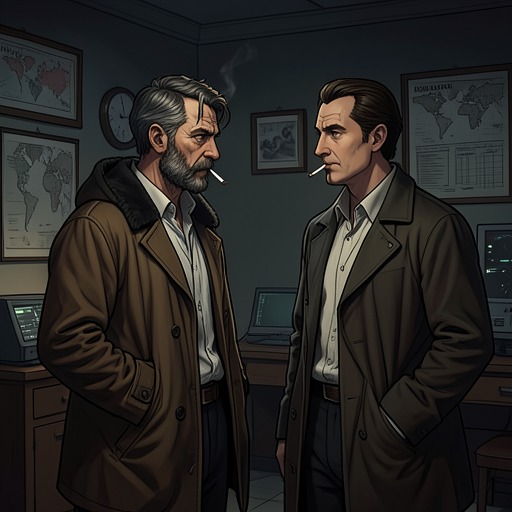
Chief Bromden—Randle McMurphy
One Flew Over the Cuckoo's NestChief Bromden and Randle Patrick McMurphy move from wary proximity toward a bond built on attention, recognition, and action. McMurphy does not demand that Chief Bromden speak, but gives him time and listens; Chief Bromden’s first words to him are a thank-you. Their growing closeness becomes visible not only in that small exchange and McMurphy’s invitation to join the fishing trip, but in Chief Bromden’s decision to intervene physically when McMurphy is attacked in the shower room. The relationship offers Chief Bromden a way back into speech and, eventually, into consequential action.
Recognition and the First Words
After McMurphy gives Chief Bromden a package of Juicy Fruit gum, Chief Bromden finds himself saying thank you before he has planned to speak. The gesture is modest: McMurphy has won the gum from Scanlon in a pennies game and offers it from his nightstand. But for Chief Bromden, who has long let people hear little beyond grunts or bellows, accepting it aloud marks a change. He repeats his thanks, holding the package in his hand, as if the words need to be tried twice.
McMurphy notices the strain in Chief Bromden’s rusty voice and jokes that it sounds out of practice. Chief Bromden tries to laugh with him, though the sound comes out more like crying. McMurphy neither makes the moment into a test nor presses him to produce more. He says he has until six-thirty in the morning to listen if Chief Bromden wants to practice, and waits. His patience makes listening itself part of the relationship: Chief Bromden is offered time and attention rather than treated as a silence to be corrected.
Silence as Shared Experience
When Chief Bromden cannot find the words for what he feels, McMurphy begins talking instead. He recalls picking beans outside Eugene as a child during the early 1930s, the only boy among adults in the rows. After they failed to listen to him, he kept quiet for four weeks. On the last day he exposed how the workers had gossiped about one another, provoking an argument that cost him his quarter-cent-a-pound attendance bonus. He says the lost money was worth it.
The anecdote gives McMurphy a way to meet Chief Bromden without claiming to know his experience. Both have occupied silence while others talked around them, but McMurphy’s story also shows that silence can be chosen and later broken with force. He does not tell Chief Bromden what to say; he offers a memory of being unheard, then leaves room for Chief Bromden to answer in his own time. The contrast between the boy who kept quiet and the man who eventually spoke helps make McMurphy’s invitation to practice feel less like instruction than companionship.
Invitation and Closeness
Chief Bromden’s attachment becomes apparent when he considers reaching toward McMurphy. He first explains the impulse to himself through a fear about what it might mean, then rejects that explanation: he wants to touch McMurphy because McMurphy is who he is. The passage distinguishes affection from the label Chief Bromden fears, showing him struggling to recognize a need for closeness without reducing it to something else.
Before Chief Bromden reaches out, McMurphy turns toward him and invites him on the fishing trip the next day. He presents the outing as an occasion to look forward to and then punctures the cover story that two women coming to collect them are his aunts: they are dancers and hustlers he knows from Portland. Chief Bromden does not answer. The invitation does not resolve his hesitation, but it places him within McMurphy’s imagined company and future plans. McMurphy’s frank, teasing manner stands against Chief Bromden’s reticence, while the invitation offers connection without requiring an immediate declaration of trust.
Shared Risk and Responsibility
That trust takes a more physical form in the shower room. After the fishing trip, the patients are ordered into a so-called cautionary cleansing. During the ensuing clash, McMurphy continues fighting despite being struck repeatedly; when another aide grabs him from behind, Chief Bromden intervenes. He picks the man up and throws him into the shower, noting the tubes in his body and how little he weighs. A second attendant seizes Chief Bromden from behind, and Chief Bromden has to force him against the tile before breaking the hold.
Chief Bromden understands his intervention partly as an amends. He believes what happened in the shower room was more his fault than anyone else’s, and decides that the only way to make amends is to do what needs doing without worrying about safety or consequences. The account makes the act more than a reflexive rescue: his concern for McMurphy and his sense of responsibility converge in a choice to risk himself. For a man who has hidden his voice and presence, this is a decisive change in how he participates in the bond.
Afterward, the patients shake both men’s hands and call the fight a victory, trying to cheer them. Yet aides from the Disturbed Ward arrive with straps and cuffs, and Nurse Ratched helps fit the restraints onto their arms. The celebration and the restraints occupy the same ending: the men have acted together and gained the patients’ recognition, but the ward’s power remains able to punish them. Their relationship is therefore not a simple escape from control. It is a source of solidarity within a system that can still confine them, and Chief Bromden’s part in the fight shows how far he has moved from silent witness toward trusted ally.