Chief Bromden’s diminished self-image
One Flew Over the Cuckoo's NestChief Bromden’s diminished self-image is a condition in which he understands himself as small and weak even when other people see a large, powerful man. The contrast becomes unmistakable when Randle Patrick McMurphy urges him to trust his strength: Bromden first denies his size, then lifts the heavy hydrotherapy control panel and recognizes his body as broad and strong again. The episode makes recovery visible not as a sudden change imposed from outside, but as a struggle over which account of Bromden’s body he can believe.
A body misread as small
In a conversation with McMurphy, Bromden explains that he could not stand up to the people who intimidate him because they are bigger and tougher than he is. McMurphy cannot understand the claim: from his perspective, Bromden stands a head taller than anyone else on the ward and could overpower any man there. Bromden answers that he used to be big but is not anymore, describing McMurphy as twice his size. The exchange establishes the state through opposed perceptions. McMurphy reads Bromden’s visible height and build as evidence of strength; Bromden experiences himself as diminished, and his own account overrides what others can plainly see.
The disagreement reaches back into Bromden’s family history. He remembers his father, Tee Ah Millatoona, as a very large man when Bromden was a child, and recalls that his mother later grew twice his size. In Bromden’s account, the change in his father was not simply caused by his mother. His father had been big, resisted pressure, and did as he pleased; people worked on him because of that defiance. The recollection makes smallness more than a private feeling: it is linked to a history in which a forceful person is gradually made less able to resist.
The Combine and learned diminishment
Bromden names that larger pressure as the Combine. He says it worked on his father for years and wanted the family to live in inspected houses and surrender the falls. Its influence extended into the tribe, while in town his father was beaten in alleys and once had his hair cut short. Bromden explains that the beatings were meant to show what awaited his father if he refused to sign papers giving everything to the government. The sequence connects bodily diminishment with coercion: pressure operates through institutional demands, violence, and repeated attempts to make resistance seem impossible.
That history shapes Bromden’s warning to McMurphy after McMurphy breaks the Nurses’ Station window. Bromden believes that the Combine will target McMurphy because his strength and defiance have become visible. He distinguishes this kind of attack from simply overpowering someone: the Combine works in ways a person cannot fight, installing machinery and continuing until the person is fixed. His warning presents smallness as an imposed condition, produced over time rather than chosen. It also reveals the fear beneath his own self-description: he expects strength to draw the attention of a system capable of wearing it down.
McMurphy’s counter-image
After the fishing trip, McMurphy offers Bromden a different interpretation of his body. Beside the hydrotherapy control panel in the tub room, he remarks that Bromden seems to have grown ten inches and calls attention to his large foot and powerful arm. Bromden notices that his foot looks larger than he remembers, as though McMurphy’s words have enlarged it. The moment does not establish literal, measurable growth; it shows how McMurphy’s perception interrupts Bromden’s settled conviction that he is small. His body becomes newly visible to him through another person’s confident attention.
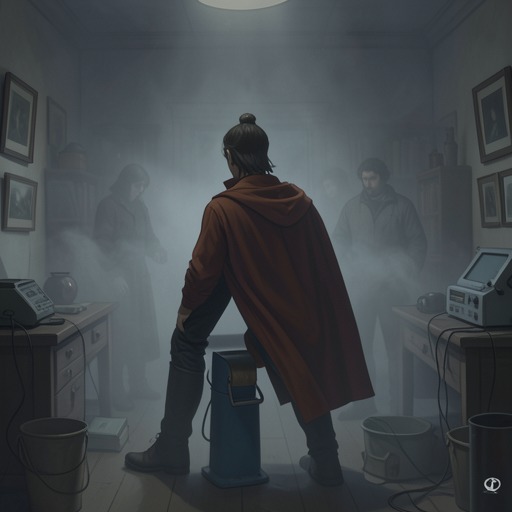
McMurphy turns that encouragement into a test. He reminds Bromden of their deal and asks him to try the panel, guiding him to take the levers and straighten up. Bromden approaches the attempt expecting to fail. When he steps away, however, the panel has shifted half a foot from its mooring. McMurphy is grinning, but asks him to put it back so no one will know yet. The displaced panel gives physical evidence against Bromden’s belief: without argument or reassurance alone, his strength has moved an object that seemed beyond his capacity.
The lift and its cost
McMurphy does not immediately tell the others that Bromden has moved the panel. Instead, he talks with the men around the pinochle games about strength and whether a man could lift it. He allows their skepticism to build, declines to claim that he can do it himself, and lets them propose the bet. The odds rise to five to one, with some men wagering as much as twenty dollars. Bromden watches, knowing McMurphy has not revealed the earlier lift, and spends the night hoping the plan will not go forward. He fears not only the physical effort but also the prospect of being made part of a wager without the others knowing what he has already done.
The next day, after the meeting, McMurphy leads Bromden and the other men into the tub room before the attendants can lock it. Bromden takes the levers and lifts the panel. The men pay their bets and remain friendly with McMurphy, but Bromden senses that the result has knocked something out from under them. He feels that he has helped cheat them and runs to the latrine without looking at McMurphy, wanting to be alone. In the mirror, he sees arms as large as they were in high school and at the village, with a broad, hard chest and shoulders. McMurphy’s confidence has led him to a test; the test leaves Bromden facing a body he had believed was gone.
McMurphy offers him a five-dollar bill as chewing-gum money. Bromden shakes his head and starts to leave, but McMurphy catches him by the arm. The exchange complicates the recovery: the lift confirms Bromden’s strength, yet its place in McMurphy’s bet makes Bromden feel implicated in deceiving the other men. His restored self-image therefore arrives alongside discomfort and a wish for solitude, not as uncomplicated triumph.
Significance
Bromden’s diminished self-image is sustained by a mismatch between bodily evidence and internal conviction. McMurphy sees a giant where Bromden sees a man too little to resist; the control panel turns that disagreement into an observable consequence. At the same time, Bromden’s memories of his father and his account of the Combine give the discrepancy a social and historical dimension. The episode suggests that a person can be made to experience strength as unavailable after years of pressure, even when the body’s capacity remains.
The panel does not erase Bromden’s fear or settle every conflict between his perception and the ward’s world. Instead, the shift, the lift, and the mirror provide successive forms of evidence that challenge his self-erasure. His arms, chest, and shoulders become a recovered measure of himself, while his unease about the wager keeps the moment morally complicated. The change is decisive because Bromden has not merely been told that he is strong: he has acted, seen what the action moved, and recognized in the mirror a version of himself he had thought lost.