Chief Bromden’s shock-induced altered consciousness
One Flew Over the Cuckoo's NestChief Bromden’s shock-induced altered consciousness is the disorienting state he enters during and after Electroshock Therapy: a collision of bodily helplessness, hallucinated machinery, and time blurred almost beyond recognition. Its defining change is not that the treatment becomes less violent, but that Bromden finds a reason to struggle back from the fog sooner than before.
Treatment and Institutional Setting
The state belongs to a ward where treatment and coercion are difficult to separate. When Maxwell Taber challenges the handling of his medication, Nurse Ratched grips his arm and declares that he may leave if he will not take it orally. The ward's black aides later seize him in the latrine, pin him face down, and hold him while a nurse prepares a long needle. Bromden sees Taber carried away wrapped in a damp sheet. The scene does not establish that Taber receives Electroshock Therapy, but it does show how bodily restraint and medical procedure operate within the ward’s disciplinary system.
Three weeks after the patients’ vote on television, anyone able to walk is taken to Building One under the stated pretext of chest X-rays for tuberculosis. Bromden suspects the trip is really a check on whether the patients’ “machinery” is functioning. The line passes an X-ray door and a throat-examination room, then a blank metal door. From the bench, Bromden hears a patient scream, sees him wheeled out smoking, and watches another drugged man brace his heels against the floor before technicians pull him through the closing door. Randle Patrick McMurphy listens to the explanation and reduces the procedure to electricity being sent through a person’s skull. The plainness of his question cuts through the institutional euphemism: the treatment is a physical intervention, not an abstract promise of cure.
The Treatment as Lived Experience
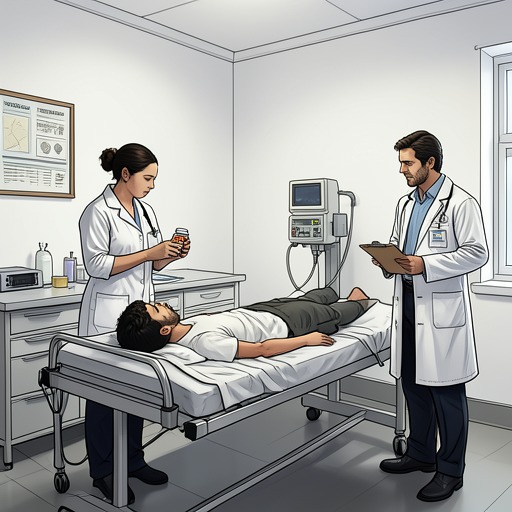
Bromden’s account turns the treatment room into an assault on the senses. The floor is cold and crackling; a long white light whines overhead; graphite salve carries the smell of a garage, mingled with what he recognizes as fear. A small high window frames sparrows hunched on a wire, their heads tucked into their feathers. The scene’s scale shifts abruptly: the room’s actual equipment remains visible, but the cold light and the birds become part of a widening vision of danger, as wind seems to blow through his hollow bones and the alarm of an air raid takes over his perception.
The procedure is also rendered as machinery acting directly upon a body. Electrodes like headphones are fitted over graphite at the temples, and a piece of rubber hose is placed between the patient’s teeth. Dials turn; two mechanical arms lower soldering irons toward the metal at his temples. The current stiffens him and lifts him from the table until only his wrists and ankles remain down. Sparks frost his body, and Bromden sees the sparrows fall smoking from the wire. The birds’ destruction makes the room’s violence visible in a second register: his hallucination does not replace the treatment’s material force so much as enlarge it into a world where the surrounding machinery appears to strike everything alive.
Hallucination, Time, and Recovery
The treatment’s effects continue as Bromden’s consciousness breaks into images of combat and manipulation. He experiences an air raid and finds himself running down a slope, unable to retreat or advance. Later he sees himself as the load inside a die, held beneath the number six while the machinery above is arranged to throw snake eyes. The image gives his helplessness a structure: he is not merely a person caught in confusion, but the hidden weight that makes an outcome seem predetermined. When the vision recedes, the number six remains in the white pillows on the floor of the Seclusion Room. They are soaked with urine from his unconscious body, connecting the dream’s dice to a concrete trace of what happened while he was unable to act.
Bromden recognizes that recovery has previously taken much longer. After earlier treatments, he could wander in a daze for as long as two weeks, unable to establish the day, his identity, or the point of returning to awareness. He describes that interval as a gray border between sleep and waking, life and death. This time, however, he works at clearing his head. He stands, rubs his eyes, reaches the small round window in the door, and taps for the aide bringing his tray. He knows he has come around in less than a day. His return is not automatic: he understands it as something he fought for, and he refuses to slip back into the fog.
The clearing comes with the sensation of surfacing after a deep dive, as if he had been underwater for a hundred years. Bromden identifies the treatment as his last. That ending gives the episode a distinct place in his experience: the fog still has the power to erase time and self-recognition, but it no longer lasts for the familiar two-week stretch. The difference lies in his active effort to emerge, not in any suggestion that the treatment itself has softened.
Contrast and Significance
Bromden’s recovery is set beside Randle Patrick McMurphy’s repeated defiance. During the same week, McMurphy receives three more treatments. As he begins to recover, Nurse Ratched and the doctor ask whether he is ready to face his problem and return to the ward for a cure. He answers with a theatrical refusal, then bows to the patients who grin at him; Nurse Ratched takes the doctor aside to authorize another treatment. On one occasion McMurphy pinches her through the back of her uniform, turning her face red. The patients’ amusement and his gestures make the treatment sessions a continuing contest over who can define his condition and command his behavior.
Bromden’s account is more inward and fractured: its alarms, sparrows, and dice register the treatment through a consciousness struggling to reconnect its images with the room around it. His emergence in less than a day contrasts with the longer post-treatment haze he remembers, while McMurphy’s repeated sessions show that recovery does not end the institutional contest. Later, after McMurphy has been absent for three weeks, the ward’s black aides wheel in a gurney bearing his name and the notation “LOBOTOMY.” The scene marks a different outcome from Bromden’s temporary, fought-through confusion: the ward receives McMurphy back bodily, but not with the capacity for resistance that had animated his earlier returns.