Chronic status
One Flew Over the Cuckoo's NestChronic status is the hospital’s classification for patients it treats as beyond repair, and it shapes both their daily lives and the ward’s hierarchy. The label appears to describe a fixed medical condition, but the narrative shows how it can also reflect institutional decisions, prolonged confinement, and the staff’s use of one group as a warning to another. Its subdivisions and individual histories resist the idea that all Chronics are alike.
Definition and Institutional Meaning
The ward divides patients into Acutes, who are regarded as candidates for treatment and recovery, and Chronics, whom the staff concede are there for good. In Chief Bromden’s account, Chronics are not kept in the hospital in order to be fixed; they are kept from walking the streets and making the institution’s product look bad. He describes them as flawed machines, but that image conveys the ward’s mechanized outlook rather than an objective diagnosis: some flaws are said to have been present from birth, while others accumulate through years of damage and neglect.
Chronic status includes several distinct levels of mobility. Walkers such as Chief Bromden can still get around if they are fed; Wheelers depend on others to move their chairs; and Vegetables are described as unable to manage basic bodily functions. The categories shape how patients are handled, but do not make their experiences interchangeable. The stark classification reduces people to what their bodies can do and to whether staff believe they can be repaired.
Daily Life and Separation on the Ward
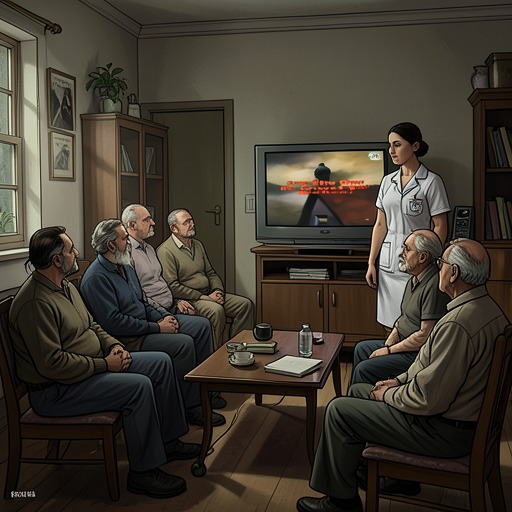
The ward enforces a division between the Chronics and the Acutes: after breakfast, patients are moved to their respective sides of the day room, and the black boys reinforce the arrangement as orderly. The separation is not simply a response to the Chronics’ condition. Acutes may complain that the Chronic side smells worse, but Chief Bromden identifies a deeper cause: they do not want to face the possibility that they could end up there themselves. Nurse Ratched understands and uses that fear, warning Acutes that failure to cooperate with staff policy could put them among the Chronics.
The daily schedule makes the categories operational. Acutes are sent to work on the ward and line up for shaving first; walking Chronics follow, and Wheelers are brought in after them. Vegetables may be rolled onto the tile after wetting their beds and are hosed down and changed by the black boys. These repeated procedures turn differences in mobility and care into a timed institutional routine. The classification is thus reinforced not only by explicit warnings but by the organization of ordinary tasks.
Time itself is subject to that control. Nurse Ratched can speed the ward clock, driving patients through repeated cycles of waking, shaving, meals, appointments, and medication until she slows it again. This manipulation affects the ward as a whole, but the Chronic categories determine how patients move through its routines: those who can walk do so, those who cannot wait to be wheeled, and those requiring the most direct care are handled by staff. The schedule presents institutional management as the natural measure of their lives.
Different Histories Behind the Label
The Chronic group contains patients whose present conditions arose in different ways. Chief Bromden says that Ellis entered as an Acute and became a Chronic after he was badly damaged during electroshock treatment. He describes Ellis as fixed against a wall with his arms out and palms cupped, still bearing the expression he had when he was last lifted from the treatment table. Staff pull the nails holding him in place when they need him moved for meals or bed, and Chief Bromden mops the puddle where he stands. This account makes the category’s history visible: at least one patient was not simply admitted as beyond help but, in the narrator’s account, became so through treatment.
Ellis and Ruckly are identified as the youngest Chronics, while Colonel Matterson is the oldest. Matterson is an aged cavalry soldier who lifts nurses’ skirts with his cane or recites history from his left hand to anyone who will listen. Yet he has not been on the ward longest: his wife brought him there only a few years earlier, when she could no longer care for him. The distinction between age and length of institutional stay further complicates any assumption that Chronic status corresponds to one uniform life story.
The narrative also distinguishes Chronic classification from involuntary commitment. Dale Harding explains that he is a voluntary patient, while Randle Patrick McMurphy is committed; he says that only a few men on the ward are committed, including some Chronics. Chronic status and legal confinement therefore overlap without being identical. At the same time, the ward’s policy mechanisms offer patients little leverage: when McMurphy’s television vote receives twenty votes, Nurse Ratched defeats it by pointing out that the ward has forty patients and a majority is required. Her authority to close the vote demonstrates how procedural rules can preserve staff control even when patients attempt collective action.
Classification as Discipline—and Its Limits
The acute–chronic division disciplines patients by making one group a forecast of the other’s possible future. Acutes are encouraged to understand cooperation as a route to cure and to fear the Chronic side as the consequence of disobedience. Chronic status thus works within the ward not only as a description of patients whom staff consider incurable but as a threat that helps secure compliance. The patients’ separation, the sequencing of their care, and the institutional schedule give that threat a physical, everyday form.
Yet the category is neither a complete account of the people placed within it nor proof of absolute incapacity. Chief Bromden is a Walker and the ward’s longest-standing patient, but he eventually runs across the hospital grounds, continues for miles, and reaches the highway. He accepts a ride from a truck driver and considers traveling toward Canada, with a possible stop to revisit places and people connected to his past. His escape does not erase the category’s force inside the hospital; it reveals the gap between an institution’s fixed classification and a person’s capacity to act beyond its walls.
Chronic status is therefore both a hierarchy of care and a mechanism of institutional control. Through Chief Bromden’s account, the term carries the weight of bodily limitation, treatment-related harm, segregation, and prolonged confinement, while individual histories expose what the label obscures. The ward treats the Chronic as a finished product of the system; the narrative’s ending insists that such a designation cannot by itself define the limits of a patient’s life.