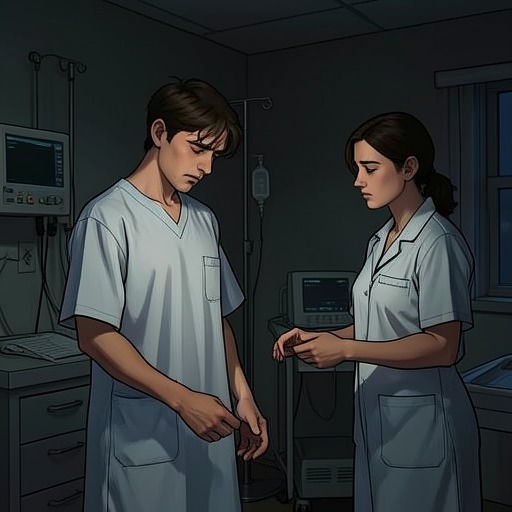
Dale Harding and Vera Harding's strained marriage
One Flew Over the Cuckoo's NestDale Harding and Vera Harding’s strained marriage is revealed in a library visit that offers the appearance of a reunion but quickly becomes a performance under observation. Vera’s teasing and Harding’s nervous wit make their intimacy seem familiar, yet his reluctance to approach her and his effort to conceal his expressive hands show how exposed he feels. When Randle Patrick McMurphy is drawn into their exchange, he rejects the part of marriage counselor and identifies the mutual injury beneath their banter.
The Visit and Its Audience
Vera arrives at the library accompanied by one of the ward’s black boys, who admits that visiting hours are over but that she talked him into bringing her in. The escort’s grin and conspiratorial manner make the visit feel like a small breach of the ward’s routine. Vera responds by blowing him a kiss, then turns toward Harding with a direct greeting and a forward swing of her hips. The entrance is confident and conspicuous; it happens not in private but in a room where patients can watch.
Harding answers her with an endearment, but does not cross the few steps between them. Instead, he looks around at the people observing them. His hesitation places the marriage under two kinds of scrutiny at once: Vera is there to see him, but the reunion is also being watched by the ward. Harding then introduces her to McMurphy as his counterpart and nemesis, declining the customary idea of a better half because, as he explains, it suggests an equal division. The clever formulation makes a joke of marital convention while hinting that he does not experience the relationship as a simple partnership of equals.
Vera is presented through precise visual details: she is as tall as Harding, wears high heels, and carries a black patent-leather purse in her hand rather than by its strap. Her red fingernails stand out against the shiny black surface. The description gives her a composed, striking presence in contrast to Harding’s watchfulness. McMurphy rises, removes his cap, and greets her; she smiles and asks him to use her first name rather than the formal title. Her ease with McMurphy sharpens the contrast with Harding, whose affectionate greeting has not become physical movement toward her.
Wit, Exposure, and Unease
Once seated with Harding and McMurphy on the couch, Vera hears Harding recount how McMurphy got the better of Nurse Ratched. Harding becomes animated as he tells the story. His hands weave through the air, seeming to turn the account into a visible performance, but when he notices that Vera and McMurphy are watching them, he traps them between his knees. His expressive gestures briefly escape the self-consciousness that governs him; once noticed, they become something he tries to suppress.
Vera tells him that he should learn to laugh rather than make his small, mouse-like squeak. McMurphy had made a similar observation about Harding’s laugh on his first day, but the repetition does not have the same effect. McMurphy’s remark had calmed Harding; Vera’s makes him more nervous. The difference suggests that identical criticism changes meaning with the speaker: from McMurphy it can register as reassurance, while from his wife it lands inside a more intimate and unsettled relationship. Harding laughs, but the moment does not dissolve his discomfort.
The tension becomes more pointed when Vera asks for a cigarette. Harding searches his pocket, finds it empty, and explains that the ward’s ration leaves him with only one pack a day. He folds his thin shoulders forward as if to hide the half-smoked cigarette he is holding, then describes the shortage as leaving no margin for chivalry. Vera answers that he never has enough. Harding treats her words as potentially both literal and symbolic, and their exchange over what she intended becomes a dispute over his adequacy as well as his supply of cigarettes. Vera eventually admits that she meant the remark in both ways. Harding corrects her grammar rather than answering the personal accusation directly, turning verbal precision into a defense and a means of keeping control of the exchange.
The Triangle with McMurphy
Vera shifts her attention to McMurphy and asks whether he can manage the simple courtesy of offering a woman a cigarette. He says that all he has to do is light it. She leans toward his match, far enough that Chief Bromden can see down her blouse from across the room. The gesture places McMurphy inside the couple’s encounter, not merely as an observer of Harding’s story but as a participant in a charged display between husband and wife. The scene does not establish a separate relationship between Vera and McMurphy; it shows her using his presence as part of the conversation and Harding watching the exchange.
Vera also complains about Harding’s friends who visit their house, describing men with carefully combed long hair and limp wrists. Harding asks whether they come to see him alone. She replies that any man who comes to see her displays more than limp wrists. Their banter makes the question of whose company those visitors seek deliberately uncomfortable. Harding’s question sounds suspicious, while Vera’s answer turns the suspicion back toward her own appeal and his position in the household. The conversation gives no account of what happens during those visits; its significance lies in how readily the subject becomes a contest over desire, attention, and status.
When Vera stands to leave, she takes McMurphy’s hand and says she hopes to see him again. The sound of her high heels draws the patients’ attention as she walks down the hall and disappears from view. Her departure repeats the public quality of her entrance: the patients watch her go, and Harding is left with them and McMurphy to interpret what has happened. Asked what he thinks, McMurphy initially answers with a crude comment about Vera’s body. Harding clarifies that he wants an opinion about the marriage, not her appearance.
Judgment, Resistance, and What Remains Unresolved
McMurphy then erupts at Harding. He refuses to act as a marriage counselor or to supply the requested sympathy by reducing Vera to a villain. Instead, he says that people spend their lives tearing one another down and insists that Harding has not made Vera feel like a queen either. His outburst does not settle which spouse is more responsible. It rejects the expectation that an outsider should validate one side and condemn the other, even as McMurphy’s judgment makes the mutual hostility explicit.
The other acute patients stare, unable to understand why McMurphy has suddenly shouted at them when none has asked anything of him. He returns to his cartoon magazine, holding it close to his face, either to prevent the others from looking at him or to avoid looking at them. The retreat follows his refusal to be drawn further into Harding’s private grievance: after speaking sharply, he shields himself from the room’s attention. At supper he apologizes to Harding for the outburst. Harding suggests that Vera often hangs people up, but McMurphy says that she cannot account for the bad dreams he has been having, since he met her only that afternoon.
The scene establishes a marriage marked by familiarity and antagonism, not a full history of how it came to be so. Vera calls Harding by an endearment and visits him; he tells her a story with evident enthusiasm. Yet he avoids approaching her, becomes nervous when she comments on his laugh, and answers her provocation with grammatical corrections. Their public jokes repeatedly cross into questions of adequacy and desire. McMurphy’s refusal to turn that tension into a simple verdict exposes its reciprocal character, while the scene leaves the marriage’s future—and the private causes of its strain—unresolved.