Disturbed Ward
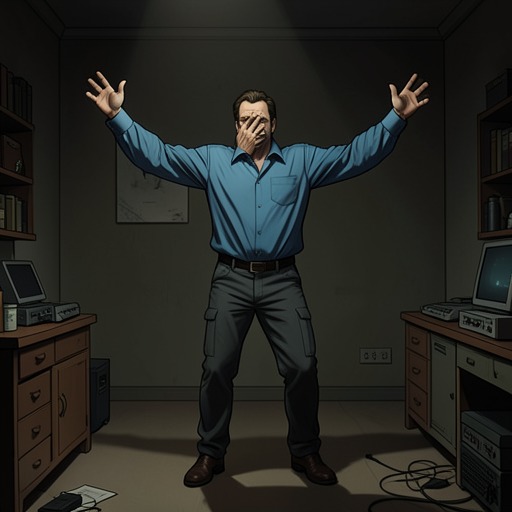
One Flew Over the Cuckoo's NestThe Disturbed Ward is the hospital’s upstairs unit for patients designated potentially assaultive, a place where the threat of transfer makes the limits of resistance tangible. Its isolation from ordinary ward life—down to the loss of television and Saturday movies—turns a change of location into a further loss of freedom. When Randle Patrick McMurphy and Chief Bromden are brought there in restraints, the ward’s relentless clatter and pacing corridors give that coercive power a physical form.
Setting and Atmosphere
The ward is reached by going upstairs from the main ward. Chief Bromden describes its sound before its inhabitants: an everlasting, high-pitched machine-room clatter that recalls a prison mill stamping out license plates. Time is marked by the steady ping-pong of a table, while patients pace short, repeated routes between walls, turning at each end and wearing intersecting ruts in the tile. The image is not of movement toward an exit but of movement worn into a circuit.
Bromden’s account makes the space oppressive through sensory impressions as well as architecture. He recalls the smell of men frightened and out of control, and imagines crouching, gnashing presences in the corners and under the ping-pong table—things beyond the reach of doctors, nurses, and disinfectant. These are the narrator’s perceptions, not a clinical inventory of the ward. Their importance lies in how they render the unit’s terror as something that seems to exceed the staff’s ability to manage it. When the door opens and the aides bring McMurphy and Bromden inside, Bromden recognizes the smell and hears the imagined gnashing again.
Transfer and Institutional Discipline
The possibility of being sent to the Disturbed Ward disciplines conduct in the main ward. Fredrickson tells McMurphy that a patient who tells Nurse Ratched to go to hell can be listed as potentially assaultive and transferred upstairs. He has experienced that consequence three times. The punishment extends beyond relocation: patients there do not get to leave the ward for the Saturday afternoon movie and do not have a television. The loss of shared recreation marks the transfer as social isolation as well as stricter supervision.
The threat sits alongside the threat of the Shock Shop and, as Harding warns, potentially more severe procedures. In this system, speaking back can be recast as hostility and used to justify escalating control. McMurphy later learns that provoking Nurse Ratched may put his own freedom at risk because he is committed, unlike Harding, who is voluntary. The Disturbed Ward therefore represents one part of a wider disciplinary structure: it is a destination patients fear, and the possibility of being sent there helps contain opposition before a transfer occurs.
The ward’s force is also visible when resistance breaks down. During the cigarette-rationing dispute, Cheswick demands that something be done, but the other patients do not support him. The ward’s black aides restrain him with a strap and drag him upstairs to the Disturbed Ward. After he is taken away, Nurse Ratched turns directly back to the question of cigarette rationing. The immediate return to the agenda makes the removal feel procedural: a patient disappears from the discussion, and the policy meeting continues.
Encounters and Contrasts
During the vote over whether the ward should watch the World Series, McMurphy tries to draw patients into supporting him after Nurse Ratched closes the vote. He reaches into the fog, as Bromden describes it, and tries to raise Ruckly’s hand because Ruckly is the youngest. Instead, Ruckly gives a crude, disconnected response. The moment places the ward’s excluded and incapacitated patients at the edge of a dispute about collective choice: McMurphy tries to include someone whose condition makes participation impossible, while the institution’s voting rules have already defeated the proposal.
The contrast between the wards is sharpened when McMurphy and Bromden arrive upstairs after their fight over George. Other patients on the main ward greet them and describe the fight as a victory, even as aides from the Disturbed Ward fit soft leather cuffs around their arms. Upstairs, the two men encounter a tall, bony patient attached by a wire between his shoulder blades. He tells an aide that he washes his hands of the whole affair, then the wire drags him down the hall. McMurphy surveys the day room with his cuffs too tight for him to put his thumbs in his pockets. The restrained gestures and the patient’s strange attachment make the new surroundings an immediate counter-image to the celebratory talk of victory below.
Narrative and Institutional Significance
Elsewhere in the hospital, Nurse Ratched is described as able to alter the speed of the ward clock, driving patients through repeated cycles of meals, appointments, and medication. The Disturbed Ward’s ping-pong beat gives time a different but related sound: not a schedule visibly sped up, but a monotonous measure beneath the patients’ repeated pacing. Together, these images portray institutional control as something imposed through ordinary routines and confined space, as well as through overt restraint.
The Disturbed Ward concentrates that control into a place patients are warned about, a place Cheswick is taken after standing alone, and a place McMurphy and Bromden enter physically bound. Yet their arrival does not erase the earlier sense of solidarity: the other patients have shaken their hands and called the fight a victory. The contrast does not make the ward less coercive. It shows how fragile a victory can be when the institution can change the setting, restrain the dissenters, and continue its business.