Electroshock Therapy
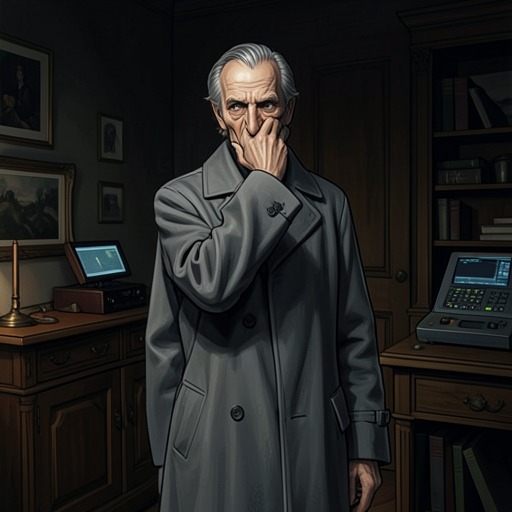
One Flew Over the Cuckoo's NestElectroshock Therapy, called EST or shock treatment in the ward, is described as a procedure that induces a seizure by passing electricity through a patient's skull. The novel places its claims of cure beside the locked doors, drugged patients, and threat of repeat treatments that govern its use. It is at once a treatment the staff defend as beneficial and a powerful instrument of institutional discipline, with its bodily effects and uncertain promise made visible through Chief Bromden's narration and Dale Harding's uneasy explanation.
Procedure and Ward Setting
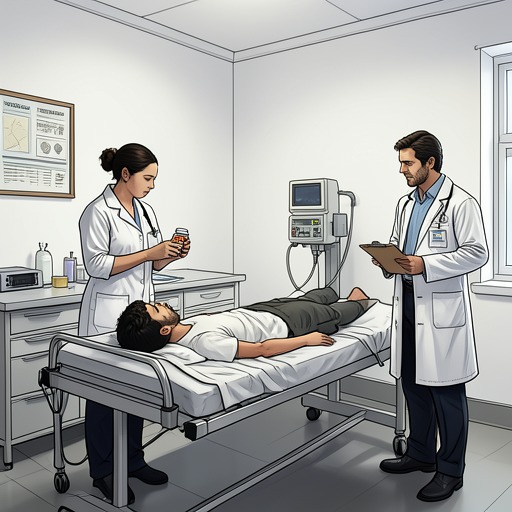
Chief Bromden encounters the treatment during a Friday trip to Building One, when ambulatory patients are taken for chest X-rays. Their bench is near an unmarked metal door, beside the marked X-ray and EENT rooms. From there he hears a patient scream and sees the door open to a room lit by twinkling tubes. A patient is wheeled out smoking; another, weakened by drugs, sways as two attendants pull him to his feet. For a moment the man recognizes where he is and braces both heels against the cement, resisting the pull toward the treatment table. The door closes, and the sound of metal striking a mattress ends the view.
The scene makes the procedure a routine embedded in hospital traffic: it happens alongside examinations, in a room whose blank door conceals what is done inside. Bromden grips the bench, afraid of being drawn through the doorway himself. The staff's movement of patients, the pre-treatment red capsules, and the brief resistance before the door shuts give the treatment a physical and procedural presence before Harding explains it. The narrative does not offer an impartial clinical account; it gives the reader the ward's machinery as seen and feared by the person waiting outside.
Explanations and Claims of Cure
Harding identifies the treatment as EST, or Electro-Shock Therapy, and describes the patient's payment as brain cells rather than money. His bitter humor calls the procedure a trip to the moon and characterizes it as brain burning, while his explanation complicates the idea that it is used only to punish. He says the hospital presents treatment as being for the patient's good, and acknowledges that shock has been credited with bringing some supposedly irrecoverable patients back into contact and enabling some people to resume rational conversation after a seizure. He also says that the effects and purpose are not fully understood, even though the possibility of benefit was taken as a reason to induce seizures.
Harding offers an origin story in which two psychiatrists observe cattle convulsing after blows to the head at a slaughterhouse. In his telling, doctors reason that a seizure might calm or reconnect some patients, but replace the sledgehammer with electricity because a hammer could injure a person. The account is delivered with comic exaggeration and skepticism; it belongs to Harding's explanation, not an independently verified history of the treatment. Its dark irony is that a procedure justified by the risk of striking a patient's head still works by deliberately inducing a seizure.
The ward's competing descriptions meet in Harding's assurance that treatment can be quick and painless and his account of how people are changed by it. He says that the patient loses memories and may emerge into a whirl of images, emotions, and recollections, as though spun through a carnival ride whose outcome could be either gain or loss. Sefelt responds to this contradiction by noting that some patients receive pills to stop seizures while others are given shock to start them. The exchange exposes the gap between a treatment's official rationale and the frightening experience its patients anticipate.
Coercion, Threat, and Patient Choice
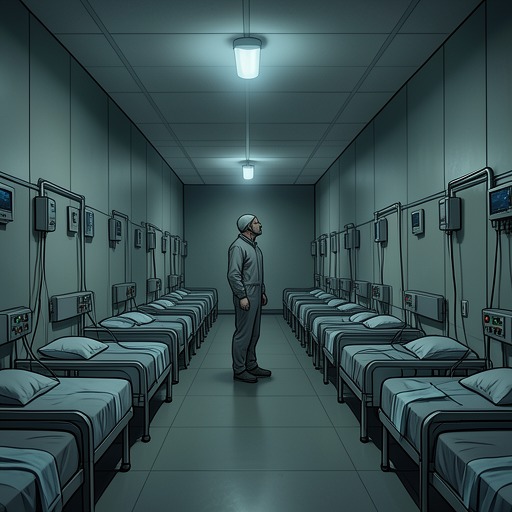
The possibility of shock treatment belongs to a wider disciplinary structure. When Randle Patrick McMurphy asks why patients do not simply tell Nurse Ratched to go to hell, Fredrickson explains that such defiance can lead to a designation as potentially assaultive and transfer to the Disturbed Ward. Harding extends the warning from transfer to the Shock Shop and possibly an operation. The threat makes shock more than a procedure discussed in the abstract: it is one of the consequences patients understand may follow from open resistance.
Harding describes EST as increasingly out of fashion and reserved for extreme cases that other measures cannot reach, such as lobotomy. His remarks do not make its threat disappear. When McMurphy later learns that most men on the ward are voluntary while he is committed, he realizes that resistance carries a special risk for him: he cannot simply leave to escape the institution's authority. He tells Harding that he has discovered why patients submit to Nurse Ratched and complains that they did not warn him that challenging her could add time to his sentence. Shock treatment thus sits within an unequal system in which patients' ability to refuse, challenge, or leave is constrained by their status and the hospital's control over treatment and transfer.
McMurphy's Repeated Treatments and the Meaning of Resistance
After McMurphy is on the Disturbed Ward, Nurse Ratched and a doctor approach as he begins to recover from each session. They ask whether he is ready to come around, face his problem, and return to the ward for a cure. He refuses, declaring that he would rather give his life for his country than surrender. As the other patients watch, he bows to them; the nurse then takes the doctor to authorize another treatment. The sequence repeats three more times that week. Each refusal is followed not by release from the threat but by the staff's decision to send him through the procedure again.
McMurphy turns the treatment's intended disciplinary effect into a public performance of defiance. His bows acknowledge the patients who watch him, while his resistance gives them a spectacle that the staff cannot entirely control. On one occasion he pinches Nurse Ratched through the back of her uniform, making her face redden; the doctor hides a grin. The moment does not undo the power imbalance, but it makes that power less seamless: the nurse can authorize another treatment, yet McMurphy's conduct draws amusement and attention from those present.
Chief Bromden recalls that earlier shock sessions could leave him confused and detached for as long as two weeks, in a blur between waking and sleeping, life and death. On this occasion he fights out of the fog in less than a day and understands it to have been his last treatment. The contrast makes clear that the treatment's consequences are not represented as a predictable, uniform recovery. For Bromden, returning from the altered state depends on having a reason to wake and the determination to fight his way out; the fog is both a lingering bodily aftermath and a condition from which he can struggle toward awareness.
Electroshock Therapy is not the final procedure used against McMurphy. Three weeks after he has been gone from the ward, a gurney bearing his name and the notation that he has had a lobotomy is wheeled into the day room. The patients recognize the battered, milk-white face beneath the red hair, but Scanlon rejects the implication that this is the man they knew. The ending distinguishes shock treatment from lobotomy while placing both within the same institutional sequence of treatment, coercion, and bodily change. EST's significance lies in that unresolved tension: the staff can describe it as a cure, while the patients experience its threat, its effects, and the limits it places on their freedom.