George Sorensen
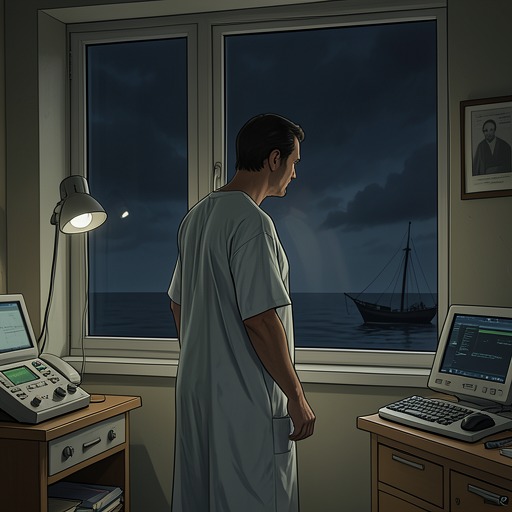
One Flew Over the Cuckoo's NestGeorge Sorensen is a shy, cleanliness-anxious patient whose apparent retreat from other people conceals a seasoned mariner. When Randle Patrick McMurphy recruits him for the fishing trip, George’s practical knowledge makes him the crew’s real captain, not merely its namesake. His arc joins two sharply contrasting conditions: command on a dangerous sea and exposure to coercive routines in the ward.
Identity and Background
The ward attendants call George Rub-adub George because of his preoccupation with sanitation. Chief Bromden presents him as an elderly, toothless Swede, knotty in appearance and so shy that he approaches McMurphy with a hand cupped over his mouth. His posture keeps others at a distance: he leans backward as he walks and speaks, his feet seeming to lead while his head falls behind. Deep-set eyes, a swaying head, and the hand shielding his face make his reluctance to meet people physically visible.
His concern with dirt shapes how he approaches the expedition. When he first offers advice, it is a warning about red worms and their suitability for Chinook fishing. The exchange initially makes his knowledge easy to overlook: he mumbles, and McMurphy has to move his hand away so his words can be heard. Yet the caution is not idle. George has spent twenty-five years working Chinook trollers, fishing from Half Moon Bay to Puget Sound before, as he puts it, becoming too dirty. His hands carry deep scars from hauling line, evidence of labor that the surrounding patients can see even though the dirt he fears is not apparent to Bromden.
George shows those hands briefly, then closes them and hides them inside his pajama shirt, as if even looking at them might contaminate them. His recollection of the work is also a recollection of pride. He remembers a forty-foot troller, drawing twelve feet of water, built of teak and oak, and insists through his rocking, emphatic manner that it was a fine boat. His retreat from fishing is therefore bound to his fear of dirt, but the story also preserves a skilled working life that the ward’s present view of him does not explain.
The Fishing Trip and His Hidden Expertise
McMurphy has trouble finding a final volunteer. The Big Nurse has frightened the other patients with accounts of rough seas and sunken boats, and George approaches him in the breakfast line only after the search has gone on. George’s first intervention is to question the bait. When McMurphy realizes that he knows the business, George’s reserved warning opens into a fuller account of his experience.
The captaincy begins as McMurphy’s accommodation of George’s fear. McMurphy promises that the boat will be clean and that George will not have to handle bait; he can simply command the crew. George remains hesitant, objecting that boats are dirty. McMurphy then offers to let him come along for five, and George studies the predicament before accepting. He takes the pencil and signs the last place on the list. After breakfast, McMurphy prints CAPT behind his name. The inscription converts a tentative agreement into a public role, while George’s long experience gives that role substance.
At the dock, he takes charge of the vessel’s controls while McMurphy calls the crew to its tasks. George shows him which buttons to use and describes the boats as easy to drive. His manner aboard is different from the backward, guarded approach he makes in the ward: he is now the person others depend on for practical direction. The expedition’s authority rests not on McMurphy’s bravado but on George’s knowledge of boats.
That knowledge becomes crucial in the crossing of the bar. The boat rises toward a hissing wave and drops into the trough, with the next wave looming behind and the black rocks of the jetty close to the left. George has explained the danger of both losing the forward wave, which could leave the boat surfing out of control, and slowing enough for the wave behind to break over the stern. He works the throttle, repeatedly looking ahead and back as he holds the boat steady. The others stop joking. His swivel-like attention is no longer a sign of nervousness but the visible work of keeping the crew safe.
Authority at Sea and After the Return
Inside the mooring, the water calms, but the return to the dock brings another test of George’s control. The captain and two police officers wait at the water’s edge, with the local men gathered behind them. George heads toward them at full throttle, then swings the wheel and reverses just before the prow could tear through the dock. He brings the boat alongside the rubber tires with precision; the wake arrives afterward, pitching the other boats and washing over the dock. The maneuver demonstrates, in a public and unmistakable way, that he can handle the vessel.
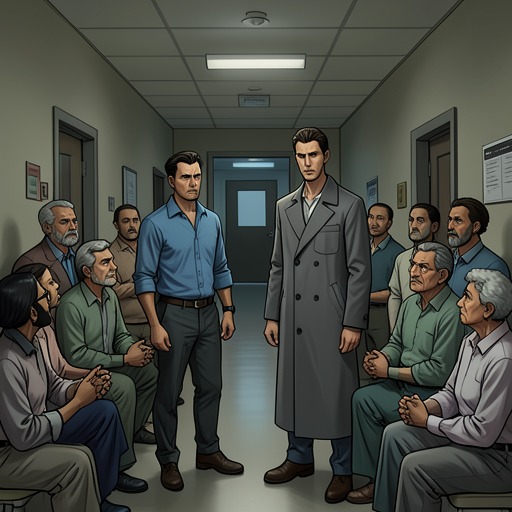
The confrontation that follows is directed chiefly by others. Dr. Spivey argues that the expedition is government-sponsored and that the police lack jurisdiction; he also raises the question of whether the boat carried enough life jackets. After the officers leave, McMurphy and the captain argue and shove each other. Meanwhile, the patients unload their catch. One of the local men praises the halibut as the biggest he has seen brought in on the Oregon coast, and the group that had watched the patients endure insults now approaches to inspect the fish. They ask George where he learned to dock so well.
Their question brings another part of his history into view. George has not only run fishing boats; he was also captain of a PT boat in the Pacific and received the Navy Cross. When someone suggests that he should have entered public office, he rejects the idea because public life would be too dirty. The remark connects his decorated service to the same aversion that seemed, at first, to disqualify him from the trip. His fear has not erased his competence: even after years away from boats, he can guide a vessel through danger and command the respect of people who had dismissed the patients as weak.
Cleanliness, Vulnerability, and the Ward
The excursion temporarily changes how the patients and the local men see George. On the trip he is captain in practice as well as in name; on returning, he shares in a group whose skill and catch have unsettled the assumptions made about them. The local men do not apologize to Candy for their earlier remarks, but they ask to see her fish politely. Before the patients leave, they share a beer with the captain. George’s competence has helped make the group harder to treat as an object of ridicule.
The ward’s routines expose a different side of his condition. George never uses soap when he showers and will not accept a towel to dry himself. The evening attendants have long allowed this practice rather than force him to do otherwise. That informal accommodation ends as an option when an attendant with a broken nose approaches him, backed by two colleagues. George leans backward, shakes his head, and covers himself with his broad hands; the other patients recognize the threat in the sudden silence and understand that the attendant cannot afford to pass up the chance to make him comply.
The contrast with the fishing trip is severe. At sea, George’s hands bear the scars of hauling line, and his knowledge protects everyone aboard. In the shower line, those same hands shield his body while his refusal of soap and towel leaves him exposed to the ward’s demands. The scene stops at the moment of threatened enforcement: George’s vulnerability is plain, as is the patients’ awareness of what may follow, but this evidence does not establish the outcome. His character is defined by neither a simple triumph nor a simple incapacity. He remains a man marked by an intense fear of contamination and by a history of labor, command, and courage that the ward cannot fully contain.