Hydrotherapy control panel
One Flew Over the Cuckoo's NestThe Hydrotherapy control panel is a massive, inactive fixture in the tub room whose changing uses make it more than background equipment. Billy Bibbit perches on it during a ward discussion; Randle Patrick McMurphy later bets that he can lift it, strains until his hands bleed, and abandons the money at stake; the next morning Martini turns it into the imagined controls of an aircraft and reacts to figures no one else can see. The panel’s steel, cement, levers, and nozzles anchor these different scenes in one solid object: at once a practical remnant of treatment, a challenge to bodily limits, and a surface on which the ward’s fears and fantasies appear.
Construction and Intended Use
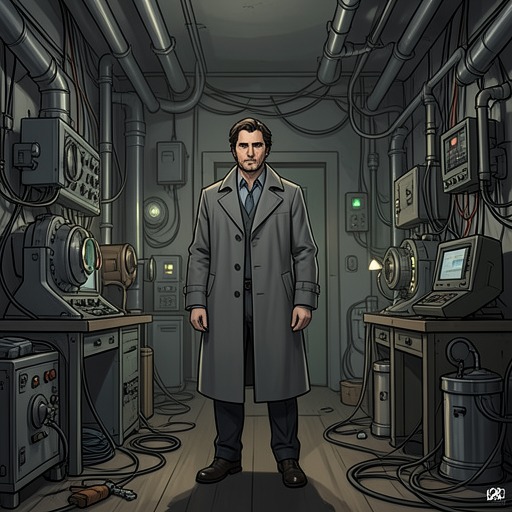
The panel stands beside a square-tiled shower booth ringed with nozzles. It is steel and cement, about half the size of a table, and is estimated to weigh four hundred pounds. Handles and cranks are set into its face. Although it appears to be held in place by little more than wires, its size and weight make it an implausible object to move by hand. McMurphy compares it to hay bales he has handled, while Dale Harding warns that it must weigh considerably more; the disagreement turns the panel’s scale into a question the ward can test rather than settle by inspection.
The apparatus is new and unused in the ward. No one has turned on the water, and the nozzles do not spray when Martini works the controls. Its design nevertheless recalls hydrotherapy equipment at the old hospital, which Chief Bromden remembers from fifteen years earlier: a patient was suspended in canvas straps while a technician operated the panel from across the room. The controls could direct sprays from different angles and vary their force, heat, and softness. That recollection gives the polished, dormant fixture a history of bodily restraint and managed sensation, even though the ward’s current equipment is not being used for treatment in these scenes.
A Perch During the Voting Dispute
The panel first enters this cluster of scenes as the seat Billy chooses while the patients consider whether a vote can change the ward’s television schedule. When asked whether he fears Nurse Ratched, Billy says that he does not think she would act against him, but doubts that a vote would matter in the long run. As he explains his hesitation, he climbs onto the panel and perches there. The awkward position makes him conspicuous without making him decisive: he is physically elevated, yet uncertain that collective action can alter anything.
McMurphy answers the patients’ doubts by treating the panel as a different kind of test. The conversation turns from the risks of raising hands to whether the heavy fixture can be lifted. In this shift, the panel becomes a concrete challenge where the abstract question of whether effort is worthwhile can be staged before the group. Its physical presence also gives Billy’s earlier perch a new charge: the object that held him while he doubted the value of a vote becomes the measure by which McMurphy asks the others to judge what trying can accomplish.
The Lift and Its Aftermath
McMurphy proposes the panel as an alternative to lifting a bed, which would be too large to fit through the window. The others point out that the panel is not nailed down, but its apparent freedom from bolts does little to diminish its weight. McMurphy stakes the money he has won from the men at poker and blackjack against his own ability to move it. Chief Bromden observes that McMurphy must know he is unlikely even to tip the fixture, let alone lift it. The bet therefore carries a visible contradiction: McMurphy wagers as though success were possible while the men expect a sure loss.
Before he tries, McMurphy lifts Billy off the panel, spits into his callused palms, and prepares himself. He adjusts his stance, takes hold of the levers on both sides, lets go, shifts his feet, and makes a second attempt. At first the men hoot and joke. Then his arms swell, veins rise, and tendons stand out as his whole body shakes with the effort. The cement grinds against the floor, briefly making the impossible seem possible to the watching patients. The strain does not move the panel: McMurphy’s breath gives out, and he falls back against the wall.
The attempt leaves blood on the levers where McMurphy has torn his hands. When he tries to sort the IOUs, his fingers are stiff and curled so tightly that he cannot work them. Rather than keep the winnings, he throws the papers onto the floor and leaves them for the others. His declaration that he tried is the scene’s decisive result: the panel remains where it was, and the bet is not won, but McMurphy refuses to let the failure be reduced to the money. The object turns the gap between outcome and effort into a public fact, witnessed by the men who had first treated the wager as certain entertainment.
Martini’s Imagined Machine
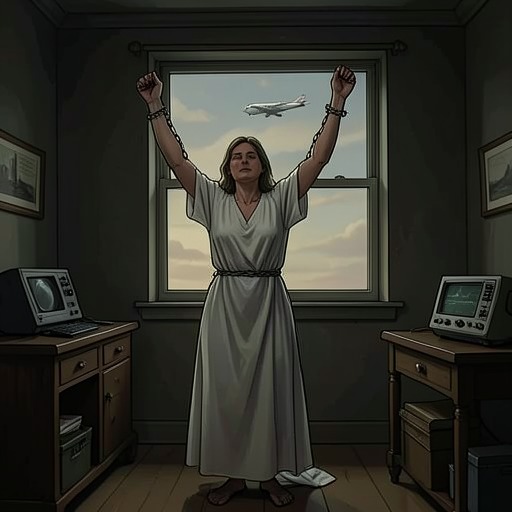
The following morning, the panel serves a different purpose. During a poker game, Martini stands behind it and plays at being a jet pilot, spinning a dial, pushing a lever, and leaning as though banking an aircraft. The controls do not activate the shower; the water remains off. Yet the panel’s handles and dials are enough to support Martini’s performance, transforming an idle medical fixture into the command station of an imagined vehicle.
The play abruptly gives way to alarm. Martini jerks his hands from the panel, stands bolt upright, and stares into the shower booth with his eyes bulging. The other card players turn to look, but see only buckles among the nozzles and stiff canvas straps. Martini looks directly at McMurphy and asks whether he saw them; McMurphy says he sees nothing. The panel thus remains materially unchanged while the scene around it shifts from comic make-believe to a frightening vision that Martini alone appears to perceive.
Narrative Significance
The panel gathers together the ward’s competing relations to control. Its original design allowed a technician to direct water onto a restrained patient; its present controls are unused, but the straps and nozzles remain visible. The object can therefore recall treatment as a system operated over a patient’s body without claiming that the apparatus is actively used in the ward. Its inertness matters: the new equipment is available to sight and touch, yet it neither sprays water nor explains Martini’s vision.
Its role changes without the fixture itself changing. Billy sits on it while doubting the force of a vote; McMurphy makes it the target of a wager that ends in blood and surrendered winnings; Martini uses its controls in play before seeing what the other men cannot. Across these scenes, the panel supplies a hard physical limit, an obsolete instrument of bodily management, and a blank surface for imagination. It cannot be lifted by McMurphy, made to function by Martini, or made to settle the patients’ doubts. What it does do is bring those doubts and efforts into view, giving the ward a common object around which disbelief, spectacle, and uncertain hope can gather.