Laughter as resistance
One Flew Over the Cuckoo's NestLaughter as resistance is a recurring force in the ward: it does not erase pain or defeat the institution outright, but lets patients recognize its absurdity, act together, and briefly occupy a world not governed by Nurse Ratched. Through Chief Bromden’s account, laughter moves from Randle Patrick McMurphy’s deliberate provocation to a contagious group response. Its most consequential effect is not simply amusement; it gives patients a way to show one another that fear and obedience are not the only possible responses.
Laughter Against the Ward’s Discipline
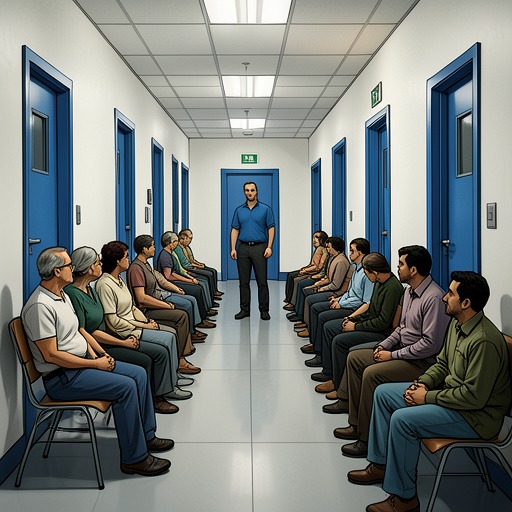
The contrast is clearest when the ward enforces compliance through force. When Maxwell Taber challenges the handling of his medication, Nurse Ratched grips his arm, tells him that hostility will be met with a more severe response, and dismisses him. Later, the black boys seize him in the latrine, hold him down on a mattress, and take him to the lab after he has been injected. Chief Bromden describes Taber as helpless in their grasp. The scene offers no shared laughter to interrupt the procedure: bodies are immobilized, speech is smothered, and treatment proceeds out of sight. Against this coercive sequence, later laughter matters as a public expression the staff cannot readily reduce to one patient’s compliance.
Randle Patrick McMurphy makes laughter part of his response to the ward’s everyday rules. He keeps an exaggeratedly courteous manner even when staff members try to provoke him; when a rule angers him, he becomes more mannerly until its childishness strikes him as funny. Chief Bromden understands that the laughter both protects McMurphy from being mastered by his anger and aggravates those enforcing the rules. Its resistance is practical as well as symbolic: instead of accepting the staff’s solemn account of order, McMurphy makes that order available for ridicule.
From Silence to a Public Vote
The conflict over television shows how laughter and McMurphy’s irreverence help expose the difference between formal permission and genuine participation. Hoping to watch the World Series, he proposes moving the cleaning work to television time and the games to the afternoon. Nurse Ratched rejects the change, invoking the delicate balance of the schedule. More startling to McMurphy than her refusal is the other Acute patients’ silence when he asks what they think. He has bets on the games with at least twelve patients, yet they remain sunk in what Chief Bromden describes as pockets of fog.
Cheswick first gets to his feet, but the other men look around to see whether anyone else will risk joining him. Later, when the question is formally put to a show of hands, McMurphy insists on seeing both the raised hands and those that stay down. His own hand, marked by a bandage from his attempt to lift the hydrotherapy control panel, rises first. Chief Bromden then sees the others emerge from the fog and join in; all twenty Acutes vote for the change. The vote concerns television, but its meaning has widened: their hands also register opposition to Nurse Ratched’s effort to send McMurphy to the Disturbed Ward and to the treatment that has beaten them down. Laughter alone did not produce that decision, but McMurphy’s refusal to accept silence as a settled answer helps make collective action imaginable.
Shared Pain, Shared Laughter
On the fishing trip, laughter does not depend on everything going smoothly. The boat runs into a log and the engine stops amid tangled lines, a bleeding thumb, the doctor’s glasses dangling from a fishing line, and the girl’s bruised breast. McMurphy laughs at the whole mishap, including himself and the people around him. Chief Bromden makes explicit the balance in that response: McMurphy recognizes that the hurts are real, but will not allow pain to blot out humor, any more than humor should blot out pain.
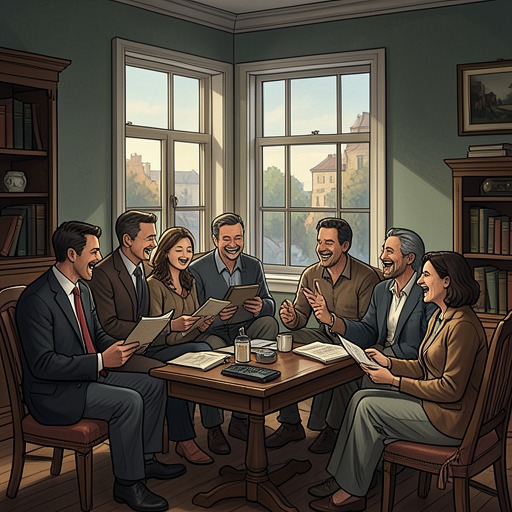
The laughter spreads beyond its instigator. Dale Harding, Mr. Scanlon, the girl, Mr. Sefelt, and Dr. Spivey join in, and Chief Bromden experiences himself as both part of the group and strangely lifted beyond it, watching the laughter travel outward in widening circles across the water. The scene makes resistance communal and bodily. Its power lies not in pretending that injury has vanished, but in changing what the group can do with the experience of injury: the patients can laugh at themselves and alongside one another rather than remain isolated in embarrassment or distress.
A later confrontation over George Sorensen’s shower routine shows how quickly that fellowship can be tested. The patients have been laughing and joking while the black boys move down the line, but the room falls silent when one approaches George to make him bend his head for treatment. George has long been allowed to avoid soap and towels; now, with the attendant’s injured nose and two colleagues behind him, the group understands that he may be forced to comply. The abrupt silence marks recognition of the danger and of their own earlier misjudgment of McMurphy. Here laughter cannot simply dissolve the threat. Its cessation makes the stakes visible: solidarity has to survive the moment when someone is singled out.
The Ward Learns to Laugh Back
During the ward’s nighttime party, Chief Bromden realizes that he is drunk and laughing on Nurse Ratched’s ward, surrounded by patients and women. He understands the night as something the group has managed to make happen inside the Combine’s stronghold, a breach that suggests the institution may not be all-powerful. The experience changes the scale of possibility for him: if the patients have made this night happen, they may be able to act again. His exhilaration becomes physical when he lifts Sandy and McMurphy in his arms and runs with them to the day room.
The next morning, the evidence of the party turns the patients’ worry into laughter. Nurse Ratched discovers the pills sprinkled on Mr. Sefelt and Sandy, and later Turkle is led out of the linen room tangled in torn sheets. The patients try to contain their laughter at first, then roar. Nurse Ratched’s pasted smile gives way to visible strain as she tries to force their good humor down. When she demands to know where the eloper has gone, the men answer with a chorus of laughter. Their faces meet hers, and Chief Bromden sees that they are no longer susceptible to her usual influence. The laughter is now a group refusal to help her restore unquestioned authority.
That reversal does not mean the ward has won. Nurse Ratched remains capable of institutional retaliation, and the later return of Randle Patrick McMurphy on a gurney, marked post-operative and labeled for lobotomy, makes the limits of resistance brutally clear. Yet her authority has been weakened: Chief Bromden observes that she can no longer rule the men as before, even while McMurphy’s presence continues to animate the ward. Laughter’s achievement is therefore neither cure nor escape by itself. It is a repeated practice of recognition and solidarity, one that allows the patients to experience themselves as more than isolated objects of discipline, even when the institution can still inflict irreversible harm.