Majority Rule for Ward Policy Votes
One Flew Over the Cuckoo's NestMajority Rule for Ward Policy Votes is the ward’s requirement that a policy change win a majority of the full forty-patient population. Its decisive effect appears when twenty patients raise their hands to change television hours: because the other twenty do not vote, the proposal fails. The procedure permits a public show of solidarity, then denies that solidarity the power to alter policy.
Definition and Institutional Setting
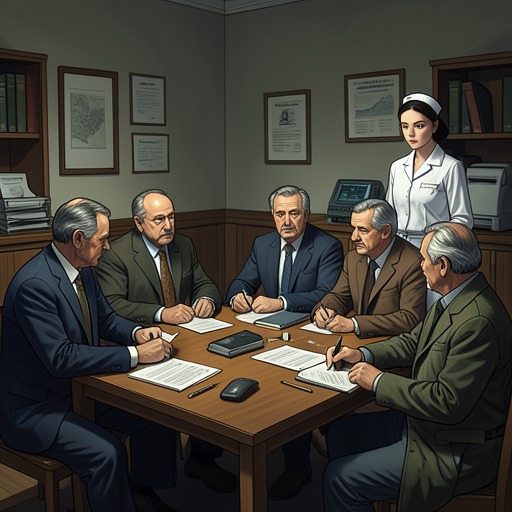
The rule operates within the ward’s group meetings, where patients may discuss policy and register their preferences by a show of hands or, if requested, a secret ballot. When a later vote is called, Nurse Ratched asks Randle Patrick McMurphy which method he wants. He chooses a visible count and insists that the raised hands and the hands that stay down both be seen. The choice makes the vote a public display of assent and nonparticipation, not merely a private tally.
The decisive standard is not a majority of ballots cast. Nurse Ratched invokes the ward constitution and explains that a majority of all forty patients is required to change policy. On the facts of the vote, that means at least twenty-one affirmative votes: exactly half of the ward cannot carry a motion. The rule therefore gives the entire patient population weight in the threshold, whether or not each patient takes part in that particular vote.
That distinction matters in a ward where speaking up is not an uncomplicated act. Fredrickson has warned that openly hostile behavior can lead to a designation as potentially assaultive and transfer to the Disturbed Ward; he has experienced that outcome three times. He also describes the Shock Shop and the possibility of further treatment as consequences for continued resistance. Those warnings do not define the majority rule, but they establish the disciplinary pressures surrounding public dissent.
The Television-Schedule Vote
The immediate proposal concerns the World Series. Randle Patrick McMurphy wants the patients to watch the games even though they fall outside the ward’s regular television hours. He suggests moving cleaning work to the evening and using the afternoon for the broadcasts. Nurse Ratched refuses, citing the delicately balanced schedule and the disruption a change would cause.
Her refusal is expected; the patients’ silence is not. When Randle Patrick McMurphy asks what they think, the Acutes remain quiet. He points out that at least twelve patients have a personal interest in the games, but no one answers. Cheswick finally calls out and stands. At this initial show of support, other patients look around to see whether anyone else will risk joining him. The hesitation makes the vote about more than television: each raised hand is also a visible departure from the safety of silence.
A later vote brings a striking change. With the question formally before the group, Randle Patrick McMurphy’s bandaged hand rises first; the bandage marks the cut he received while trying to lift the hydrotherapy control panel. Other hands follow. Chief Bromden describes the movement as the red hand reaching into the fog and drawing the men out, one after another. Twenty patients raise their hands, a sharp contrast with the four or five who might have supported a vote the day before.
How the Majority Is Counted
Nurse Ratched counts the raised hands and points out that there are only twenty. Randle Patrick McMurphy initially treats twenty as the whole group present for the vote. She answers that the ward has forty patients and that a majority is necessary to change its policy. When he objects that the old patients are being counted too, she maintains that the procedure follows the ward constitution. Dr. Spivey confirms that the majority requirement applies.
The arithmetic makes the result unambiguous under the stated rule: the twenty affirmative votes amount to half of forty, not a majority. The proposal is therefore declared defeated, even though every patient who voted supported it. The hands come down, and the patients begin to retreat toward the safety of silence. The procedure records their participation but makes their collective preference insufficient to compel a change.
The exchange also reveals how the voting mechanism can turn a substantive disagreement into a question of procedure. The patients have made a clear choice on the schedule; the decision instead rests on the size of the total ward population and the number who did not vote. Randle Patrick McMurphy objects that this is an unjust way to use the rule, but neither his protest nor the patients’ raised hands changes the outcome.
Consequences and Significance
The vote briefly changes what seems possible in the room. Chief Bromden sees the other hands emerge from the fog and understands the gesture as opposition not only to the television schedule but also to Nurse Ratched’s effort to send Randle Patrick McMurphy to the Disturbed Ward and to the way she has worn the patients down over the years. The ballot thus gathers several grievances into one visible act. Its force lies in the patients’ movement from isolated hesitation to collective declaration, even though that declaration loses under the ward’s threshold.
Nurse Ratched’s response also makes the meeting itself part of the conflict. After Randle Patrick McMurphy denounces the result, she calls attention to how upset he appears and asks that this be noted. She then proposes ending the meeting early in view of his condition. The procedural defeat is followed by an effort to frame his reaction as evidence about him, shifting attention from the patients’ failed bid to change policy to his apparent agitation.
The rule’s significance lies in the gap between permission to vote and power to decide. A show of hands can bring twenty patients into public view and expose a previously muted opposition, yet the requirement that more than half of the entire ward agree lets nonparticipation defeat the proposal. The vote is neither meaningless nor effective in the ordinary policy sense: it reveals solidarity while demonstrating that the ward’s formal democratic procedure does not guarantee that patient preference will govern.