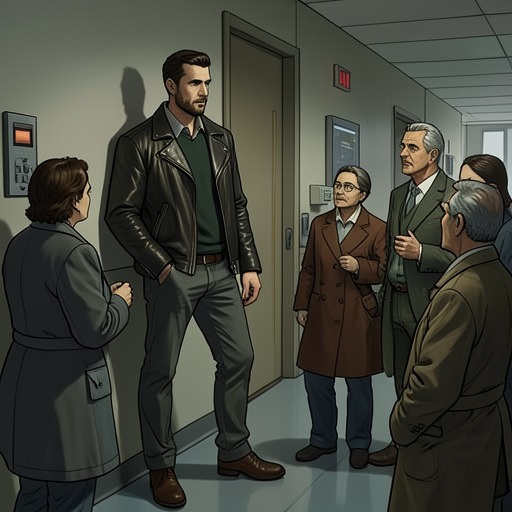
McMurphy's involuntary commitment
One Flew Over the Cuckoo's NestRandle Patrick McMurphy’s involuntary commitment is the fact that transforms his stay in the mental hospital from a short, predictable sentence into confinement with no set release date. He initially measures his time against a work-farm sentence; after learning that hospital staff control the timing of discharge, he recognizes that his resistance may prolong his stay. The status makes time itself a source of institutional power, and forces him to reconsider both the ward’s politics and his own stake in them.
A Sentence Without a Release Date
McMurphy arrives thinking in the terms of a fixed sentence. He has served two months of a six-month term at Pendleton Work Farm and expects to spend no more than four additional months locked up anywhere. By the time he has been in the hospital for close to a month, its beds and orange juice may seem preferable to the work farm, but not enough to make years of confinement acceptable. His calculation depends on an assumption that prison and hospital are different settings for a limited punishment, not that one may hold him indefinitely.
A conversation at the swimming pool breaks that assumption. The lifeguard explains that a jail sentence comes with a known release date, whereas commitment does not work that way. When McMurphy asks what happens to someone who is committed, the lifeguard offers no end date. He describes his own circumstances: picked up for drunk and disorderly conduct, he has remained in the hospital for eight years and eight months. Though he believes he could do some work even with his injured arm, the nurse on his ward continues to tell the doctor that he is not ready to leave. His account gives McMurphy a concrete example of confinement continuing long after the original circumstance that brought someone inside.
The implication reaches McMurphy as he treads water. He stops splashing, asks how long the lifeguard has been waiting, and later sits frowning at the shallow end. Chief Bromden connects this reaction to Nurse Ratched’s earlier assurance at a staff meeting that McMurphy could remain committed for weeks, months, or years, as the staff chose. What had sounded like institutional confidence now has a personal meaning: McMurphy’s remaining time is not determined by the work-farm arithmetic he brought with him.
How the Ward Enforces Its Rules
The threat of extended confinement gives the ward’s disciplinary machinery a different weight. During the dispute over medication, Nurse Ratched takes hold of Maxwell Taber’s arm, tells him he may leave if he will not take his medication orally, and treats his objection as evidence of hostility. The black boys later seize Taber in the latrine, restrain him on a mattress, and he is taken to the lab. The scene shows that a patient’s refusal can be answered not only with argument but with physical force and treatment; commitment places patients under institutional control while leaving them little practical power to contest it.
McMurphy also hears what may follow open defiance. Fredrickson tells him that a patient labeled potentially assaultive can be sent to the Disturbed Ward, where patients lose ordinary privileges such as Saturday movies and television. Harding adds the possibility of the Shock Shop and an operation. These are not abstract warnings to McMurphy: they make visible a sequence of consequences through which the hospital can answer resistance. The threat helps explain why a person who appears to have room to challenge Nurse Ratched may in fact be risking more than a temporary reprimand.
The ward’s voting procedures offer another example of the difference between apparent participation and effective authority. When twenty patients vote in favor of changing policy, Nurse Ratched counts only twenty votes among forty patients and declares the proposal defeated for lack of a majority. When McMurphy objects, she describes him as upset and asks the doctor to note his condition. The vote cannot secure the change he sought, while his protest can be recorded as evidence about him. In this setting, a public procedure does not give him control over the terms of his confinement.
Learning the Cost of Resistance
Before he understands the distinction between voluntary and involuntary patients, McMurphy treats his fellow patients’ requests as a shared campaign against Nurse Ratched. He pushes them to tell her off and believes she has not yet hurt them. Fredrickson’s account of transfer and shock makes clear that such defiance can carry severe consequences. McMurphy initially does not understand the ward’s vocabulary or the risks concealed in its routines; he is not yet aware that his own status leaves him especially exposed to decisions about how long he stays.
That misunderstanding becomes explicit when McMurphy realizes that the others have not explained the danger of provoking Nurse Ratched. He says he has learned that she can keep him committed until she is ready to release him, and that he had been drawn into confronting her over matters such as the dorm door and cigarettes in the Nurses’ Station without understanding what he stood to lose. He had assumed the patients’ appeals reflected a shared risk. Instead, he recognizes that he has been carrying their fight while they may have more room to leave: Dale Harding tells him that he is voluntary, whereas McMurphy is committed. Harding says that only a few men on the ward, including McMurphy and Scanlon, are committed.
The realization changes McMurphy’s reading of his own conduct. He begins avoiding Nurse Ratched because he fears that provoking her could add another year or more to his stay. His concern is not a general reconciliation with her authority; he frames it as self-preservation and objects to having been enlisted without being told the stakes. The ward’s appeals now appear to him as requests that someone else take a risk from which they may be less constrained. Commitment has altered the balance between solidarity and personal survival.
Confinement, Treatment, and Consequence
The staff meeting makes the power behind that calculation explicit. Nurse Ratched presents McMurphy’s continued commitment as something the hospital can sustain for as long as necessary. Even after he has won a bet by getting under her skin, he continues to behave provocatively, and the patients enjoy watching him. But his later discovery of the lifeguard’s eight-year confinement helps explain why his confidence gives way to caution: the question is no longer simply whether he can make the nurse angry, but whether she can keep him there.
The hospital’s treatment practices intensify the stakes. Chief Bromden sees patients being taken through a metal door for electroshock treatment, and McMurphy learns that electricity is sent through a patient’s skull. Later, while in the Disturbed Ward, McMurphy receives three more treatments in a week. Each time he resists Nurse Ratched’s invitation to give up and return to the ward for a cure; after his refusal, she arranges another treatment. The account presents his defiance as continuing, but also shows that staff can repeatedly subject a committed patient to treatment while he remains confined.
The consequence is finally rendered in the day room as a chart on a gurney: Randle P. McMurphy, postoperative, with lobotomy written below. Chief Bromden and the others see his bruised, pale face and red hair, and Scanlon rejects the suggestion that the figure is still the man they knew. The chart does not explain every decision that brought McMurphy to this point, but it makes the consequence of prolonged institutional power visible. His involuntary status had denied him a fixed endpoint; the postoperative return shows how much can happen to a person while release remains in other hands.