Midnight party in the ward
One Flew Over the Cuckoo's NestMidnight party in the ward is a night-long breach of the hospital’s regimented order, organized around an unlocked window, contraband drinks, and the patients’ willingness to make room for pleasure and companionship. The gathering gives Chief Bromden a rare, concrete experience of collective freedom: the ward’s rules still surround the men, but for several hours they do not dictate what the men do. The party’s exhilaration is inseparable from its danger. It ends with the staff discovering McMurphy and Candy together, and with the prospect of escape giving way to the consequences of having stayed.
Conditions and Preparations
By this point, McMurphy has learned that his commitment may keep him on the ward indefinitely, while many of the other patients are there voluntarily. He has also discovered how much risk they had allowed him to take in challenging Nurse Ratched without telling him what he stood to lose. His reduced confrontation with her is not simple surrender: he now understands that his freedom is more precarious than theirs. That knowledge gives the party’s later escape plan a practical urgency. The men are not merely indulging in a prank; they are testing whether McMurphy can leave and whether the others can imagine leaving with him.
The plan depends on Turkle, who is working the night shift after the regular staff go off duty. McMurphy has discussed the arrangements with him in advance: Candy is to enter through a window rather than risk the lobby, the Seclusion Room is to be unlocked for Billy and Candy, the dorm doors are to be closed, and the lights are to stay out. The precautions show how much the ward’s ordinary operations govern even a secret gathering. Entry, privacy, and the risk of waking the other patients all have to be negotiated around the institution’s spaces and staff.
The women are late, and Billy grows increasingly anxious, uncertain whether he wants them to arrive. To explain the delay, Turkle and McMurphy turn on lights around the ward, eventually settling on the lights in the doctor’s office rather than waking everyone with the dorm’s overhead lights. The improvised solution makes the ward appear as bright as daytime. Then comes a tap at the window. McMurphy sees the visitors and draws Billy over, pressing him toward the encounter even as Billy hesitates. Candy arrives with Sandy, the woman who had not come on the fishing trip; Sandy has left her husband and joined the night’s escape from ordinary life.
The Ward Transformed
The window becomes the party’s threshold. Candy and Sandy have to lift their skirts to climb through, carrying bottles by the neck. Their entrance turns a forbidden hospital ward into a place where visitors can move among the patients. For Chief Bromden, that crossing is more than a logistical success: a part of the outside world has entered a place that usually controls who may come and go.
The danger of discovery remains immediate. A nurse notices the lights and questions Turkle in the hall, asking why the ward is illuminated and why the latrine he is supposed to clean is dark. Turkle struggles to invent an explanation while the patients pass a bottle in the shadows and wait. His strained performance exposes how thin the cover story is; the gathering survives not because the staff’s suspicions disappear, but because the party remains just out of view while Turkle tries to hold the questioning nurse off.
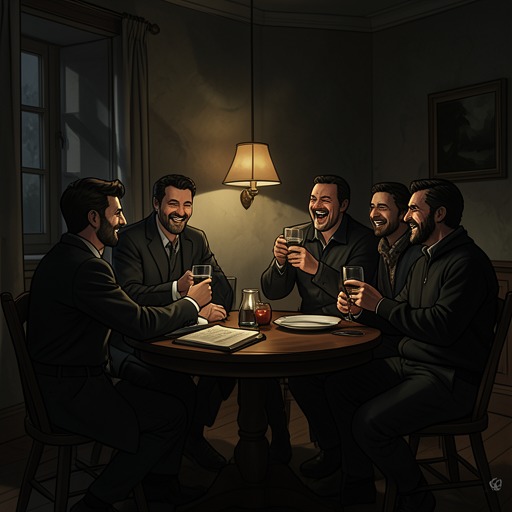
McMurphy and Turkle obtain a bottle of cherry-colored cough syrup from the drug room. Its label lists alcohol and codeine, and McMurphy proposes cutting it with vodka. The men mix it with liquor and port wine in paper medicine cups, at first drinking in careful, silent doses as if taking prescribed medication. The familiar ritual of medicine is repurposed as contraband pleasure. When the lights in the Day room go out, the men drink together, and the cautious first cups give way to laughter and open celebration.
The party’s disorder produces comic encounters that the ward’s normal routines would exclude. One of the women wanders into the dorm and startles Colonel Matterson, who comes wheeling after her with a pillow mistaken for a horse. Sefelt escorts her to the latrine and tries to protect her privacy, only to find himself keeping the Colonel’s wheelchair from charging into the room. The woman helps Sefelt return the Colonel to bed, and the two then waltz down the hall to music nobody can hear. The scene briefly rearranges the patients’ roles: the men are not simply recipients of care or discipline but hosts, escorts, guards, and partners in a shared joke.
Pleasure, Solidarity, and the Escape Plan
The revelry gathers force in the patients’ laughter. Chief Bromden recalls the men and women rolling among the couches and chairs, laughing until they choke and cry. When one of the women mistakes the way to the latrine and enters the dorm, the Colonel’s sudden appearance becomes another comic interruption rather than a medical or disciplinary crisis. Even the ward’s vulnerable, confused patients are drawn into the night’s improvised social world, though the episode remains unpredictable and could easily have brought the staff’s intervention sooner.
As the night wears on, the group also has to reckon with morning. Billy and Candy ask Turkle to unlock the Seclusion Room, and the pair leave under flashlight beams. The remaining patients turn from celebration to the problem of cleaning up. Chief Bromden realizes that he is drunk, something he has not experienced since his time in the Army, and is astonished to be intoxicated with other patients and women in the middle of the institution’s strongest hold. He understands the night as something the patients themselves have made possible. For a moment, the Combine seems less than all-powerful—not because its machinery has vanished, but because its apparent inevitability has been interrupted by collective action.
Harding takes charge when McMurphy seems too drunk to manage the situation. He proposes tying Turkle up with strips of torn sheet, making it look as if McMurphy had taken Turkle’s keys, broken into the drug room, scattered medication, damaged the files, and escaped through the screen. The invented trail of mischief is meant to seem plausible enough to draw suspicion away from the others, protect Turkle’s job, and give McMurphy a chance to get away. Harding suggests that the women could drive him to Canada, Tijuana, or Nevada; he reasons that police do not pursue hospital escapees very aggressively because many return within days.
McMurphy calls the scheme absurd but recognizes Harding’s clear-headed effort to protect the group. He then asks why the other men should not leave with him. The question turns the escape plan into a test of the solidarity the party has created. The others do not take the offered route out that night. McMurphy, Candy, and the patients settle back into the ward, and the elaborate plan remains unexecuted. Their decision leaves the contrast unresolved: they have experienced freedom together, but have not yet found the courage or means to claim it beyond the ward.
Discovery and Significance
At six-thirty, when the black boys come to turn on the dorm lights, they find McMurphy and Candy together in bed. The discovery ends the night’s concealment and places the party’s consequences back in the hands of the institution. The escape plan has not protected McMurphy, and the celebration has not stopped the staff from resuming control at the appointed hour. Its ending is deliberately ordinary in its timing: the morning lights arrive according to the ward’s schedule, as if the night’s breach could simply be absorbed into routine.
Chief Bromden later reflects that the events following the party might have happened even if McMurphy had escaped. He reasons that Nurse Ratched would have learned what had taken place, that Billy would still have suffered the later crisis, and that McMurphy would have heard and returned. This retrospective thought complicates any simple claim that the party itself causes what follows. The night’s significance lies instead in what it makes visible: patients who have been organized, watched, and kept within institutional routines can still form a temporary community, take risks for one another, and discover that the ward’s authority is not absolute. The discovery at dawn closes the party, but it cannot undo the shared knowledge that, for a night, they made another kind of life inside the ward.