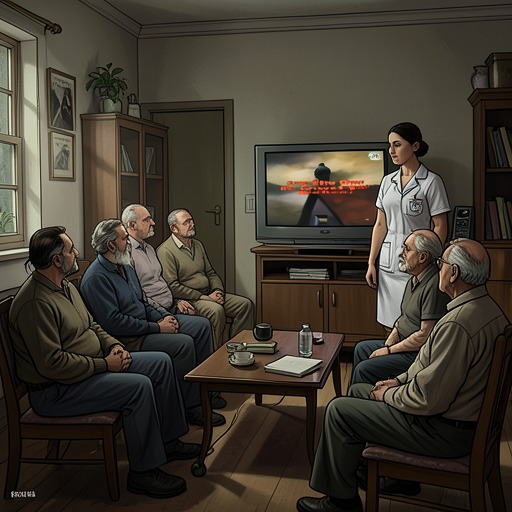
Mrs. Bibbit
One Flew Over the Cuckoo's NestMrs. Bibbit is Billy Bibbit’s mother and a receptionist in the hospital lobby. Chief Bromden presents her through Billy’s dependence on her and through a remembered afternoon when she treats her adult son like a child. That intimacy offers Billy affection, but it also leaves him vulnerable: when Nurse Ratched invokes Mrs. Bibbit’s likely reaction, Billy collapses into fear.
Identity and Place in the Hospital
Mrs. Bibbit works at the lobby desk, where Billy encounters her when the patients go to activities. Bromden describes her as a solid, well-packed woman whose hair changes from blond to blue to black and back to blond every few months. She is also, according to what Bromden has heard, a neighbor of Nurse Ratched and a dear personal friend. The account gives no access to Mrs. Bibbit’s private thoughts; her character emerges from the gestures Bromden witnesses and from the influence others attribute to her.
Her place in the hospital is both ordinary and unusually close to Billy’s daily life. When the men leave for activities, Billy is obliged to stop at her desk so she can dab a kiss on his cheek. The routine embarrasses the other patients as well as Billy, but nobody teases him about it. That restraint marks the affection as a familiar part of his life, while also showing how visibly it sets him apart from the other men.
Mother and Son
In a remembered scene, whose exact date Bromden cannot recall, the patients wait in the lobby and outside while a black boy uses the phone. Mrs. Bibbit leaves her desk, takes Billy by the hand, and leads him onto the grass, where she sits stiffly with her legs out in front of her. Billy lies beside her with his head in her lap, and she teases his ear with a piece of dandelion fluff. The scene makes their closeness physical and tender, but its arrangement also places Billy in a childlike posture, receiving attention while his mother guides the encounter.
Billy tells her that he hopes to find a wife and go to college someday. Mrs. Bibbit laughs at what she treats as foolishness and reassures him, “Sweetheart, you still have scads of time for things like that. Your whole life is ahead of you.” When Billy protests, “Mother, I'm th-th-thirty-one years old!”, she answers by asking whether she looks like the mother of a middle-aged man. She continues to tease his ear and makes a kissing sound. Her reply sidesteps his insistence on his age rather than engaging with the adult future he has described.
Bromden emphasizes the contrast between Billy’s actual age and the impression he gives. Billy can look like a child, yet stands as tall as the other men; he is thirty-one, not the boyish figure suggested by his face and manner. Bromden says he did not believe the age until he edged close enough to read the birth date on Billy’s wristband. Mrs. Bibbit’s playful refusal to regard him as middle-aged echoes that discrepancy, while Billy’s explicit correction shows that he knows it too.
Influence and Vulnerability
Mrs. Bibbit does not appear in the confrontation that makes her importance most consequential. After Nurse Ratched finds Billy with Candy, she turns from him to invoke his mother: “What worries me, Billy,” she says, “is how your poor mother is going to take this.” Ratched tells him that Mrs. Bibbit has been proud of his discretion, describes her as sensitive and liable to become ill when disturbed, and reminds him of her pride in her son. The appeal works immediately. Billy flinches, begs Ratched not to continue, and cries out when she insists, “Billy Billy Billy. Your mother and I are old friends.”
The force of that intervention depends on Mrs. Bibbit’s closeness to Billy and on Ratched’s claimed closeness to her. Ratched presents their friendship as a reason to trust her knowledge of Mrs. Bibbit, then makes Billy anticipate the shame and harm his conduct might bring his mother. The scene does not establish what Mrs. Bibbit herself would say or do; it shows Ratched using Billy’s attachment and his fear for his mother to control him. Her absence therefore does not make her irrelevant. The remembered affection in the lobby gives emotional weight to the threat made in the ward.
Narrative Role
Bromden’s recollection places Mrs. Bibbit within the story as Billy experiences her, but it also records how the other patients see their closeness: the public kiss embarrasses them, and the scene on the grass makes Billy’s dependence visible without prompting ridicule. His account holds together signs of tenderness and constraint rather than resolving them into a single judgment. Mrs. Bibbit is affectionate in the remembered scene, yet her dismissive response to Billy’s plans leaves his adult aspirations unanswered.
The contrast between those moments and Ratched’s use of her name reveals how a private family bond can become leverage inside the hospital. Mrs. Bibbit’s account of Billy’s life is not supplied independently, and her intentions cannot be established from Bromden’s observations. What the narrative does show is the consequence of the bond as Billy understands it: when Ratched invokes his mother’s judgment and vulnerability, he stops resisting her and folds into panic. Mrs. Bibbit thus matters not through direct action in the ward, but through the attachment that Ratched can summon in her absence.