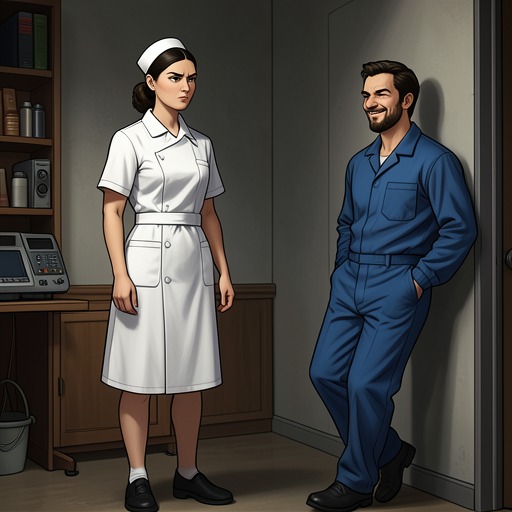
Nurses’ Station window
One Flew Over the Cuckoo's NestThe Nurses’ Station window is both a practical barrier and a recurring measure of the ward’s contested authority. Randle Patrick McMurphy breaks it to reach cigarettes, does so again after Nurse Ratched refuses a pass, and sees another replacement shattered by a basketball. Its repeated repair and destruction turn an ordinary pane of glass into a conspicuous boundary: transparent enough to make the cigarettes visible, but solid enough to obstruct access—and, repeatedly, to invite defiance.
First Break: A Barrier Made Visible
In the first scene, Randle Patrick McMurphy rises from his chair and crosses the Day room toward Nurse Ratched’s station with his thumbs hooked in his pockets. Chief Bromden watches him approach, describing his long, swaggering steps and iron heels striking the tile. Nurse Ratched appears not to expect him to act; as he comes near, her eyes widen, and she looks for the ward’s black aides. McMurphy stops at the window and says he figures he can use one of the cigarettes he bought that morning. Then he puts his hand through the glass.
The pane does not merely open a route to the cigarettes. It breaks apart, while Nurse Ratched throws her hands to her ears. McMurphy takes the carton bearing his name, removes a pack, and puts the carton back. He then turns toward the nurse, sitting rigidly, and carefully brushes glass from her hat and shoulders. His apology is pointedly courteous: “I'm sure sorry, ma'am,” he says, adding that the glass was so clean he “com-pletely forgot it was there.” The explanation makes the window’s transparency the joke: the pane is physically present, but he treats its apparent invisibility as an excuse for breaking it.
The gesture combines access with mock consideration. McMurphy takes only a pack from his own carton, but he has made his way through the barrier by force; afterward, he handles the shards on Nurse Ratched with tenderness. The scene ends quickly: he returns to his chair, lights a cigarette, and the ringing in Chief Bromden’s head stops. The shattered glass thus marks a brief release in the observer’s perception as well as a breach in the station’s physical enclosure.
Repair, Refusal, and Repetition
The window is replaced before the next confrontation. In the intervening days, McMurphy continues to make requests in impeccably polite terms, including asking for an unaccompanied leave. Nurse Ratched answers that she will take the request to the staff, then returns to say a pass is not considered therapeutic. His manners do not mean submission: he leaves the station and blows his whistle loudly, calling the patients back to practice. The contrast between formal politeness and disruptive action becomes part of the atmosphere surrounding the glass.
After a month on the ward, McMurphy requests an accompanied pass at a group meeting and writes that he will be accompanied by Candy Starr, whom he describes as a friend from Portland. The request is refused because Nurse Ratched does not consider Miss Starr wholesome company for a patient. On the same day workmen install a new pane in front of the nurse’s desk. McMurphy shrugs at the refusal, walks to the newly glazed window, and puts his fist through it again. Blood runs from his fingers as he claims he thought the cardboard had been left in place and the frame was open, asking when the glass was put there and calling it a menace.
This second break repeats the first while changing its cost. The earlier act gave McMurphy access to his cigarettes; now his hand is cut, and Nurse Ratched tapes it while he sits grimacing on a stool. Scanlon and Dale Harding retrieve the cardboard from the garbage and tape it back into the frame, using adhesive from the same roll the nurse uses to bandage McMurphy. The improvised repair and the treatment of his injured hand occupy the same small scene: the pane is patched, and the person who broke it is patched too. McMurphy winks at Scanlon and Dale Harding over the nurse’s head. Nurse Ratched’s face remains blank, but she pulls the adhesive tight enough to reveal strain in her otherwise remote patience.
The Ward Takes Up the Pattern
The struggle does not remain McMurphy’s alone. The pane in front of Nurse Ratched’s desk is replaced again and marked with a large white X, intended to make the glass impossible to overlook. Before the whitewash is dry, Scanlon accidentally sends the basketball through it. The ball punctures the window while the patients’ basketball season is already under way; in the gym, their team has lost to the aides by twenty points, and the narrative has emphasized the mechanical accuracy of the opposing players. At the station, however, the broken pane changes the immediate scene. Martini picks up the ball “like a dead bird” and carries it to the nurse, asking whether she can fix it with tape and make it well again. Nurse Ratched says nothing, jerks the ball from his hand, and stuffs it into the garbage.
The third break differs from McMurphy’s two deliberate acts: Scanlon’s is accidental. Yet its timing makes the repeated failure of the barrier hard to dismiss. The white X tries to correct the window’s earlier ambiguity by making it visible; the basketball goes through before that warning is even dry. The pane is therefore not simply an obstacle that one defiant patient can choose to attack. It is an object repeatedly restored, marked, and broken amid the ward’s wider activities, with each attempted repair exposed as temporary.
Material Object and Contest of Authority
The window’s importance lies in the sequence of concrete uses and failures rather than in any single symbolic meaning. It separates the patients from the station and the cigarettes kept there; McMurphy’s first breach makes that separation traversable. Its clean transparency supplies the language of his excuse, while its shards produce the nurse’s alarm and, in the later episode, cuts that require bandaging. Replacements and the conspicuous white X try to reassert the barrier, but another ball breaks through before the marking is complete.
The object also draws different responses into the same space. McMurphy turns breakage into a performance of mock apology and defiance; Nurse Ratched responds with rigid composure, then with visible strain as she tapes his hand. Dale Harding and Scanlon help restore the frame, while Scanlon later breaks the new pane by accident. Martini’s appeal to repair the punctured ball meets Nurse Ratched’s silent disposal of it. Across these moments, the window shifts from an apparently transparent fixture to a damaged, repeatedly handled thing whose material presence cannot be ignored. Its recurring destruction gives the ward’s challenge to Nurse Ratched a visible form, without making every breakage identical or every patient’s action deliberate.