Randle Patrick McMurphy
One Flew Over the Cuckoo's NestRandle Patrick McMurphy is a redheaded gambler whose boisterous humor turns resistance into a public, shared act in the ward. He challenges Nurse Ratched’s authority not only through wagers and defiance but by drawing other patients into choices they had been afraid to make; the same struggle ultimately leaves him subjected to repeated electroshock treatments and returned to the ward after a lobotomy.
Identity and Arrival
McMurphy introduces himself as R. P. McMurphy and announces himself as a gambling fool, punctuating the introduction with a fragment of a card-playing song. His entrance is marked by a joke about being washed repeatedly during transfers: after showers at the courthouse and jail, he says, he has begun to associate the sound of water with having to gather his belongings. He objects to being hurried through another routine before he has had a chance to look over his new home, the Institute of Psychology. Even on arrival, he treats institutional procedure as something to mock rather than quietly accept.
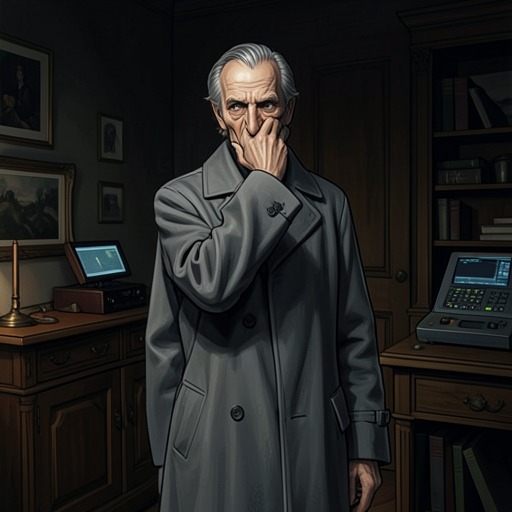
Chief Bromden remembers McMurphy’s voice as loud and full of force, reminiscent of Chief Bromden’s father, but distinguishes their appearances and kinds of strength. McMurphy is a broad white man, redheaded, with long sideburns and unruly curls protruding from beneath his cap. A seam across his nose and cheekbone still bears the stitches from a fight. His body is broad across the jaw, shoulders, and chest; his grin is broad, too. When the other men fail to welcome him, he laughs. Chief Bromden stresses that the laughter is not a response to anything funny: it is free and loud, unlike the constrained, socially managed laughter associated with the Public Relations man. The contrast makes McMurphy’s laughter an immediate challenge to the ward’s emotional discipline.
His confidence is physical as well as verbal. After studying Chief Bromden’s face, McMurphy reaches out his hand and insists that Chief Bromden shake it despite his apparent deafness. He frames refusal as an insult and styles himself the hospital’s new “bull goose loony,” turning the ward’s language of status into a boast. The gesture matters because McMurphy treats the supposedly unreachable, silent Chief Bromden as someone whose response is worth demanding.
Wagers and the Challenge to Authority
McMurphy soon turns the other patients’ description of Nurse Ratched into the basis for a wager. He asks how many are certain enough of her invincibility to put money on it. The bet gives the men a way to test their fear in terms McMurphy understands: not as an abstract debate about authority, but as a public commitment with a stake. His characteristic confidence makes opposition look possible, though it also risks making the other patients’ vulnerability seem less consequential than his own.
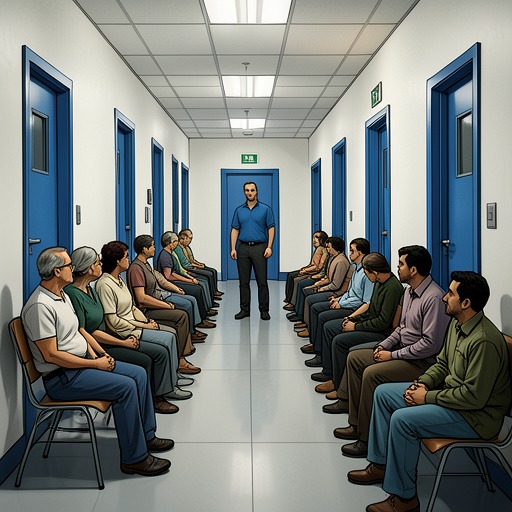
The stakes become visible when McMurphy’s bandaged hand appears in the vote over television. The bandage marks the injury he sustained trying to lift the hydrotherapy control panel. As Chief Bromden watches, McMurphy’s hand rises first, followed by the hands of the other Acutes. Eventually all twenty stand in opposition to Nurse Ratched, not merely over television but against the possibility of McMurphy’s transfer to the Disturbed Ward and against the years of being intimidated and beaten down. Chief Bromden imagines McMurphy’s hand reaching through the fog and pulling the others into view. The vote is announced as defeated despite this collective stand, and Nurse Ratched calls attention to McMurphy’s apparent agitation. The episode joins a concrete policy dispute to a larger change: the patients have acted together, even when the institution refuses to recognize their decision as effective.
McMurphy’s appetite for the ward is not simple at first. He compares its meals favorably with those at Pendleton Work Farm, where breakfast, lunch, and dinner seemed to consist of burnt food and potatoes. In the ward, he celebrates a breakfast of bacon, toast, butter, eggs, coffee, and a large glass of orange juice—the first such glass he says he has had in six months—and jokes that nobody could pay him to leave. The exuberance is comic, but the comparison also shows how readily he can treat confinement as a better bargain than the place he has left. His later recognition that the others may have used him makes that easy confidence harder to sustain.
Recognition and Unequal Risks
McMurphy’s certainty falters when he learns more about the patients’ circumstances. He says he has asked around and discovered why they defer to Nurse Ratched, as well as what they were using him for. Dale Harding explains that he is voluntary and not committed, so he has more to lose. When Harding confirms this under McMurphy’s scrutiny, McMurphy turns to the others and demands to know whether they have been deceiving him too. The exchange exposes a difference that the wager had obscured: McMurphy had been treating the patients’ opposition as a common contest, while their legal and personal risks are not the same.
The institution’s threat of transfer gives that difference practical force. Fredrickson warns that a patient who speaks against Nurse Ratched can be designated potentially assaultive and sent to the Disturbed Ward; he says this has happened to him three times. Patients there do not even leave for the Saturday afternoon movie and have no television. This account clarifies why defiance is not a cost-free game for the men McMurphy is rallying. After McMurphy realizes that the others’ stakes may exceed his own, his anger is not simply a reversal of allegiance: it is the shock of recognizing that he entered the contest without understanding what the others stood to lose.
Defiance, Humor, and Solidarity
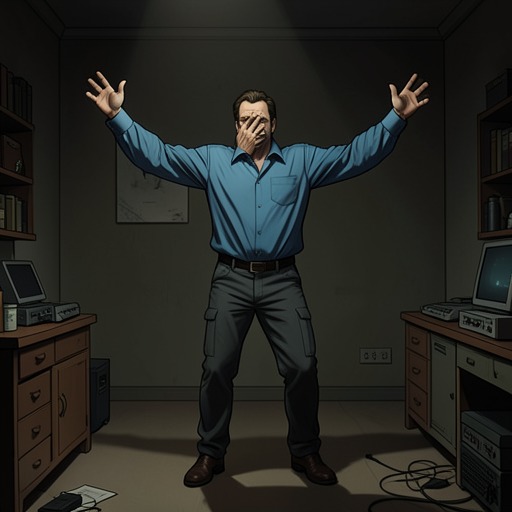
McMurphy continues to make resistance visible through his manner and actions. In the Day room, he rises with a sigh, stretches and yawns, scratches his nose, and walks toward Nurse Ratched with his thumbs hooked into his pockets and his boot heels striking the tile. Chief Bromden sees him as the swaggering gambler, logger, brawler, and cowboy of the television screen, strolling down the middle of the street to meet a dare. McMurphy breaks the Nurses’ Station window, takes a pack of cigarettes from the carton bearing his name, then gently brushes the glass from Nurse Ratched’s hat and shoulders. The sequence refuses a single register: the broken window is a direct breach of the ward’s order, while the careful gesture afterward is almost tender. His irreverence can be aggressive without becoming emotionally simple.
His bond with Chief Bromden takes the form of direct invitations and challenges. McMurphy wakes and notices an aide kneeling under Chief Bromden’s bed. Later, he asks Chief Bromden to join the fishing trip and offers a special bodybuilding course and a free ten-dollar trip if Chief Bromden can promise to lift the hydrotherapy control panel once he has regained his former size. The offer turns McMurphy’s belief in Chief Bromden’s strength into a wager and a practical goal. It also treats his size not as proof that he needs to remain passive but as capacity that might return through effort.
On the fishing excursion, the patients stand together in uneasy silence while townspeople slow their cars to stare at the men in green uniforms. The fine autumn weather does not dispel their embarrassment; some think it would be easy to return to the ward and concede that Nurse Ratched had been right. McMurphy tries jokes and teasing, but at first his efforts only deepen their discomfort. His response is not to pretend that the humiliation or pain is absent. Laughing across the water, he includes the patients, Chief Bromden, the girl, the captain, and the watching world in the reach of his laughter. Chief Bromden understands the laughter as a way to stay balanced: humor cannot erase hurt, but hurt need not blot humor out either. McMurphy’s defiance thus becomes more than swagger; it offers a means of facing pain without allowing it to define the whole experience.
Violence, Treatment, and Ending
That solidarity is tested in the shower room, where McMurphy is caught in a fight with an aide. The first blow catches him by surprise and nearly knocks him down; the men catch him and push him back toward his opponent. He takes another hit before accepting that the fight has begun, then catches the next swing by the wrist. The scene places his physical courage among the other patients rather than above them: they keep him from falling, and he responds within the violence rather than withdrawing from it.
Three weeks after the television vote, the patients are taken to Building One for chest X-rays. McMurphy listens to an explanation of electroshock and asks whether it means electricity is shot through a person’s skull. The question registers his dawning awareness of the institution’s procedures, which Chief Bromden interprets through the image of machinery being checked. Later, after McMurphy has been sent to the Disturbed Ward, he receives three more treatments in one week. As he begins to recover between them, Nurse Ratched and the doctor return to ask whether he is ready to face his problem and come back to the ward for a cure. McMurphy refuses to yield, answering with a mock-patriotic defiance that invokes giving his life for his country and tells her she will not make him surrender. The repeated treatments make the exchange a pattern: the institution renews its demand that he submit, and he answers each time while he can.
The final supplied image of McMurphy is a gurney wheeled through the ward door. Its chart identifies him as postoperative and records a lobotomy. The official label is stark beside the loud, laughing, gambling presence introduced at the ward’s entrance. The contrast gives the character’s arc its decisive force: the system that could not make his resistance disappear through argument or the patients’ defeated vote finally subjects his body to an operation that marks a profound change in his condition. His earlier gestures remain consequential, however. The raised hands, the invitation to Chief Bromden, and the laughter on the water have shown the patients acting together and seeing one another differently, even as the institution retains the power to punish their resistance.