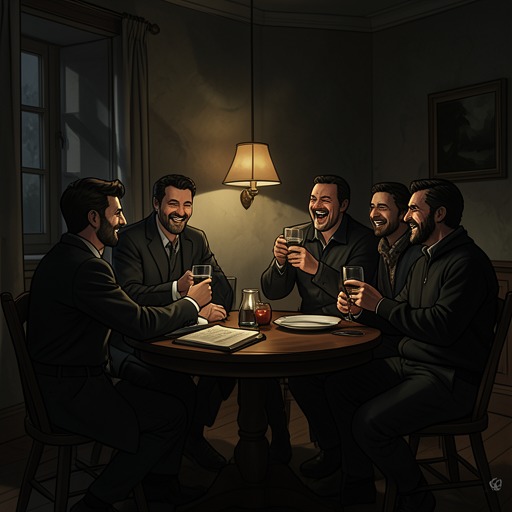
Ratched shames Billy after finding him with Candy
One Flew Over the Cuckoo's NestNurse Ratched’s shaming of Billy Bibbit after finding him with Candy turns a discovery in the Seclusion Room into a test of authority: when the ward’s laughter makes public humiliation ineffective, she uses Billy’s fear for his mother to break his composure. Recounted by Chief Bromden amid the patients’ watching and laughter, the confrontation exposes the leverage beneath the nurse’s apparently calm control—and the vulnerability through which she can still exert it.
Discovery and Public Exposure
The scene begins with Nurse Ratched learning that Billy is missing. One of the black boys returns to the Nurses’ Station and tells her; she puts down the telephone and comes out demanding to know where he has gone. Her hair has slipped from beneath her cap, and she is sweating. Instead of an answer, she faces a chorus of laughter. The patients watch her search their faces, and her confident smile no longer commands the room.
She calls Washington and Warren to accompany her on a room check. As they unlock the laboratory, the Tub Room, and the doctor’s office, Scanlon whispers that Billy will be the object of a joke—and then realizes that someone else in the room will be, too. The aside makes the search feel less like routine supervision than a shared anticipation among patients who know what discovery may mean for Nurse Ratched’s standing as well as for Billy.
At the Seclusion Room, the patients crowd behind Nurse Ratched and the two black boys. The room has no windows; in the darkness, a squeak and a scuffle precede the nurse’s switching on the light. Billy and Candy are on a mattress on the floor, blinking up at the people gathered in the doorway. The exposure is immediately collective: the ward has followed the search to its conclusion, and Nurse Ratched must address Billy with an audience behind her.
Billy and Candy Before the Ward
Nurse Ratched tries to restore the encounter to a disciplinary register by calling Billy’s full name in a cold, stern voice. Billy does not get up or button his pajamas. Instead, he takes Candy’s hand, grins, and greets the nurse before introducing her. His unhurried gesture contrasts with the formal reprimand directed at him and with the crowding bodies at the door.
The narration presents Candy looking for her nylons beneath the mattress and between the mattress and the tile floor. She pauses to look up and smile at Nurse Ratched, checks whether her sweater is buttoned, and resumes searching. Chief Bromden guesses that the pair are still fairly drunk; the scene thus registers their slow, warm post-sleep manner without establishing it as certain fact. Their apparent ease stands against the nurse’s rigid pose and the ward’s attention.
Nurse Ratched responds by calling Candy cheap, low, and painted. Dale Harding supplies possible words for her, including courtesan, Jezebel, Salome, and dame, then pointedly presents the list as an effort to help. His intervention turns the nurse’s insult into an occasion for verbal mockery. Meanwhile Billy concentrates on standing: he rolls to his knees, pushes up onto his hands, finds his feet, and straightens. The patients cheer and tease, but he appears pleased with having got upright and seemingly unaware of their taunts. The moment gives the scene a contrast between the crowd’s performance and Billy’s absorbed, physical effort.
The Mother as Leverage
The laughter and talk gather around Nurse Ratched. She looks from Billy and Candy to the patients behind her; her composed, enamel-and-plastic appearance seems to cave in. She shuts her eyes and strains to steady herself. When she opens them, her gaze is small and still. The narration marks this as a reversal: she recognizes that she is backed against the wall, and changes tactics rather than continuing to trade insults with the group.
She tells Billy that what worries her is how his mother will take the discovery. Billy flinches and puts a hand to his cheek as if burned. Nurse Ratched elaborates that Mrs. Bibbit has been proud of his discretion, is sensitive about her son, and may become ill if disturbed. She also reminds him that she and his mother are old friends. The threat is not merely that the incident will be reported: it is framed as an injury to a vulnerable mother, with Nurse Ratched placing herself between Billy and the person whose judgment he fears.
Billy’s speech breaks into stammers and repeated pleas. He shakes his head, begs Nurse Ratched not to tell, and cries out no. The patients stop laughing and watch as he folds toward the floor, rubbing his green pant leg and shaking like a child anticipating punishment. When Nurse Ratched touches his shoulder in an apparent gesture of comfort, the touch shakes him like a blow. Her outwardly consoling manner therefore does not relieve his fear; in the moment, contact intensifies it.
Reversal and Significance
Nurse Ratched presses the accusation even after Billy protests. She says she has to tell his mother and asks what else she can think, given that she found him alone on a mattress with a woman she has just disparaged. Billy denies that he brought Candy there and says that she did. The exchange leaves his claim at odds with the nurse’s assertion that Candy could not have forced him, while her stated concern for his mother keeps the confrontation focused on his anticipated shame rather than on a neutral account of what happened.
The scene’s balance of power shifts twice. At first, Nurse Ratched directs the search and publicly names Billy; once the patients gather and laugh, her customary confidence falters. She regains influence not by silencing the group but by isolating Billy through his fear of Mrs. Bibbit. His pleas replace his earlier grin, and collective laughter gives way to observation. The confrontation thus shows both the force and the limit of the ward’s solidarity: it can deprive Nurse Ratched of her easy command in front of the patients, but it cannot prevent her from reaching Billy through a private vulnerability made public.