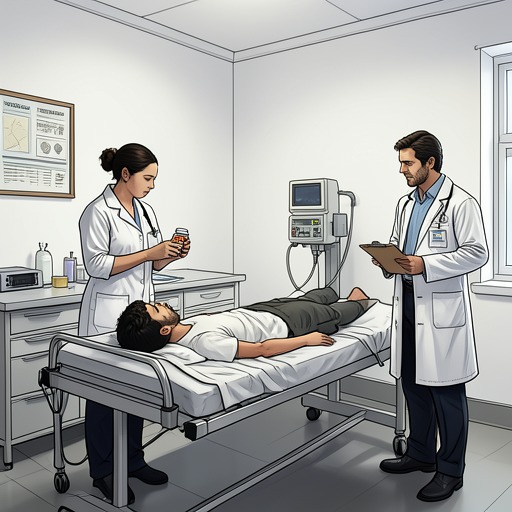
Taber refuses medication, is forcibly injected, and is sent for treatment
One Flew Over the Cuckoo's NestMaxwell Taber’s refusal to swallow unidentified medication becomes an early, concrete demonstration of how the ward converts a patient’s question into grounds for coercion. In Chief Bromden’s account, Taber’s demand to know what is being put into his body is met not with an explanation but with a sequence of escalating controls: Nurse Ratched frames his resistance as hostility, attendants forcibly restrain him, and he is sent on for treatment whose scope soon extends beyond the disputed capsules.
The Medication Dispute
At eight o’clock, medication is distributed through an orderly routine: patients file past the nurses, receive capsules in paper cups, and wash them down with water. Against this practiced flow, Taber asks what the two small red capsules are, distinguishing them from the vitamin with which they have been given. He is an Acute already acquiring a reputation as a troublemaker, but his stated objection is specific: he does not want to swallow something without knowing what it is, because he fears it might alter him.
The nurse attending the line urges him to take the capsules and tries to soften the instruction with a flirtatious manner, glancing toward Nurse Ratched to see whether the tactic is approved. Taber still refuses. Nurse Ratched then takes hold of his arm, and the grip leaves him unable to move it freely up to the shoulder. Rather than answer his question, she characterizes his conduct as childish and hostile, presents the ward’s prior kindness as having been rejected, and tells him he may leave if he will not take the medication orally. His protest is cut short by the repeated instruction to go. The exchange turns an ordinary request for information into an institutional choice between compliance and removal from the medication line.
Forced Restraint and Transfer
The confrontation does not end at the medication line. Two of the ward’s black aides catch Maxwell Taber in the latrine and drag him to the mattress room; he manages to kick one in the shins, but Bromden sees how helpless he looks once the men have hold of him. They push him face down onto a mattress, one sitting on his head while the other tears open the back of his trousers. Taber curses into the mattress as the aide restrains him, and a nurse arrives with a long needle smeared with Vaseline. She shuts the door while the injection is given, then emerges wiping the needle on a shred of his torn clothing. Bromden glimpses an aide dabbing Taber with a Kleenex before they carry him, wrapped in a damp sheet, across the hall to the laboratory.
The sequence makes the ward’s coercion physical and procedural. Taber’s question about the capsules has become a struggle in which his body is pinned, exposed, injected, and moved without his consent. The attendants’ control is reinforced by the brief closing of the door: the treatment is hidden for a moment, but Bromden’s partial view records enough to show that the earlier demand for oral compliance has given way to force.
After a period in the laboratory, Taber is wheeled out on a gurney. A technician tells Nurse Ratched that Taber began to come around during a spinal tap, so they had to give him another shot. The technician proposes taking him to Building One for electroshock treatment rather than waste the additional Seconal; Nurse Ratched approves the suggestion and proposes checking his head with an electroencephalograph afterward, where they might find a reason for further brain treatment. These are presented as proposed next steps, not as procedures the account confirms were carried out. The uncertainty itself is significant: Taber’s original refusal is followed by invasive treatment and then by plans for additional interventions, with no explanation to him recorded.
Bromden watches the technicians hurry away with Taber on the gurney, likening their movement to puppets in a mechanical performance. That image links the episode’s forced medication to the ward’s wider machinery: the patient is handled as an object within a sequence of routines, while decisions about his body pass between staff. The incident establishes how readily a demand for information can be recast as misconduct and how the language of treatment can accompany escalating restraint.
The Ward’s Treatment Regime
Taber’s ordeal belongs to a larger system in which refusal can expose a patient to further control. Dale Harding warns Randle Patrick McMurphy that a patient who tells Nurse Ratched to go to hell may be labeled potentially assaultive and sent to the Disturbed Ward. Harding has experienced that transfer three times; patients there do not even leave the ward for the Saturday movie and have no television. His account makes the threat behind Nurse Ratched’s response to Taber legible: resistance is not treated as a request to be answered, but can be converted into a reason to restrict a patient further.
The novel later renders the feared treatment process visible. Three weeks after the patients’ television vote, Chief Bromden recalls being taken with the others to Building One for chest X-rays. Beside the marked X-ray and EENT doors is an unmarked metal door; from inside comes a patient’s scream, and a person wheeled out after treatment is still smoking. A patient on the bench stiffens his heels against the floor as attendants pull him toward the room. Randle Patrick McMurphy asks whether electricity is being sent through a person’s skull. The scene does not establish that Taber received electroshock, which staff had only proposed for him, but it shows why the proposed escalation carries such weight in the ward.
Taber’s episode thus foreshadows a treatment system whose procedures extend well beyond the original dispute over medication. Later, when Randle Patrick McMurphy is repeatedly offered the chance to return to the ward and accept a cure, he refuses, and Nurse Ratched authorizes another electroshock treatment. That later sequence is distinct from Taber’s case, but it sharpens the contrast the earlier scene establishes: staff present intervention as treatment, while patients experience the decisions as coercive and the prospect of refusal as costly. Taber’s fate after the technicians take him away is not reported here; the account leaves the proposed further procedures unresolved.
Narrative Perspective and Unresolved Outcome
Bromden’s account keeps the limits of what can be known in view. Taber’s own question supplies the clearest evidence of his concern, while the narration follows what can be seen: the hold on his arm, the struggle in the mattress room, the needle, and the gurney. The staff, by contrast, get to name his conduct and discuss his treatment. That imbalance makes the episode’s uncertainty part of its force: the record offers no answer to Taber’s original question about the capsules, and no report of what became of him after the technicians carried him away.