The Democratic Therapeutic Community
One Flew Over the Cuckoo's NestThe Democratic Therapeutic Community is the ward’s declared method of turning group discussion, shared responsibility, and patient votes into treatment. Its decisive significance lies in the contrast between that democratic promise and the power the staff retain: patients are encouraged to expose themselves to one another, but they do not control the terms of discussion, the consequences of disclosure, or even what counts as a successful vote. Through Chief Bromden’s account of the meetings, the model appears both as a therapeutic ideal and as a language that can disguise discipline as participation.
Stated Theory and Aims
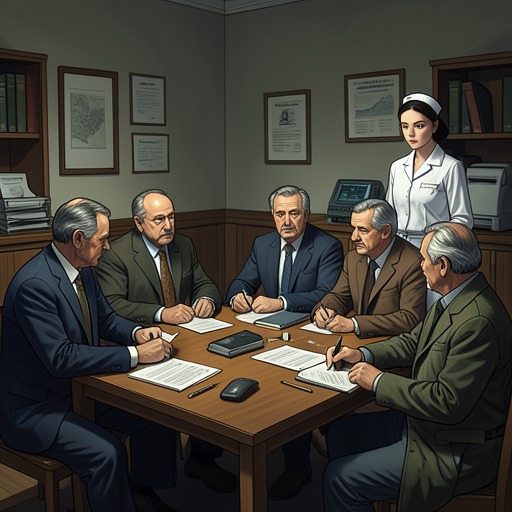
Dr. Spivey usually explains the theory when a new patient arrives, and this is one of the few occasions when he takes charge of a meeting. The group, he says, helps a person recognize where he is out of place and learn to function among others; the larger society determines who is considered sane, and patients must learn to measure up to its expectations. The ward is supposed to be democratic, run by patients and their votes, and to prepare them to return to the outside world as worthwhile citizens.
The stated method is to bring complaints and proposed changes before the group instead of letting resentment accumulate. Patients should feel comfortable discussing emotional problems in front of both staff and peers, and group discussion should help them examine themselves and one another. In the doctor’s account, openness serves both the individual and the community: a patient is not merely to receive treatment but to participate in helping others.
That principle extends beyond formal meetings. Patients are expected to enter everyday conversation into a logbook for staff review, including things a friend has said. The practice is presented as helping rather than informing, and as a way of bringing concealed faults into the open. Yet the requirement makes ordinary conversation potentially reportable and leaves little protected space between friendship and institutional observation. The promise that there should be no secrets among friends thus carries an administrative consequence: what patients disclose can also become information for staff.
Rules, Meetings, and Staff Authority
The theory operates alongside rules that shape how patients may participate. When Randle Patrick McMurphy gets up during a meeting, Nurse Ratched redirects attention to the rule that patients remain seated. Dr. Spivey explains that the requirement is necessary to maintain order. The episode places a procedural limit inside the democratic setting: patients may speak and deliberate, but their participation takes place within boundaries established by staff.
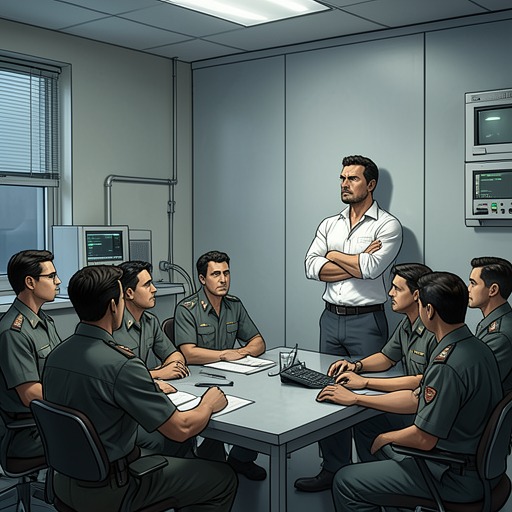
The meetings’ customary rhythm further complicates the ideal. At two o’clock, after a discussion has run on, Dr. Spivey becomes visibly uncomfortable; Nurse Ratched checks her watch and instructs the patients to return the tables from the tub room, with the discussion to resume the next day. The group is not simply self-governing: the staff control the schedule and can suspend the conversation.
Nurse Ratched also has the authority to direct what happens when discussion stalls. On one occasion, after Dr. Spivey has given his explanation, she invites the Acutes to reveal their secrets and waits in silence for twenty minutes, watching them. When nobody speaks, she turns to the logbook and presses the question of whether anyone has committed an undisclosed act. The demand for voluntary openness has become a managed silence in which patients are watched until the staff decide how to proceed.
Group Disclosure and Peer Pressure
Chief Bromden’s account of Dale Harding’s meeting shows how discussion can become collective prosecution. For forty-five minutes the group questions Harding about his marriage, his suspicions, and why he cannot satisfy his wife. The questions are framed as efforts to make him answer honestly and get well, but the patients take turns pressing and insinuating until the session has treated him like a criminal before a jury.
At two o’clock, the Acutes emerge from their trance and briefly look toward Harding. Their faces show shame as they recognize that they have been maneuvered into grilling a friend. They avoid him afterward, finding tasks elsewhere rather than approaching him. The result is not simply the exposure of a personal difficulty: the method leaves the person under examination isolated, while those who helped conduct the examination feel implicated and withdraw.
Randle Patrick McMurphy notices both the silence around him and the lack of laughter, and initially waits to understand the ward before acting. Later, when the group’s treatment of Harding ends, he watches the patients drift away and then approaches Harding, who is left alone and sweating in his chair. These moments set the community’s stated purpose of mutual help against the social pressure of a group that can be recruited to enforce conformity. Participation does not guarantee solidarity; under staff direction, it can make patients instruments of one another’s humiliation.
Voting and the Limits of Ward Democracy
The voting rule makes the gap between democratic language and practical control especially visible. When Randle Patrick McMurphy tries to change the ward’s television policy, twenty patients vote in favor, and he initially treats their support as a decision. Nurse Ratched points out that the ward has forty patients and only twenty have voted. Because a majority of the whole ward is required to change policy, she declares the motion defeated and the vote closed.
The outcome follows the stated threshold, but it also shows how procedure can defeat the apparent will of those who participate. The patients have voted, yet the staff retain the authority to interpret whether the vote is sufficient and to end the matter. When Randle Patrick McMurphy protests that the group has been treated unfairly, Nurse Ratched describes him as upset and asks Dr. Spivey to note his condition. The argument over policy is thereby reframed as evidence about the protesting patient, and she proposes closing the meeting early.
The community’s democratic form therefore does not mean that patients possess decisive control. Their grievances may be heard, but a formal rule can render their participation ineffective; protest can be recast as a symptom; and staff authority remains in force when patients challenge the result. The novel does not present the vote as meaningless in itself. Rather, it shows how participation can be real but bounded, with the institution controlling the terms on which a collective choice becomes binding.
Coercion and the Meaning of Treatment
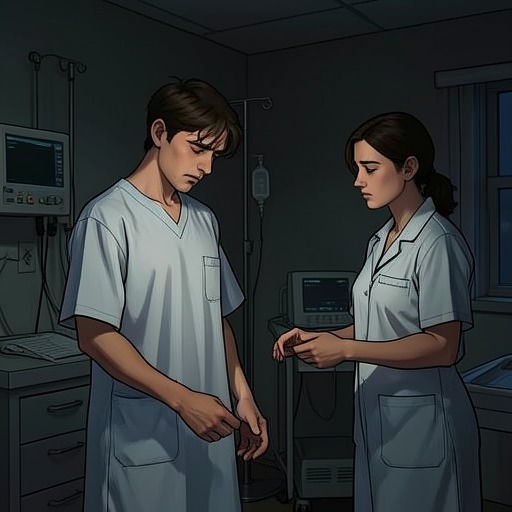
The surrounding ward practices make the community’s therapeutic language harder to separate from discipline. When Maxwell Taber questions medication, Nurse Ratched takes hold of his arm and tells him he may leave if he will not take it orally. Later, ward aides drag him to a mattress room, restrain him, and staff administer an injection before he is taken across the hall to the lab. The scene contrasts the invitation to discuss and disclose with the bodily force available when a patient refuses a treatment. It does not establish that the community’s meeting rules directly cause the injection; it does show that patient participation exists within a ward where staff can compel compliance.
The same imbalance appears in the threat of escalation. Fredrickson explains that patients who are labeled potentially assaultive may be sent to the Disturbed Ward, where they lose ordinary privileges, and that he has been sent there three times. Randle Patrick McMurphy learns that open defiance can lead onward to electroshock treatment or an operation. Later, while patients wait for chest X-rays, he sees the separate treatment door, hears a patient screaming, and watches another man resist being pulled inside. When he asks whether electricity is sent through a person’s skull, the exchange makes the ward’s treatment system, not the community’s rhetoric, the immediate subject.
Randle Patrick McMurphy eventually discovers why the patients have been cautious about Nurse Ratched. He recognizes that their silence and deference are connected to the risks he himself faces, and accuses them of having allowed him to challenge her without warning him that he might lengthen his stay. Dale Harding explains that he is voluntary, whereas Randle Patrick McMurphy is committed; only a few patients are committed. The distinction reveals how unequal the risks of dissent are. A voluntary patient may leave, while an involuntarily committed patient’s ability to challenge staff is constrained by the possibility of continued confinement and further treatment.
Consequences and Significance
The novel’s account does not reduce the Democratic Therapeutic Community to a single meeting rule. Its ideal of discussion and mutual assistance is repeatedly tested by the structures surrounding it: compulsory disclosure, staff-set limits, peer questioning, restrictive voting procedures, and treatment that patients cannot always refuse. The group is asked to help patients adjust to society, while the staff retain the power to define proper conduct and interpret resistance. In practice, democratic participation can become one of the means by which patients are monitored and regulated.
The later consequences sharpen that contradiction. After repeated electroshock treatments, Randle Patrick McMurphy continues to defy Nurse Ratched when she asks whether he is ready to return to the ward for a cure; he answers with a taunt, and another treatment is authorized. After his absence, he is returned to the day room on a gurney marked post-operative and lobotomy. These events are not simply procedures within a discussion-based community: they expose the force that stands behind its therapeutic vocabulary. The community’s central question is therefore not whether patients are permitted to speak or vote, but whether their speech and votes can alter decisions made by the institution. The ward’s repeated answer is that participation is encouraged, while control remains elsewhere.