The mental hospital patients' deep-sea fishing trip
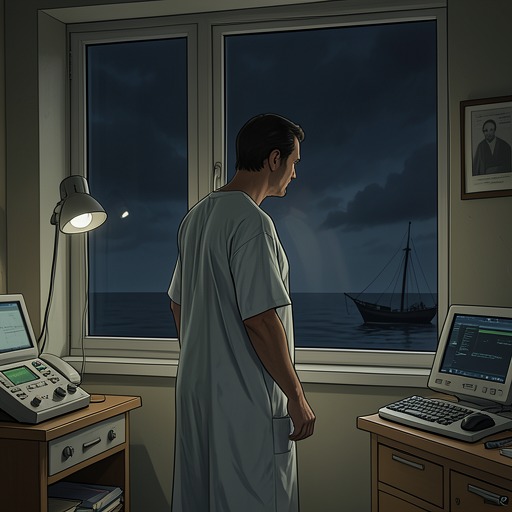
One Flew Over the Cuckoo's NestThe mental hospital patients' deep-sea fishing trip is a rare excursion beyond the ward and a practical test of whether its patients can act together outside the routines that confine them. Organized by Randle Patrick McMurphy, it begins under the shadow of institutional rules and public suspicion, but becomes an experience of collective competence, danger, and laughter. Chief Bromden recounts how the outing changes the patients’ view of themselves—and how their conduct changes the way strangers treat them.
The Ward and the Decision to Go
The excursion follows a period in which McMurphy has discovered that his place in the ward is more precarious than he had understood. Dale Harding explains that he is voluntary, while McMurphy is committed; few patients on the ward are committed, and McMurphy realizes that antagonizing Nurse Ratched could prolong his stay. He recognizes that the other patients had let him challenge her without warning him about the risk to his own freedom. The fishing trip therefore takes shape not as a simple continuation of his defiance, but after he has begun to weigh its cost.
The ward’s rules have already taught the patients to expect that apparent choice can be withdrawn. During an earlier vote, Nurse Ratched counts only twenty votes among forty patients and declares the proposal defeated for lack of a majority. When McMurphy protests, she calls attention to his agitation and asks Dr. Spivey to note it. Elsewhere, Maxwell Taber’s resistance to taking medication ends in physical restraint and an injection. These episodes give the excursion’s permission and logistics their stakes: getting out of the hospital requires more than wanting to leave it.
Chief Bromden remembers the prospect of the trip as so difficult to believe that he repeatedly checks the posted list. The plan is for two women coming down from Portland to take the patients deep-sea fishing. McMurphy’s name heads the signup sheet; Billy Bibbit is listed next, followed by Dale Harding and Fredrickson. Chief Bromden’s name appears at number nine, and the tenth place remains open. His name on the board makes an imagined departure concrete: he is not merely hearing about an outing but has been included in it.
Permission, Departure, and the Dispute at the Pier
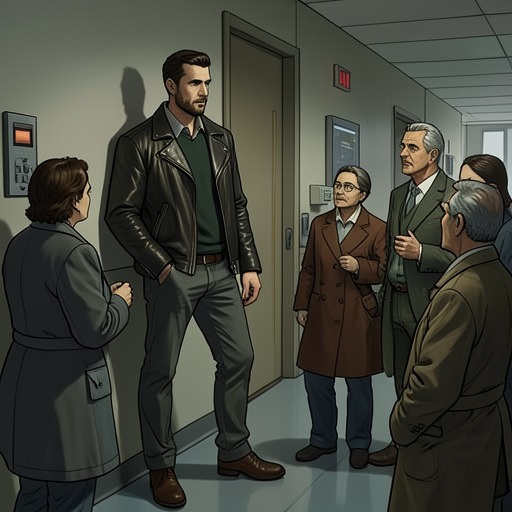
When Candy arrives, the patients gather around her, and Billy Bibbit is the first to react openly, with a whistle that makes her laugh. McMurphy introduces her to the group. Nurse Ratched immediately asks how ten patients will fit into one car. McMurphy asks to borrow a staff car and drive some of them himself, but she cites the requirement for another driver to sign a Responsibility Slip. Without one, part of the group must stay behind, and McMurphy says he will have to repay the excluded patients. When Nurse Ratched suggests canceling the trip and refunding the money, he answers that he has already rented the boat and paid a deposit.
Dr. Spivey eventually drives, and the patients divide between his car and McMurphy’s. At a gas station roughly a mile from the hospital, the service-station attendant recognizes their uniforms and becomes uneasy. The doctor nervously pays for both cars’ fuel, while the attendant keeps his distance. The patients, already quiet at the sight of townspeople slowing to look at them, encounter suspicion before they reach the water. Their release from the ward does not mean that the outside world welcomes them as ordinary travelers.
At the pier, the boat’s captain refuses to leave without a signed waiver clearing him with the proper authorities. He argues that a group like this might go overboard and leave him liable. Men at the bait shop leer at Candy and make a degrading remark about her. McMurphy keeps arguing with the captain, while the rest of the party—including Dr. Spivey—feels ashamed that nobody intervenes against the men. The group’s earlier confidence has ebbed: out of the hospital, they are again exposed to other people’s judgments and unsure how to answer them.
McMurphy stops trying to persuade the captain and finds another way forward. He comes out of the bait shop announcing that the boat is ready, with gas, bait, and beer aboard. He assigns tasks: George Sorensen is to warm up the motor, Scanlon and Dale Harding are to untie a rope, and Candy is called back to the boat. The practical bustle reverses the stalemate at the pier. Rather than wait for the captain’s approval, McMurphy gets the group organized to depart.
Fishing, Danger, and Shared Laughter
George Sorensen drives toward a gathering of birds over the water and explains that cormorants feed on small candlefish, which in turn attract salmon. As the boat reaches the feeding fish, the surface breaks into diving birds, churning minnows, and flashing silver-blue salmon. Chief Bromden feels a hard strike travel up his arms; his line burns from the reel, and he presses his thumb against it because he does not know how to use the star drag. The other rods bend too, and the passengers scramble around the deck, both helping and getting underfoot. The outing’s promise of recreation becomes sudden physical commotion, with fish and people pulling against one another.
The confusion grows around the boat. Scanlon fights a fish amid tangled lines, Dr. Spivey’s glasses-on-a-string dangle from one line, and George Sorensen takes his eye off the route long enough to run into a floating log and kill the engine. Candy struggles with her pole; Billy Bibbit tries to help her hold it, and the fishing scramble leaves her breast bruised and red. Chief Bromden is left with a bleeding thumb. McMurphy laughs at the whole disorder, but the laughter does not deny that anyone has been hurt. Bromden understands it as a way to keep pain and humiliation from taking over the experience, rather than pretending that pain is absent.
The laughter spreads beyond McMurphy. Dale Harding, Scanlon, Candy, Sefelt, and Dr. Spivey join in, and Chief Bromden finds himself both among the laughing group and, in his vision, above it, looking down at the boat and the widening circles of laughter across the water. The scene joins an intensely physical mishap to a change in perspective: the patients are no longer only people observed as objects of amusement. For a moment, they make the laughter themselves and share it with one another.
The Return and What the Trip Changes
The way back is dangerous. As the swells rise near the shore, George Sorensen makes everyone put on life jackets. There are three jackets too few, and Billy Bibbit, Dale Harding, and George Sorensen go without them; Billy also helps Candy into his jacket. At the bar, George Sorensen keeps the boat balanced between the wave ahead and the one behind, adjusting the throttle so the boat neither loses control over the crest nor takes the following wave over its stern. The passage is tense and requires steadiness rather than bravado. McMurphy watches, grinning, instead of insisting on a heroic role for himself.
Inside the harbor, George Sorensen drives toward the pier at speed and then reverses at the last moment, bringing the boat alongside the dock without tearing it apart. The captain and two police officers wait there, but the boat’s wake rocks the other vessels and spills over the dock before the patients can tie up. The confrontation does not end in a formal apology. Instead, after the group brings in its catch, the men who had watched them endure insults admire the large halibut and ask George Sorensen about his seamanship. They learn that he had run fishing boats and served as a PT boat captain in the Pacific, earning the Navy Cross. The men become polite to Candy, and everyone shares beer before the patients leave.
The change is visible to the group as well as to the onlookers: these are not the same patients who had stood silently while the men at the bait shop insulted them. Back at the hospital, Candy sleeps against Billy Bibbit, whose arm has gone numb from holding her. He tells her he would ask her on a date if he had a free weekend; she offers to visit in two weeks, and Billy looks to McMurphy for reassurance. McMurphy embraces them both and settles on a time. The trip thus carries a new connection back into the ward, while its larger result is collective: the patients have experienced danger, responsibility, competence, and pleasure beyond the identities imposed on them there.