The nighttime party on the ward
One Flew Over the Cuckoo's NestThe nighttime party on the ward is a planned breach of Nurse Ratched’s control that grows into a night of collective celebration, improvised disorder, and escape talk. Chief Bromden’s account makes the party more than a visit by two women: patients and an accommodating night attendant open parts of the institution to pleasure, laughter, and shared action, if only until morning.
Background and Arrangement
The party takes shape after McMurphy learns that his position on the ward is more precarious than he had understood. Unlike Dale Harding, who is voluntary, McMurphy is committed; Harding explains that only a few patients are committed, including McMurphy and Scanlon. McMurphy realizes that provoking Nurse Ratched could lengthen his stay, and that other patients had not warned him of the risk. This knowledge tempers his earlier challenge to her authority, but it does not end his resistance. The earlier television vote had already shown how ward procedure could defeat a majority of the patients who actually voted: Nurse Ratched counted the twenty votes against a total of forty patients and closed the vote. Against that background, the party’s practical, collective disobedience becomes a different kind of test of what the patients can do together. The plan depends on timing and access. At midnight, the departing staff leave and Turkle begins his shift. McMurphy and Billy are already awake, and McMurphy reminds Turkle of an arrangement discussed beforehand: Candy should enter through a window rather than risk being seen at the lobby, the Seclusion Room should be unlocked for the couple, and the dorm doors should stay closed so the other patients are not woken. Billy, stammering and apprehensive, repeatedly asks McMurphy to wait. The plan is designed as both an intimate occasion for Billy and Candy and a covert disturbance of the ward’s normal night.
The Guests Arrive
The ward is still waiting after two o’clock. To make the dark building easier to find, McMurphy and Turkle turn on lights throughout the halls, stopping short of waking the entire dorm. When tapping comes at the window, McMurphy looks out, grins, and brings Billy over. He urges Turkle to let the visitor in and offers Billy five dollars on the expectation that he will overcome his hesitation. Two women climb through: Candy, carrying bottles, and Sandy, who had not joined the fishing trip. Candy is unsteady with drink, and she explains that Sandy has left the husband she calls a maniac. Their entrance turns the ward’s quiet waiting into a gathering that no longer follows the institution’s ordinary boundaries. At first, the visitors and patients form an awkward cluster in the day room, talking and giggling because no one knows quite what to do. The spell breaks when a key rattles the ward door: the supervisor has returned to make rounds. Everyone hides in the latrine, extinguishes the light, and listens as she searches for Turkle. Harding opens the door a crack and deals with her; after she declines his offer and leaves the ward, the group rushes out to congratulate him. The near-discovery does not end the party. Instead, the patients resume their improvised celebration with the knowledge that the rules can be evaded, at least for a while, through cooperation.
Improvisation, Drink, and Laughter
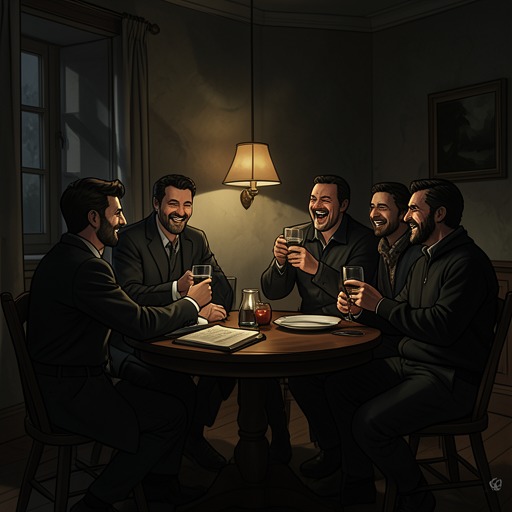
The party draws on whatever the ward can yield. Sefelt asks for something to mix with vodka, and Turkle says the supervisor alone has a key to the drug room. McMurphy persuades him to let the group try the lock with paper clips. While they work, the others explore the Nurses’ Station and look through patient files. Scanlon discovers that his folder contains even his first-grade report card; Billy and Candy examine his records together, and Candy questions the diagnoses listed there. The episode sets the patients’ private histories against the apparent completeness of the institution’s records, now opened and read by the people those records describe. McMurphy and Turkle get into the drug room and bring out a bottle of cherry-colored cough syrup. Its label lists alcohol and codeine along with inert ingredients. McMurphy tastes it, then suggests mixing it with vodka. The group combines the syrup with liquor and port wine in paper medicine cups and drinks in the darkened day room. At first, the patients take the cups in silence, watching one another to see whether the mixture will harm anyone; the quiet, almost ceremonial manner of drinking gives way to giggling and conversation. The same space governed by medication routines becomes, for the moment, a place where they choose what to drink and share it with guests. As the night loosens, laughter carries the revelry into the dorm. One of the women misses the latrine door and staggers into the dorm, where Colonel Matterson wheels out after her, exclaiming that the pillow is a horse. Sefelt escorts her and then has to keep the colonel from wheeling into the latrine. The woman helps Sefelt return him to bed, and the two then waltz down the hall to unheard music. The scene folds together the ward’s patients, visitors, and routines in an absurd, unexpectedly convivial spectacle; even Colonel Matterson’s repeated appearances become part of the night’s disorder rather than an interruption that restores normality.
Dawn, Escape, and Significance
Harding eventually turns the revelers’ attention to the danger of the morning. After asking for more to drink, a woman watches him scatter pills over Sefelt and her; Harding then delivers a mock funeral sermon in which he imagines Nurse Ratched lining the patients up and tranquilizing them out of existence. His melodramatic performance makes the group confront the consequences of what they are doing. Billy and Candy note that it is after four and ask Turkle to unlock the Seclusion Room. As the others begin considering how to clean the ward, Chief Bromden recognizes that he is drunk alongside the patients and the two women, in the center of what he regards as the Combine’s strongest domain. The importance of the night lies not only in the pleasure but in the fact that the patients have made this breach themselves; he wonders what might stop them from doing it again. Harding responds to the prospect of the staff’s return with an escape plan. The group would tie Turkle with strips of torn sheet, make it appear that McMurphy had taken his keys, broken into the drug room, scattered medicine, disturbed the files, and escaped through the screen. Harding argues that this would protect the other patients from blame, preserve Turkle’s job, and get McMurphy off the ward. He suggests that Candy and Sandy could drive him to Canada, Tiajuana, or Nevada, and says the police rarely pursue hospital runaways very hard. McMurphy calls the scheme a television plot, but praises Harding’s clear-headedness. He then asks why the rest of them should not get dressed and leave with him. The party thus ends not with an escape but with the possibility put plainly before the group: a night of temporary freedom raises the question of whether that freedom can become permanent. The account later records that, after McMurphy had been gone for three weeks, the ward door opened and the attendants wheeled in a gurney marked with his name and the word lobotomy. That later return gives the party’s escape discussion a grim frame, but it does not erase the night’s immediate change in the ward. For a few hours, the patients make their own arrangements, share the risks, and laugh together in a place organized to regulate their time and conduct. Chief Bromden’s account presents that brief collective freedom as evidence that the institution’s authority, though formidable, is not absolute.