The ward's fog-bound state
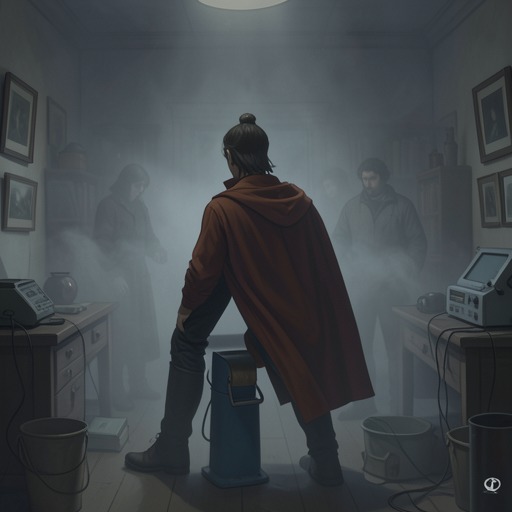
One Flew Over the Cuckoo's NestThe ward’s fog-bound state is a recurring condition in which the hospital’s fog machine fills the ward with obscurity, while Chief Bromden experiences that obscurity as a bodily and psychological enclosure. The fog can hide what is happening, but it does not offer reliable safety: Bromden cannot see through it, cannot escape those holding him, and cannot easily separate remembered experience from nightmare. Its fluctuations also alter the ward’s sense of time. In Bromden’s narration, the fog is at once an institutional effect and a figure for consciousness under pressure.
The Fog as an Instrument of Control
When the ward’s black aides catch Bromden after he flees the mop closet, they drag him back to the shaving room. As the machine starts again, the fog descends cold and white, thick enough that he cannot see six inches ahead. He imagines that he might hide inside it, but the aides still have hold of him. His attempt to keep quiet breaks into uncontrollable screaming, and the sound overwhelms his perception of everything else. Nurse Ratched rushes down the hall, pushing patients aside, and forces her wicker bag into his mouth with a mop handle. The scene makes the fog’s contradiction concrete: it appears to offer concealment, yet does not interrupt the ward’s physical power over him.
The threat is intensified by Bromden’s earlier attempt to retreat into memory. He tries to think of the village and a bird hunt with his father, but fear intrudes into the recollection; like the bird hiding in a cedar, he is pursued and eventually found. The transition from the remembered hunt to his capture and forced return to the shaving room links the fog to a larger experience of exposure. Hiding, whether in memory or in the machine’s whiteout, cannot guarantee escape from those who control the ward.
Obscurity, Time, and the Ward’s Routine
The fog is not equally dense at every appearance. Before a group meeting, it has not been turned up fully, and Bromden can still see if he strains. He anticipates that one day he may stop straining and lose himself in it, as some of the Chronics have. For now, however, his attention remains on the new arrival, Randle Patrick McMurphy, and the approaching meeting. When the fog dissolves completely, the ward’s staff clear the day-room floor and prepare for the patients to gather. The change from partial visibility to clear space marks a shift from isolated, obscured perception to a scene of collective activity.
Bromden describes the fog as one of the ward’s recurring alternatives to time control: when the fog takes over, time loses its meaning. On a day when neither mechanism has been imposed since shaving, the ordinary schedule becomes strikingly legible. The clock reads four-thirty when the swing shift arrives, and the routine proceeds in sequence. This contrast presents fog not simply as a visual condition but as part of the ward’s regulation of experience. When the fog is absent, time can be checked against the clock; when it envelops the ward, that ordinary measure disappears.
The ward’s fog also appears to change alongside McMurphy’s presence. Bromden notes that it has not been used at full force since the newcomer arrived, and imagines that McMurphy would protest if it were. The observation connects the machine’s operation to the ward’s shifting atmosphere without establishing that McMurphy controls it. His presence gives Bromden a reason to watch events rather than surrender to the obscurity, and the reduced fog coincides with a day in which ordinary time and activity become clearer.
Nightmare, Memory, and Uncertain Reality
At night, Bromden hears the fog machine’s cold, whistling breath and sees its first wisps seep from beneath McMurphy’s bed. In that moment he hopes McMurphy knows to hide. The fog opens onto Bromden’s vision of a subterranean machine room, where workers seem to process people as parts of a vast mechanism. As the fog grows thicker, he no longer has to watch what is happening. He expects to be pulled out of it and returned to the ward, where there will be no sign of the events he has seen; if he tries to tell anyone, he anticipates that they will call it a nightmare.
Turkle does in fact find him and treats the episode as a bad dream, telling him to return to sleep. Bromden’s account does not settle the vision into either objective fact or mere fantasy. Instead, the fog is the medium through which the experience becomes visible and the condition that makes it hard to verify. Bromden explicitly acknowledges the difficulty of thinking clearly about what he has endured and anticipates that his account may sound like ranting. His insistence that the truth can persist even when events did not happen as narrated preserves the distinction between literal occurrence and the truth of his terror.
Narrative and Thematic Significance
The fog’s changing density shapes what Bromden can perceive and when he can bear to perceive it. In the shaving-room scene, it blocks sight but cannot block the aides’ grip or Nurse Ratched’s intervention. In the machine-room vision, it eventually screens him from sights too horrible to watch. Elsewhere, its disappearance restores the visible schedule of the ward. These reversals prevent the fog from functioning as a simple refuge: it can conceal, disorient, and temporarily shelter, but it also leaves Bromden vulnerable to the institution’s routines and to the uncertainty of his own memories.
Because the account is filtered through Bromden’s frightened, sensory experience, the fog joins physical machinery to subjective disturbance without making them identical. The machine is present in the ward, while the way its effects spread into memory and vision belongs to the novel’s rendering of Bromden’s consciousness. The recurring condition therefore gives form to both institutional pressure and the difficulty of bearing witness to it. As the fog thickens, visibility and certainty recede; when it clears, the ward’s procedures and the passage of time return to view.