Ward cigarette rationing policy
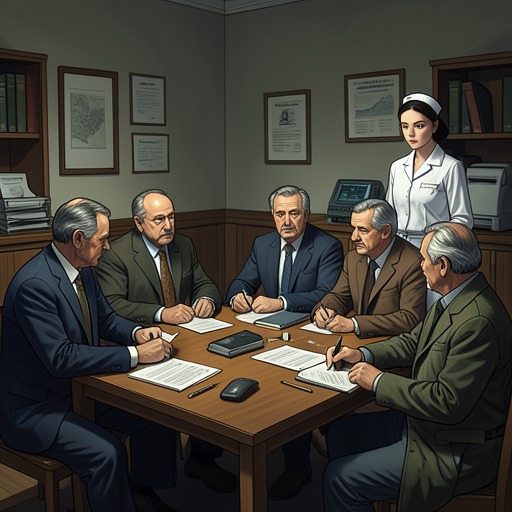
One Flew Over the Cuckoo's NestWard cigarette rationing policy gives Nurse Ratched control over the patients’ purchased cigarette cartons and limits each man to one pack a day. Its importance lies in how an ordinary necessity becomes a tool of ward administration: the rule is justified as protection of the men’s health, while also restricting the cigarettes they can wager, exchange, or lose to Randle Patrick McMurphy.
Definition and Operation
The policy does not prohibit smoking or deprive the men of the cartons they bought at the canteen. Instead, Nurse Ratched has those cartons impounded at the Nurses' Station and dispenses one pack to each patient daily. This arrangement makes access dependent on her administration rather than on each man’s possession of his own supply. The cigarettes remain theirs in name, but the desk becomes the point at which their use is measured and controlled.
Nurse Ratched presents the restriction as a health decision. She tells Dr. Spivey that some men had been smoking three, four, and sometimes five packs a day during the week after McMurphy arrived, and says that this excess prompted her to limit distribution. The account she gives is therefore specific and plausible as a rationale for moderation. Yet the ward’s understanding of the immediate context is different: patients know the rule also stops them from wagering their cigarettes to McMurphy at cards.
The Gambling Dispute
The restriction follows a breakdown in McMurphy’s relations with the other Acute patients over their refusal to vote with him. After the vote, he argued with them about why they had not supported him, then won heavily from them at poker and blackjack. They became so deeply in debt that they were afraid to play for money, and the new cigarette rule removed the alternative of gambling for tobacco. The result was a conspicuous quiet in the tub room: no money games, no cigarette games, and no easy way for McMurphy to draw the group back into play.
Nurse Ratched’s control of the cartons thus intervenes in more than smoking. Cigarettes had served as stakes in the men’s games, and the games had become one of McMurphy’s ways of engaging the ward. The policy restricts that exchange at the point of supply. The narrator understands its practical purpose to be preventing McMurphy from winning the men’s cigarettes, even as Nurse Ratched describes it as a response to excessive consumption.
The matter becomes an open dispute at a staff meeting. Cheswick raises the question of cigarettes after Nurse Ratched has suggested that a change in ward policy might be considered, and the other Acutes join his complaint. McMurphy directs the question to Dr. Spivey before Nurse Ratched can answer, asking how she has the right to keep the cartons on her desk and release only a pack at a time. Dr. Spivey’s surprise indicates that he had not known she had taken over the extra cigarettes to stop the gambling. Her explanation then makes the health rationale explicit, but does not erase the conflict over who decides how the men may use what they bought.
Enforcement and Unequal Authority
The cigarette dispute takes place within a ward where questioning Nurse Ratched can carry consequences beyond the immediate disagreement. Fredrickson tells McMurphy that hostile conduct may lead to a patient being classified as potentially assaultive and transferred to the Disturbed Ward; continued hostility may also result in a trip to the Shock Shop or an operation. This warning helps explain why resistance is risky even when the object of protest is as ordinary as a carton of cigarettes. The rule is backed not only by control over the supply but by a wider disciplinary structure.
A separate dispute over ward policy shows how procedural language can also close off a challenge. When only twenty of the forty patients vote on the television question, Nurse Ratched declares the vote defeated because a majority is required to change policy, then asks Dr. Spivey to note that McMurphy seems upset. That vote concerns television, not cigarette distribution, but it clarifies the limits of ward participation: the men may raise objections, while the rules governing whether their objections count remain in staff hands.
McMurphy later explains that he has learned the other men were using him to challenge Nurse Ratched without warning him how much he risked. Once he discovers that antagonizing her could extend his stay, he says he must protect his own interests. Harding then clarifies that McMurphy is among the few patients who are committed, unlike the voluntary patients. These revelations expose the uneven stakes behind protest: a cigarette dispute may be shared by the ward, but the consequences of continuing the confrontation are not equal for everyone.
Daily Consequences and Significance
The personal cost of the ration is visible in a visit from Vera Harding. When she asks Dale Harding for a cigarette, he finds his pocket empty and explains that the men are limited to one pack a day. He folds his shoulders forward while holding a half-smoked cigarette, treating even this small shortage as an embarrassment that narrows his ability to offer her one. The moment gives the rule a domestic consequence: its reach extends beyond the card table and into an intimate exchange between husband and wife.
The policy also shows how administrative care and discipline can operate through the same measure. Nurse Ratched invokes health, while patients experience the loss of control over their own supply and the interruption of their games. Neither account makes the other disappear. By keeping the cartons at the Nurses' Station, the ward turns cigarettes into a rationed privilege and weakens one of the social channels through which McMurphy had gathered the men around him. What looks like a modest limit on consumption therefore becomes part of the larger struggle over who controls daily life, collective activity, and the terms on which patients may resist.