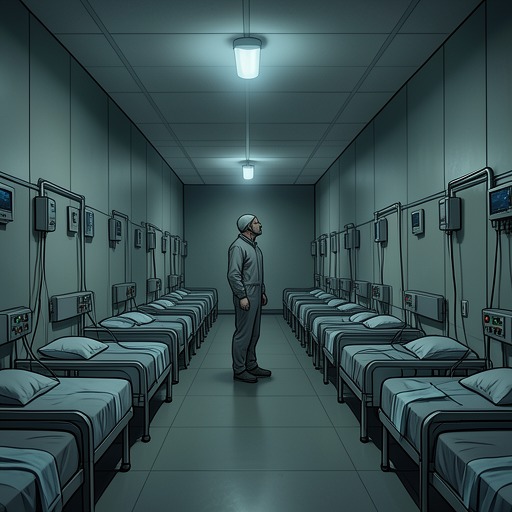
Ward logbook
One Flew Over the Cuckoo's NestThe Ward logbook is the ward’s written record of patients’ disclosures, a tool that converts conversation into institutional evidence. Its therapeutic language promises openness and mutual help; in practice, it makes private remarks available for scrutiny, discipline, and public pressure. The book’s power lies not only in what it records, but in the rules surrounding who is expected to contribute and who can use what has been written.
Recording and Rewarding Disclosure
Patients are encouraged to watch one another for revealing remarks. When a man says something personal, another patient may quietly leave the table, go to the logbook near the Nurses’ Station, and record what he heard. Nurse Ratched presents the practice as gathering information of therapeutic interest to the ward. Chief Bromden, however, understands it as a means of accumulating evidence that could lead to a patient being sent to the Main Building for reconditioning.
The reporting system offers a concrete inducement: the patient who writes down a disclosure receives a star beside his name on the roll and permission to sleep late the following day. The logbook therefore organizes more than recordkeeping. It gives patients a small privilege in exchange for helping the staff monitor their peers, making surveillance part of the ward’s everyday social relations.
A Democratic Ideal and Its Contradiction
The ward’s account of the Therapeutic Community gives disclosure a benevolent rationale. Patients are told to raise grievances in group discussion, speak freely about emotional problems, and record what they hear in ordinary conversation. Reporting is described as helping a fellow patient rather than betraying him; secrets, in this model, obstruct recovery, while confession supposedly allows the group to help its members.
That ideal sits uneasily beside the consequences Chief Bromden associates with the logbook. A disclosure is not simply shared and discussed: it can be preserved, collected, and used by staff. The promise of a democratic community thus depends on an unequal arrangement. Patients are urged to expose themselves and each other, while Nurse Ratched retains authority over the record and over the ward’s response to what it contains.
Harding’s Remarks Read Back to Him
The logbook’s function becomes unmistakable when Nurse Ratched reads from its entries during a group meeting about Dale Harding. She recalls the discussion of his wife and cites remarks that patients have reportedly recorded, including his resentment of the attention his wife attracts and his fear that her body makes him feel inferior. She also reads a remark in which Harding characterizes his wife as illiterate and associates masculine strength with brutality.
The entries transform Harding’s words into a prepared case against him. Rather than letting him control the setting or context in which his thoughts are discussed, Nurse Ratched selects and recites them before the group, then asks whether anyone wants to continue the discussion. The book allows her to make observation appear collective: the information came from patients, but she determines when it is brought forward and how it frames the meeting.
Recordkeeping Within a Wider System of Control
The Ward logbook belongs to a ward where observation and scheduling work together. Nurse Ratched’s notes are described as material for a machine behind the steel door at the Nurses’ Station; dated Order Daily Cards are then inserted to set the day’s routine. The logbook and the cards are distinct instruments, but both belong to an administrative environment in which patients’ behavior is recorded and daily life is arranged in advance.
The book’s importance is therefore not that it operates the ward’s machinery, but that it makes patients’ own speech usable within a system of supervision. Its therapeutic vocabulary offers disclosure as fellowship, and its star rewards turn reporting into a minor privilege. When Nurse Ratched reads Harding’s recorded remarks aloud, that double function becomes visible: what the ward calls help can also leave a patient exposed to a discussion whose terms he does not control.