Ward recorded-music system
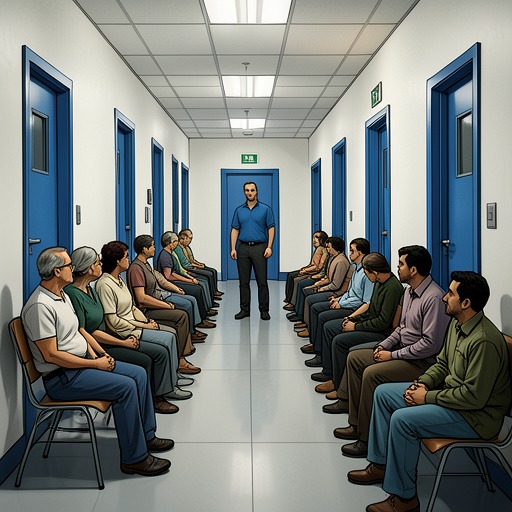
One Flew Over the Cuckoo's NestThe Ward recorded-music system is a ceiling-speaker network fed by a long tape from the Nurses' Station. It plays through most of the day, stopping during sleep, and has become so familiar to the patients that many no longer consciously hear it. Randle Patrick McMurphy, new to the ward, notices it immediately. His irritation exposes what the others have learned to ignore: the music is not an occasional accompaniment but a near-constant feature of institutional life, present even as patients play cards, talk, and move through their routines.
Placement and Operation
The music comes from speakers in the ceiling, but it is not transmitted on a radio beam. The distinction matters in the ward's imagined machinery: the walls' other mechanisms do not interfere with the tape's playback. The source is close at hand, in the Nurses' Station, and the recording is familiar enough to the patients that they know it by heart. Yet familiarity does not mean it has been turned off or that the patients have chosen it; the tape continues to play in the shared space except when they sleep.
Dale Harding explains that patients can hear the recording if they concentrate, much as a person can attend to a heartbeat, but that repetition has made it slide from awareness. He compares this habituation to the sound of a waterfall becoming unheard by people who live near one. The explanation gives the system two simultaneous qualities: it remains acoustically present, while becoming practically absent from the attention of those who have lived with it. McMurphy's arrival briefly breaks that accommodation, making the background audible again.
Harding also distinguishes the tape from news on the radio, which the ward regards as potentially nontherapeutic. The recording supplies sound without bringing the outside world's changing reports into the room. That contrast suggests an environment in which what patients hear is not simply whatever happens to be on the air: the ward provides a familiar, managed sound in place of unrestricted broadcast. The music's predictability is part of its operation, even though no patient is shown selecting it.
Habit and the Sound of the Falls
The waterfall comparison opens onto a very different sound for Chief Bromden. As Harding discusses the tape, Bromden remembers the falls on the Columbia River and the sounds associated with them: fish striking the water, children laughing on the bank, and women working at the racks. The recording and the remembered falls are both sounds that can become familiar through repetition, but they do not carry the same place or life. The tape belongs to the ward's enclosed daily environment; Bromden's memory reaches beyond it to a landscape and community from long ago.
That contrast keeps Harding's analogy from being merely an explanation of how hearing adapts. For Bromden, the natural sound of the falls remains vividly audible in memory, while the ward's music has become something the patients scarcely register. The episode sets managed repetition against remembered experience: one sound fills the ward day after day, while the other recalls a world that is no longer physically present to him. The speakers therefore function not only as a source of noise but as part of the ward's shared, enclosing atmosphere.
McMurphy Makes the Background Audible
McMurphy first encounters the recording while dealing blackjack for cigarettes beneath a ceiling speaker. He has pulled his cap forward, holds a cigarette between his teeth, and calls the game in a rapid, auctioneer-like patter. The music is loud enough to compete with the card table, and he complains that it has been playing since he arrived that morning. Harding's calm explanation that the patients seldom hear it only sharpens the difference between McMurphy's fresh attention and their habituation. Cheswick confirms that it runs throughout the waking day, though not during sleep.
McMurphy asks whether it plays all the time and responds by proposing to get the attendant to turn it off, adding a threat. Harding immediately warns him that such a statement could get him branded assaultive and reminds him of the wager. The exchange shows that irritation with the music cannot be separated from the ward's rules for conduct: even a complaint about the sound risks becoming evidence against the person making it. McMurphy's response is checked not by a change in the recording but by the consequences his words could bring.
When the next song begins, loud and clangy with accordion, McMurphy raises his patter to match it. The system continues uninterrupted; he does not silence the speaker. Instead, his voice becomes a competing sound, turning a private annoyance into a small public contest over what can be heard in the room. The moment is comic, but its terms are precise: the recording sets the acoustic conditions, and McMurphy answers by making his own presence harder to ignore.
Routine and Institutional Presence
The music's persistence places it among the ward's other repeated procedures, without making it identical to them. The daily order is organized through instructions prepared in advance and put into operation at the start of the day; the tape, by contrast, is described as a long recording played from the Nurses' Station. The evidence does not show that the music itself directs patients or that it is controlled by the same mechanism as the schedule. Its significance lies instead in its constant return within a life already shaped by routines: it accompanies the ward's shared hours until repetition reduces it to something patients scarcely notice.
McMurphy's complaint briefly restores the distinction between an imposed background and chosen silence. His attempt to challenge the music is constrained by the ward's disciplinary vocabulary, and his eventual answer is to talk louder rather than gain control of the speakers. The Ward recorded-music system thus makes institutional presence audible in an understated form. It does not need to interrupt every conversation to fill the space; it can remain overhead, familiar to the point of seeming absent, until a newcomer listens and makes the rest of the room confront what has been playing all along.