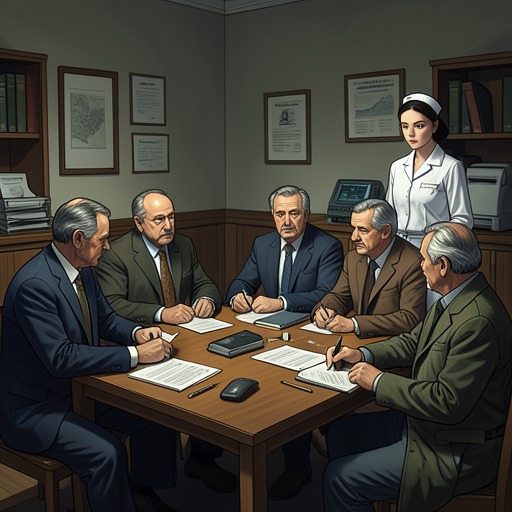
Ward television and chore schedule
One Flew Over the Cuckoo's NestThe Ward television and chore schedule governs more than when patients clean or watch baseball: it makes ordinary time a test of obedience, and gives Nurse Ratched a procedural means to deny a change even when patients appear to support it. Randle Patrick McMurphy’s attempt to rearrange chores around the World Series exposes the gap between voting as a ward ritual and voting as actual power. His later sit-in before a television with no picture makes that gap visible, while the patients’ continued gathering turns the schedule from an unquestioned routine into a shared point of resistance.
Routine as Institutional Control
Chief Bromden describes the ward’s daily order as if it were programmed in advance. Nurse Ratched’s notes are typed and fed into a machine behind the steel door at the Nurses’ Station; punched Order Daily Cards are inserted to set the day’s operations. Lights come on at six-thirty, Acutes are hurried out of bed and put to work, and the subsequent sequence includes shaving, meals, appointments, and medication. The description presents routine not as a neutral convenience but as a system that organizes patients’ movements and assigns them tasks.
The schedule sorts patients as well as activities. Acutes line up alphabetically at the mirrors to shave; walking Chronics wait until the Acutes are finished, and Wheelers are brought in afterward. Bromden’s account extends this order to patients who require more assistance: some are rolled from their beds after wetting them and hosed down by the ward’s black aides. This fixed sequence makes access, labor, and care depend on institutional categories, not on each patient’s choice about how to spend the day.
The timetable’s authority is reinforced by the ward’s wider discipline. Fredrickson explains that patients who are listed as potentially assaultive can be sent to the Disturbed Ward, where they lose privileges such as going to a Saturday movie or watching television. Continued hostility may also bring a trip to the Shock Shop. The threat helps explain why challenging a schedule is not simply a matter of persuading other patients: disagreement can be treated as evidence against the dissenter and met with punishment.
The World Series Proposal and Vote
With the World Series approaching, McMurphy has taken bets on the games and wants the patients to watch them, although the broadcasts fall outside the permitted television hours. At a group meeting, he proposes shifting housework to the evening and watching the games in the afternoon. Nurse Ratched refuses, defending the existing arrangement as delicately balanced and warning that changing the routine would throw it into turmoil. Her response casts the schedule as a necessary system rather than a rule open to negotiation.
McMurphy expects opposition from Nurse Ratched, but is surprised when the Acutes do not answer his appeal. He points out that at least twelve patients have a personal interest in the games. Scanlon hesitates, preferring the familiar six-o’clock news and repeating the concern that a change might disrupt the schedule. McMurphy then calls for a vote. Cheswick rises and voices his support, but McMurphy clarifies that patients must raise their hands; the gesture is meant to count as a formal expression of preference, not merely an outburst of enthusiasm.
The first count produces twenty raised hands. Nurse Ratched then points out that there are forty patients on the ward and that a majority is required to change policy. Because only half have voted, she declares the proposal defeated and closes the vote. The episode distinguishes a visible show of support from a decision with binding force: the patients have demonstrated that many want the change, but the rule makes nonparticipation count against them. The timetable remains in effect, and the meeting’s prescribed process prevents McMurphy’s proposal from becoming ward policy.
Work Hours, Television, and the Sit-In
The failed vote does not end the contest over how patients use the scheduled hours. When the afternoon housework period arrives, the baseball games are on television, and patients line up chairs in front of the set rather than clean until dinner. The Nurses’ Station power is shut off, leaving a blank gray screen, but the patients continue to gather. McMurphy fills the time with stories, including accounts of earning and losing money driving a truck and of a rodeo trick involving a blindfolded rider on a bull. His entertainment gives the group something to share even when the television cannot deliver the promised games.
In the immediate aftermath of the vote, McMurphy acts out the afternoon broadcast as though it were beginning. While he and other patients are doing chores, he announces that it must be game time, leaves his scouring rag, and moves an armchair in front of the set. He switches on the television, turns up its sound to drown out the music from the ceiling speaker, draws another chair close, and settles back with a cigarette. The gestures appropriate the space and the scheduled hour despite the absence of an image on the screen.
Nurse Ratched tells McMurphy that he is supposed to be working during those hours and warns him again when he ignores her. He does not answer by returning to the chores. Instead, he keeps watching the blank screen, while the other patients stop their work and watch from the corners of their eyes. His refusal changes the practical meaning of the afternoon schedule: the demand to work is still made, but the patients’ attention has shifted from their assigned tasks to a deliberate, collective spectacle of noncompliance.
Effects and Significance
The schedule gives institutional authority a daily, concrete form. It determines when work must be done and when television is permitted, while the majority requirement determines whether patients can alter those terms. The World Series dispute shows how procedural rules can preserve management’s decision even after a substantial group signals a different preference. Nurse Ratched’s emphasis on McMurphy’s apparent agitation further redirects attention from the disputed rule to the patient’s behavior: she asks that his condition be noted, framing protest as a problem of the protester.
For McMurphy, the contest also sharpens the stakes of challenging ward authority. He later says he has learned that the other patients had not told him how much risk he was taking by antagonizing Nurse Ratched, because he might add another year or more to his sentence. Harding clarifies that he is voluntary, while McMurphy is committed; only a few men on the ward are committed. That exchange concerns the broader danger of his position rather than the television rule alone, but it makes clear that a ward vote cannot determine whether he is free to leave. The policy’s procedural limits sit within a larger imbalance in which patients do not possess equal power over their treatment or confinement.
Bromden’s account of the schedule’s machinery and accelerated clock enlarges the conflict beyond one afternoon. He describes Nurse Ratched as able to turn a dial behind the steel door and make the clock race, forcing patients through repeated rounds of daily activity until she slows it again. In this account, the timetable is not merely a list of hours: it is part of a ward in which routine can be imposed, intensified, and enforced. McMurphy’s blank-screen sit-in does not abolish that structure, but it makes its demands newly perceptible and briefly gives the patients a common way to refuse them.