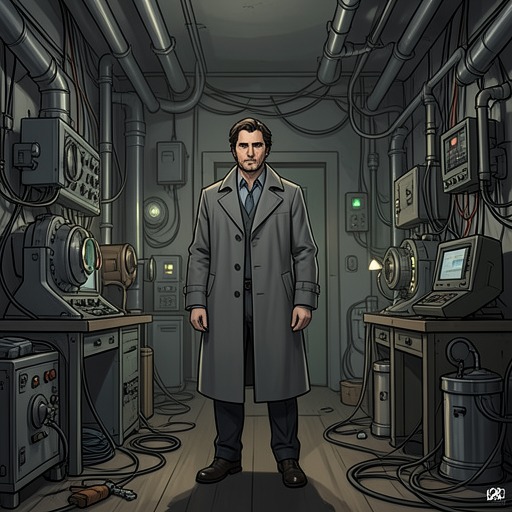
“Vegetables”
One Flew Over the Cuckoo's Nest“Vegetables” is Chief Bromden’s collective name for patients whose lives in the ward are shaped by profound dependence and institutional care. The term gathers them into a group rather than presenting individual histories, and the ward’s routines make that reduction concrete: their bodily needs trigger alarms and hands-on procedures, while the institution determines when and how they are cared for. Their final appearance beside McMurphy after his lobotomy gives the category a stark narrative weight without making the patients interchangeable with him.
The Category and Its Context
Chief Bromden’s label places the “Vegetables” among the ward’s Chronic status patients, set apart in practice from the Acutes, who are expected to get up and work through the morning schedule. The classification describes their place in the ward’s arrangement, but it does not supply individual diagnoses or personal histories. The narrative offers a collective image instead, emphasizing dependence and the institution’s power to organize daily life.
Dale Harding distinguishes commitment from the ward’s other forms of residence when he tells McMurphy that only a few patients are committed, including some of the Chronics. His distinction shows that chronic classification and legal commitment are not presented as identical: some long-term patients are committed, but the terms do not describe every resident in the same way. The ward contains different kinds of confinement and dependence, even as its routines bring patients under a common institutional order.
Daily Care and Institutional Control
The “Vegetables” enter the morning routine through an especially physical procedure. When they wet their beds, an electric shock and buzzer are activated; the ward’s black aides roll them onto the tile, hose them down, and get them into clean greens. Bromden’s account places bodily care within a system of alarms, equipment, and staff action. The patients’ needs are not described as private events: they become signals for a prescribed institutional response.
That routine belongs to a larger schedule that begins with a dated Order Daily Card inserted into the machine behind the steel door. Lights come on at six-thirty, and the ward’s residents are driven into their assigned activities. The clock can also be sped up by Nurse Ratched, compressing shaves, meals, appointments, and medication into a frantic repetition. Although Bromden’s description of the accelerated clock concerns the ward as a whole, it clarifies the environment in which the “Vegetables” are cared for: time and bodily routine alike are subject to institutional control.
Appearance and Narrative Significance
The patients’ most striking later appearance comes after McMurphy has been away for three weeks. The ward door opens, and the ward’s black aides bring in a gurney marked with his name and the word “LOBOTOMY.” They leave it in the Day room beside the “Vegetables.” The patients stand at the foot of the gurney, read the chart, and look toward McMurphy’s bruised, milk-white face. Scanlon rejects the sight as not being McMurphy, and Martini agrees that he looks nothing like himself.
The placement makes the “Vegetables” more than part of the ward’s background. Beside McMurphy’s changed body, their presence sharpens the consequence of the institution’s treatment: a man who had resisted its order has been returned to the Day room in a profoundly altered state, beside patients already defined by dependence. The scene does not claim that McMurphy has become one of them; rather, the juxtaposition makes the loss of his former agency visible while keeping the patients’ own individual stories outside the scene’s focus.
Limits of the Representation
The collective term conveys the ward’s hierarchy and the way its routines manage patients as a group, but the evidence gives the “Vegetables” little distinct speech or personal history. Their bedwetting, exposure to the buzzer, washing, and clean clothing are narrated from the perspective of Chief Bromden, who sees the ward through its machinery and procedures. That perspective exposes how institutional care can turn intimate bodily needs into a sequence of signals and tasks, while also leaving the people receiving care largely unindividuated in the account.