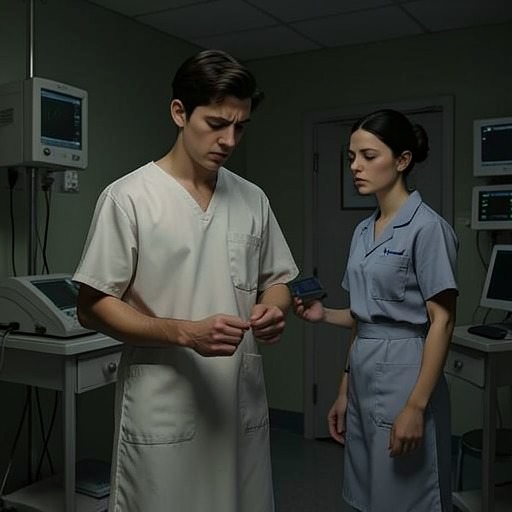
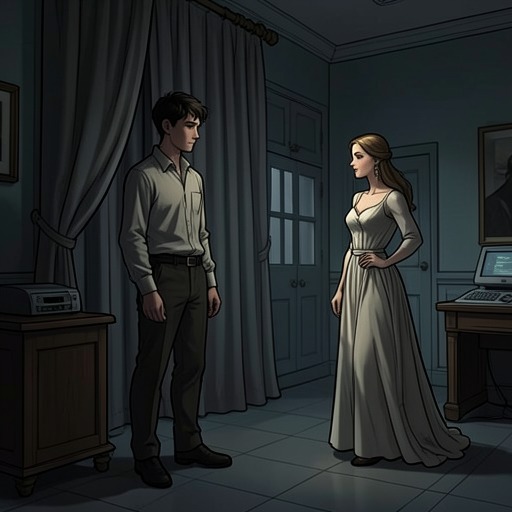
Billy Bibbit and Candy are discovered by Nurse Ratched
One Flew Over the Cuckoo's NestThe discovery of Billy Bibbit and Candy in the Seclusion Room becomes a contest over who can define the moment: the ward initially turns it into a joke at Nurse Ratched’s expense, but she redirects the crowd’s attention by invoking Billy’s mother. The scene’s decisive reversal is emotional as much as public: Billy moves from sleepy ease to panic, and the laughter around him gives way to silence.
The room check and discovery
The scene begins as part of a room check. Chief Bromden and the others follow Nurse Ratched, Washington, and Warren through the hall as rooms are unlocked, including the lab, the tub room, and the doctor’s office. Before they reach the Seclusion Room, Scanlon whispers that Billy is going to be the target of a joke, then remembers there is someone else in the room as well. His aside makes the discovery feel anticipated by the crowd, though not by Nurse Ratched.
At the end of the hall, the Seclusion Room is windowless and dark. The men press close behind Nurse Ratched and the two black boys, craning for a view as she unlocks the door and switches on the light. Billy and Candy blink up from a mattress on the floor. The sudden exposure turns the room into a makeshift stage: the onlookers can see the couple, while Nurse Ratched must face both them and the laughter behind her.
Billy greets Nurse Ratched with a good morning, takes Candy’s hand, and introduces her by name. He makes no move to get up or button his pajamas. Candy searches beneath the mattress for her nylons, pauses to smile at Nurse Ratched, checks her sweater, and resumes tugging at the nylon caught between the mattress and the tile. Chief Bromden guesses that the two are still fairly drunk. Their slow, unhurried movements contrast with the crowd at the doorway and with Nurse Ratched’s rigid stance.
Laughter and a temporary reversal
Nurse Ratched tries to shame Billy by expressing disappointment in him and disparaging Candy. Dale Harding answers with mock assistance, suggesting increasingly lurid names for the kind of woman Nurse Ratched means. His performance turns her attempt to control the language of the encounter back against her: instead of joining her condemnation, he makes her choice of insult part of the joke. Nurse Ratched turns to stare him down, but Harding continues.
Billy, meanwhile, concentrates on standing. He rolls onto his knees, pushes himself up first onto his hands and then his feet, and straightens, looking pleased with the effort. The crowd teases and cheers him, but he seems not to register their attention. His slow, physical struggle to rise gives the scene a second focus: while the others treat the discovery as comic, Billy is absorbed in getting upright.
The noise closes around Nurse Ratched. She looks from Billy and Candy to the patients behind her, and her controlled expression appears to falter. She shuts her eyes and strains to steady herself; when she opens them, her gaze has become small and still. The narrator presents her as aware that she has been pushed into a corner. For a moment, the crowd’s laughter has reversed the usual direction of scrutiny: Nurse Ratched, rather than Billy, is the person under pressure.
Billy’s mother becomes leverage
Nurse Ratched changes her approach by raising the question of how Billy’s mother will react. Billy flinches and puts a hand to his cheek as if burned. Nurse Ratched elaborates that Mrs. Bibbit has been proud of his discretion, is sensitive about her son, and can become ill when disturbed. She also says that she and Mrs. Bibbit are old friends. The threat is not merely that Billy has been seen with Candy; it is that the discovery may be carried into the relationship he fears most.
Billy’s response marks the sharpest change in the scene. He shakes his head, stammers for Nurse Ratched not to tell, and cries out when she insists that his mother must be told. The patients stop laughing and watch as he folds toward the floor, rubbing his pant leg and shaking in panic. When Nurse Ratched touches his shoulder, the contact makes him recoil as though struck. Her appeal to his mother has turned a public joke into visible distress, and the crowd’s reaction changes with it.
Billy tries to deny responsibility, saying Candy did it. Nurse Ratched counters that Candy could not have forced him into the room and frames her own interpretation as unavoidable, while also claiming she would prefer to believe otherwise for Mrs. Bibbit’s sake. The exchange leaves the account contested rather than settled: the scene records Billy’s protest and Nurse Ratched’s dismissal of it, but does not establish what happened between Billy and Candy. What it does establish is how quickly Nurse Ratched can redirect the encounter from the patients’ laughter to Billy’s vulnerability.
The scene’s unresolved turn
The discovery exposes a brief crack in Nurse Ratched’s authority, but it does not end with the ward’s comic triumph. Her control returns through a personal pressure point: Billy’s fear of his mother’s judgment and illness. The progression—from darkness and surprise, to the crowd’s laughter, to Billy’s pleading and the sudden silence—makes the shift in power legible without resolving its consequences. At this moment, Candy remains beside Billy, the patients have witnessed his distress, and Nurse Ratched has made clear that she intends to tell his mother. The scene stops with that threat still active.